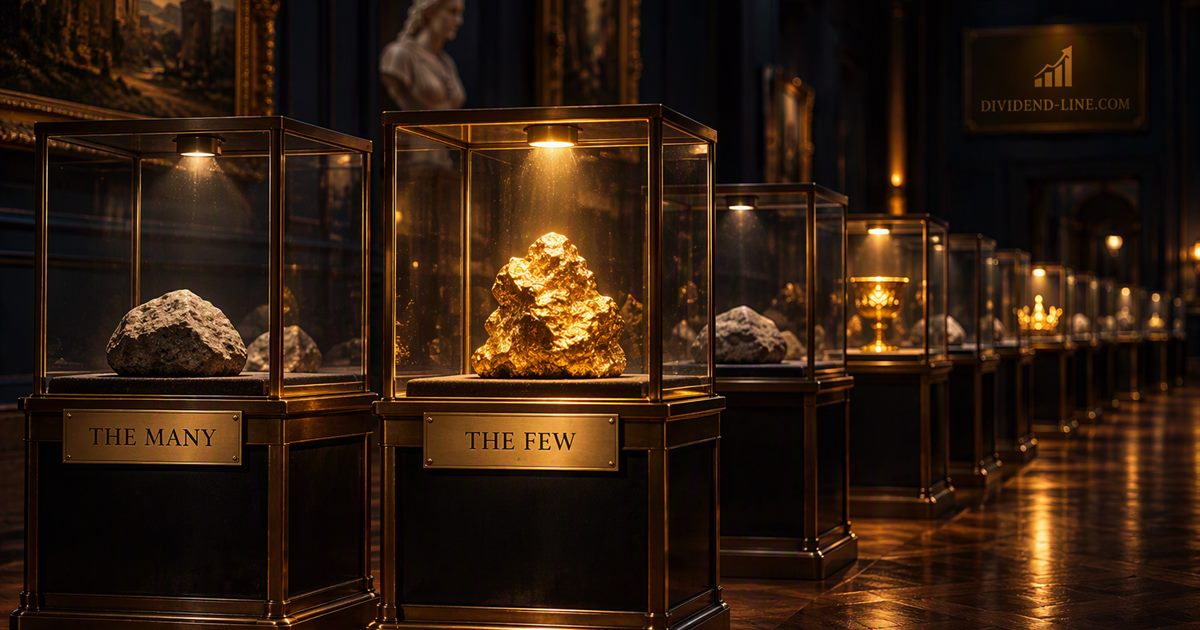
We have now published 71 company reports, and every one of them scores the moat out of ten. That makes a dataset we can count rather than argue about — and counting turns out to be more informative than the argument.
Three companies scored ten. Thirteen reports scored nine. Everything else — sixty-odd businesses, many of them famous, several of them excellent — sat at eight or below.
What 71 scores look like when you line them up
| Moat score | Reports | Who |
|---|---|---|
| 10 / 10 | 4 | Visa · Mastercard · Coca-Cola |
| 9 / 10 | 13 | S&P Global, Prologis, P&G, Microsoft, Meta, McDonald's, LVMH, JPMorgan, Costco, Berkshire, Amazon, Apple |
| 8 / 10 | 20 | Walmart, Nvidia, Broadcom, Google, Lilly, J&J, Home Depot, Diageo, Deere, Salesforce, AmEx… |
| 7 / 10 | 17 | Oracle, Netflix, Altria, BAT, Lockheed, IBM, Realty Income's peers… |
| 6 / 10 | 12 | Exxon, Chevron, Nike, Realty Income, NNN, Alexandria… |
| 5 / 10 | 4 | Tesla · PayPal · Pfizer · Lululemon |
| 3 / 10 | 1 | IIPR |
The first thing worth noticing is the shape. Four scores out of 71 are perfect. If you spend any time reading market commentary you will see the phrase "wide moat" applied dozens of times a week. On our own scoring it describes roughly a fifth of the companies we have examined, and the top of the scale describes three.
Four scores out of seventy-one are perfect. "Wide moat" is said far more often than it is true.
What Visa, Mastercard and Coca-Cola have in common
It is not what they sell
Look at the three and the obvious answer — great brands — is the wrong one. Plenty of companies further down our list have great brands.
The real common feature is stranger: none of the three makes the thing its customers think they are buying.
- Visa and Mastercard do not lend you money. Your bank does, and your bank takes the credit risk. The networks operate the rails the money travels along, and take a fraction of a percent of everything that crosses. They are toll bridges that never lend and never default.
- Coca-Cola largely does not bottle. It sells concentrate and a hundred years of habit to bottlers who handle the trucks, the glass and the capital. The capital-intensive half of the business belongs to someone else.
- All three sit in a layer everyone must cross. A merchant cannot opt out of card payments. A bottler cannot manufacture the brand. The position is structural rather than competitive — they are not winning a race, they are standing in the doorway.
Because they own the layer rather than the product, all three take a percentage rather than a margin. When prices rise across the economy, their revenue rises automatically without a single negotiation, a single new customer, or a single extra factory.
That is why these businesses tend to survive inflation that destroys the margins of the companies passing through them. It is also why the moat and the pricing power are, in their case, the same thing.
Being first is not a moat
Tesla, PayPal, Pfizer, Lululemon — all scored five
The bottom of the list is more instructive than the top, and the pattern is uncomfortably consistent. Every company scoring five in our library was genuinely, spectacularly first at something.
First at electric cars. First at paying strangers online. First to a blockbuster drug. First to make technical fabric a status symbol. In each case the advantage was real, enormous, and temporary — because a head start is a position in a race, and a moat is a reason the race cannot be run.
Pfizer is the cleanest illustration, because its advantage has an expiry date printed on it. A patent is a moat with a calendar. When the calendar runs out, the question becomes what the company built while it had protection — which is exactly the question that separates the pharma businesses in our library.
Three questions that sort most companies in ten minutes
If the answer is 'our brand' or 'our execution', that is a seven at best. If the answer is 'the customers are already connected to each other through us', or 'they would have to rebuild a network nobody can rebuild', you are near the top.
Networks do — each new participant makes the thing more valuable to everyone already in it. Scale economies do, up to a point. Brands mostly do not; they are maintained, not compounded. This is the question that separates nine from seven.
The uncomfortable one. Many great companies score highly on the first two questions purely because nobody has arrived yet. Ask what happens when someone does — and if the honest answer is 'we would have to compete', the moat is a lead.
Two payment networks and a syrup formula. None of them makes what you think they sell.
Each moat is argued in full, with the evidence and the date it was written.
What to do with this on Monday
Score your own holdings out of ten, honestly, using the three questions above. Most people find they own several eights and believe they own several tens — and the difference matters, because an eight has to be watched and a ten mostly has to be left alone.
Then look at whichever position you scored lowest and ask the third question about it. If its advantage came from being first, you are holding a clock, not a castle — and clocks should be priced differently from castles.
Frequently asked
Which companies have the strongest moats?
In our own scoring across 71 reports, only three companies reached ten out of ten: Visa, Mastercard and Coca-Cola. Thirteen reports scored nine. That distribution is itself the finding — a genuinely impregnable position is rare, and most businesses people describe as having a wide moat are somewhere between seven and eight.
What do the strongest moats have in common?
None of the three makes the thing its customers think they are buying. Visa and Mastercard do not lend money and take no credit risk; they operate the rails that other people's money travels along. Coca-Cola largely does not bottle. Each owns a layer that everybody else has to cross, and charges for the crossing.
What makes a weak moat?
Looking at the bottom of our own list, the pattern is consistent: the advantage was a head start rather than a structure. Being first is not a moat. It buys time, and time runs out — which is why the lowest scores in our library tend to belong to companies that were genuinely first at something and then discovered that first is a position, not a defence.
Can a moat be measured?
Not directly, but its consequences can. A real moat shows up as returns on capital that stay high for years while competitors are free to enter, and as gross margins that survive an inflationary period intact. If high returns persist without a structural reason, the reason is usually that nobody has tried hard enough yet.