The business, in plain English
What it does · how it got here · where it operates
Here is a business I wish I had understood sooner. Visa does not lend you a penny, does not carry a cent of your credit risk, and never sends you a bill. It owns the road that money travels on. Every time a card with its four letters is tapped — in a Lisbon café, a Nairobi market, a Tokyo taxi — a message races across Visa's network to ask "is this good?", the answer comes back in under a second, and Visa clips a tiny toll for carrying the message. Multiply that toll by tens of thousands of transactions a second, every second, forever, and you have one of the most beautiful machines ever assembled.
Founded inside Bank of America in 1958 as the BankAmericard and spun out as its own public company in 2008, Visa is not a bank and not a lender. It is a payments network — the pipes, the rulebook and the brand that let 200-plus countries' banks, merchants and shoppers transact with one another. In the year ended September 2025 it carried the world's spending and kept $40.0 billion of net revenue and $20.1 billion of profit — a net margin north of fifty per cent, a figure so rare I had to read it twice. The whole enterprise is worth about $658 billion.
"The single most important decision in evaluating a business is pricing power. If you've got the power to raise prices without losing business to a competitor, you've got a very good business." — the test Visa passes without breaking a sweat
Consider what that fifty-per-cent margin is telling you. For every dollar that flows through the network, half of it drops to the bottom line — because once VisaNet is built, the next billion transactions cost almost nothing to carry. It reinvests barely 4% of revenue in capital spending. There is no factory to feed, no inventory to spoil, no loan book to blow up in a recession. It is, in the most literal sense I can offer, a toll booth on the movement of money itself — and the traffic on that road has grown every decade as the world trades paper cash for a tap of plastic or a phone.
| Founded | 1958 (BankAmericard) · IPO 2008 · San Francisco, USA |
| Sector / Industry | Financial Services · Credit-Services network |
| Reach | 200+ countries · tens of thousands of transactions / second |
| What it is not | Not a bank · takes no credit risk · issues no cards itself |
| Revenue (net, FY2025) | $40.0 B |
| Market capitalisation | ~$658 B |
The circle of competence
The four-party model — who pays whom, and where Visa's sliver comes from
To own this business honestly, you must understand one diagram — the four-party model — because almost everything written about "swipe fees" gets it wrong. Let me walk the whole machine, the way I'd explain a candy store's till:
When a merchant grumbles about a ~2% "card fee", the lion's share of that — the interchange fee — does not go to Visa. It goes to your bank, the one that issued the card and took the risk that you might not pay. Visa's own take is a much thinner network / data-processing fee, a handful of basis points on each transaction. That is the elegant, almost invisible genius of the thing: Visa earns a sliver so small no single shopper would ever notice it, yet collects it on roughly every non-cash purchase on earth outside China. A grain of gold from an ocean of commerce.
- Cash keeps dying — the decades-long shift from notes and coins to cards and phones has years left to run, especially abroad.
- The network stays the network — banks and merchants keep routing over Visa's rails rather than building or adopting an alternative at scale.
- Regulators clip, but do not sever — antitrust suits and fee caps trim the edges without breaking the toll booth in two.
How it makes money
Revenue by category · geographic mix · the size of the pond
Visa reports its takings in a few plain buckets, then hands a chunk back to its bank partners as client incentives — rebates that reward them for steering volume onto Visa rather than a rival network. Here is where the $40 billion of net revenue comes from.
This is the opposite of Coca-Cola's slow pond. The tide itself is rising: every year the world converts more of its cash into digital payments, and Visa takes its sliver of a growing pool without lifting a finger. The one giant lake it cannot fish is China, where the domestic network UnionPay and the wallets Alipay and WeChat Pay rule — a reminder that even the widest moat has a far shore it never reaches.
The moat
The two-sided network · how durable · where it could crack
If Coca-Cola's moat is the rarest brand and Microsoft's is the deepest switching cost, Visa's is the most self-reinforcing of them all: the two-sided network. It is filled from three springs.
The network effect. Every merchant accepts Visa because billions of people carry it; billions carry it because nearly every merchant accepts it. Each new cardholder makes the network more valuable to merchants, and each new merchant makes it more valuable to cardholders. A would-be rival must win both sides at once, in every country, on day one — a chicken-and-egg problem that has swallowed fortunes. This is the textbook two-sided network, and Visa is its finest living example.
The infrastructure & rulebook. VisaNet has carried global commerce for decades without a systemic failure. The trust, the security, the settlement plumbing and the shared rules that thousands of banks agree to — none of it can be conjured overnight, at any price.
The brand. Those four letters signal "this will work, anywhere" to a traveller in a foreign airport. Acceptance is the brand, and acceptance took sixty years to build.
How durable? Measured in decades. The honest crack to watch is disintermediation — new rails (India's UPI, Brazil's Pix, America's FedNow, account-to-account transfers, stablecoins) that let money move around the card networks rather than over them. So far Visa has met each threat by partnering, buying, or plugging in — but this is the one tide an owner must never stop watching. I treat it in Part VIII.
Management & ownership
Who runs it · their record · whose money is on the line
I look for managers who treat every share as if it were the last one they owned. Visa's record on the one thing that matters most — what they do with the cash — is close to exemplary.
A word on a departed shareholder, because it is instructive. For years Berkshire Hathaway held stakes in both Visa and Mastercard — modest positions by its standards — and in early 2026 it exited both. I read little alarm into it: they were never core holdings, and a great business sold is not thereby a bad business. But it is a useful reminder from the shrewdest desk in the land that even a perfect toll booth has a price at which a careful buyer walks away. Hold that thought for the valuation.
The numbers
Sourced from your endpoints · TTM unless noted · linked to the data pages
| Metric | Value | Read |
|---|---|---|
| Revenue growth (5-yr CAGR) | ~12% | ▲ double-digit, secular |
| Net income (FY2016 → FY2025) | $6.0B → $20.1B | ▲ ~3.3× |
| Gross margin | 81.3% | ▲ extraordinary |
| Operating margin | ~61% | ▲ among the best on earth |
| Net profit margin | 51.7% | ▲ half of revenue is profit |
| Return on equity (ROE) | 58.9% | ▲ exceptional |
| Return on invested capital (ROIC) | 32.7% | ▲ the truer, still-stunning figure |
| Net debt / EBITDA | 0.4x | ▲ a fortress balance sheet |
| Interest coverage | 26x | ▲ trivially covered |
| Free cash flow / yield | ~$24B · 3.2% | ▲ converts beautifully |
| Capex / revenue | ~3.7% | ▲ wonderfully asset-light |
I have looked at a great many companies in my life, and I can count on one hand those that keep half of every revenue dollar as profit while also growing at double digits on almost no capital. Visa does. There is no leverage trick flattering these returns — net debt is a rounding error at 0.4× EBITDA, and interest is covered twenty-six times over. The ROE looks almost too good, but unlike a bank's it is not built on a tower of debt: the ROIC of 33% confirms the quality is real. Financially, this is as strong and clean a statement as you will find in the whole market. The only place the machine looks vulnerable is not on this page — it is on the price tag.
Valuation
Where the yardsticks diverge · DCF vs. the Street · margin of safety
| Yardstick | Today | Forward | Read |
|---|---|---|---|
| P/E — reported earnings | 29.9x | ~26x (FY26) · ~23x (FY27) | full — priced for the growth |
| Price / Owner Earnings ◆ | ~31x | — | ≈ FCF (capex tiny) |
| P/FCF — free cash flow | 31.0x | — | the lenses converge |
| EV/EBITDA | 23.7x | — | rich |
| PEG (P/E ÷ growth) | ~1.9 | — | paying up for quality |
| Dividend yield | 0.8% | — | a grower, not an income stock |
Like Coca-Cola, Visa reinvests so little that its reported earnings, its owner earnings and its free cash flow all land in the same place — what you see is what you get. The disagreement is not within the business; it is about the price. A conservative discounted-cash-flow appraisal comes out near $227 — well below today's $343 — because a plain DCF, with its cautious terminal growth, chronically underprices durable compounders (it did the same to Microsoft and Alphabet). The analysts, looking at the growth, cluster near $390. Today's quote sits squarely between the two. That is the honest picture: a wonderful business at a full-to-rich price.
Risks & controversies
Regulation · disintermediation · concentration — with sources
Visa's risks are real and worth respecting. The US Department of Justice has sued it, alleging it illegally protects a debit monopoly — the kind of case that can trim economics even when the network survives. More profound is disintermediation: government-built instant-payment rails like Brazil's Pix and India's UPI let money move bank-to-bank and skip the card networks entirely, and America's FedNow plus stablecoins point the same way. So far Visa has answered by partnering and acquiring rather than being displaced — but this is the tide to watch for a decade, not a quarter. Add its permanent exclusion from China and constant global pressure on interchange, and you have a business whose moat is wide but not walled off from history. The honest summary: a fortress under steady, patient siege — not a fire.
Dear shareholder — every so often you come across a business so well-made that the only hard question left is what to pay for it. Visa is one of those. I have spent this letter admiring the machine; let me end it by being honest about the price.
First, the machine. Visa is as close to a toll booth on human commerce as anything I have ever studied. It lends nothing and risks nothing; it simply owns the road that money travels and clips a sliver — smaller than any shopper would notice — from nearly every non-cash purchase on earth outside China. Because the road is already built, half of every new dollar of revenue falls straight to profit: a net margin above fifty per cent, returns on capital above thirty, and a balance sheet with essentially no debt. And unlike Coca-Cola's placid pond, Visa's tide is rising — the world keeps trading cash for a tap, and Visa takes its cut of the growing pool without lifting a finger. It is a wonderful business by every measure I know.
Its fortress is the two-sided network: merchants accept it because everyone carries it, and everyone carries it because every merchant accepts it. A rival must win both sides at once, everywhere, on the same morning — a task that has defeated far richer men than its founders. Management, for its part, has done the one thing I prize most: returned the cash. The share count has quietly shrunk by nearly a fifth in a decade. When a great business also retires its own shares, the owner who does nothing grows richer each year.
Now the honesty. A business this good is rarely a secret, and Visa is no secret — it changes hands at about thirty times earnings. A cautious appraisal of its cash flows comes out well below today's quote; the analysts, dazzled by the growth, sit above it; and the price rests right between them. That is not the shape of a bargain. It is the shape of a crowd that already knows exactly what it owns. I also note, without drama, that even Berkshire chose to walk away from the payment networks this year — a reminder that wonderful and wonderfully priced are two different words.
So what would I do? I would want to own this business — and I would want to own it bought well. With fresh money at today's price I would begin only a small position, if any, and hold my fire. My conviction buy sits on weakness toward the low three hundreds, near its recent lows and about twenty-three times next year's earnings, where the toll booth's growth finally does the paying for me instead of the other way around. The great danger with a business this fine is not that it disappoints — it rarely does — but that you fall so in love with the machine you forget to mind the price. Mind the price. As I have said all my life: it is far better to buy a wonderful company at a fair price than a fair company at a wonderful price. Visa is the wonderful company. Now we wait, patiently, for the fair price.
Articles that take this apart
 PortfolioHow many stocks should you own?The maths of diversification has a very clear answer, and almost nobody's portfolio reflects it — in either direction.
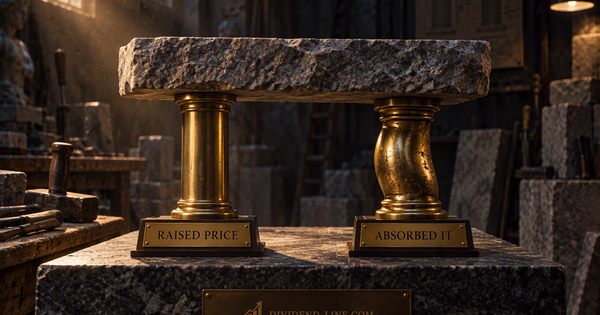 MoatsPricing power: the only part of a moat you can actually measureEveryone claims a durable advantage. Inflation is the audit: it asks every company the same question at the same time, and the gross margin publishes the answer.
 MoatsWe scored 71 moats. Only three got full marks.Everyone can define a moat. Far fewer can tell you which companies have one, which is why it is worth counting rather than theorising.