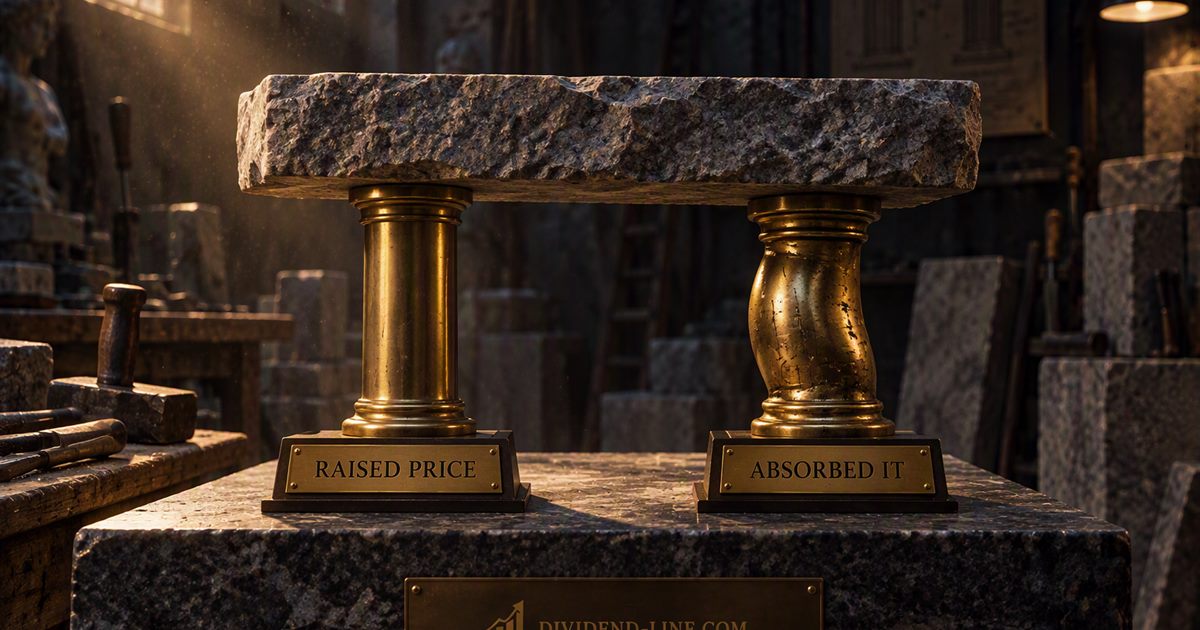
A moat is an opinion. Pricing power is a number.
Every company in every annual report claims some durable advantage. Almost none of those claims can be checked — until input costs rise sharply, at which point every business in the economy is asked the same question at the same time: can you pass this on?
The gross margin publishes the answer, and it publishes it whether management discusses it or not.
One line, two dates
Gross margin, before and after a cost shock
| What the gross margin did | What it means | How rare |
|---|---|---|
| Held flat, or rose | The cost was passed on and the customer stayed. This is pricing power, demonstrated rather than claimed. | Uncommon |
| Fell, then recovered | The company could raise prices, but with a lag. Real power, imperfectly exercised — usually contracts or shelf negotiations getting in the way. | Common in good businesses |
| Fell and stayed down | The cost was absorbed because it could not be passed on. Whatever advantage the company has, it is not this one. | Very common |
Why a small margin move is a large profit move
Take a business on a 40% gross margin. Its input costs rise 10%, and it absorbs the increase entirely rather than lose customers.
Revenue 100, cost of goods 60, rising to 66. The gross margin falls from 40% to 34% — which sounds survivable, six points. But gross profit per unit has fallen from 40 to 34: a 15% fall. And because the fixed costs underneath do not shrink, operating profit falls by considerably more than that.
That is the whole reason this line matters more than its size suggests. Six points of gross margin is not six percent of the problem. It is a fifth of the profit, and often much more.
Anybody can raise a price once. Pricing power is raising it and still having the customer next year.
Four kinds of pricing power, from strongest to weakest
Payment networks, ratings agencies, index providers, some exchanges. Revenue rises with the price level automatically. The power never has to be exercised, which means it can never be refused. In our own library these are the businesses that scored ten.
A small, frequent, low-consideration purchase attached to a brand built over decades. The price rise is invisible because nobody is comparing. Strong, and slowly erodible by a generation that shops differently.
Switching costs, long leases, embedded software. Real power, with a date on it. The test is what happens at renewal, and the honest version of this analysis waits to see.
The weakest, and the easiest to mistake for the others, because while it lasts the numbers look identical. Fashion supports a price until it does not, and it never announces the change in advance.
Positional pricing power produces exceptional financials right up to the moment it stops. Gross margins rise, the brand is celebrated, and the multiple expands — and none of it is evidence, because the same pattern appears whether the position is durable or temporary.
The only way to tell is to ask what would happen if the company raised prices again next year, and to be honest about whether the answer is "they would pay" or "they would shrug and buy something else".
Four businesses, four tiers
Our own moat scores sort these almost mechanically. The businesses that charge a percentage sit at the top of our library; the one whose price rests on being the fashionable option sits near the bottom, at five out of ten — not because it is a poor company, but because its advantage has to be re-won every season.
A network that takes a percentage, a brand bought without thinking, a franchise with contracts, and a position that has to be re-earned.
Each one shows the gross margin across the cycle, not just the latest year.
What to do with this on Monday
Open the annual report of your largest holding and find the gross margin for the last six years. Not the operating margin — the gross margin, which is the one that isolates the price you charge from the cost you pay, before any management decision about spending gets involved.
If it is flat or rising across a period when costs rose, you own a business with demonstrated pricing power and you should hold it accordingly. If it drifted down and stayed down, you own a business that absorbs its industry's problems — which can still be a fine investment, but should never be bought at a multiple that assumes otherwise.
Frequently asked
How do you measure pricing power?
Look at the gross margin through a period when input costs rose sharply. A company that passed the cost on holds its gross margin roughly flat; a company that could not holds volume instead and the margin falls. You do not need to model anything — the answer is two numbers, several years apart, in the same table of the annual report.
Why does absorbing a cost increase hurt so much?
Because of where it lands. A business on a 40% gross margin whose input costs rise 10% and who absorbs it entirely sees gross margin fall to 34% — but gross profit per unit falls 15%, and operating profit falls by far more, because the fixed costs underneath do not shrink. Small margin moves are large profit moves.
Does raising prices always prove pricing power?
No — raising prices and keeping the customer does. Anyone can put prices up once. The test is whether volume holds afterwards, which is why the honest version of this analysis looks at revenue growth split into price and volume, and treats a price rise accompanied by falling volume as evidence of the opposite.
Which businesses have the most pricing power?
In our own scoring, the strongest moats belong to businesses that charge a percentage rather than a margin — payment networks, ratings agencies, index providers. Their revenue rises with the price level automatically, without a single negotiation. That is pricing power in its purest form: it does not have to be exercised, because it is structural.