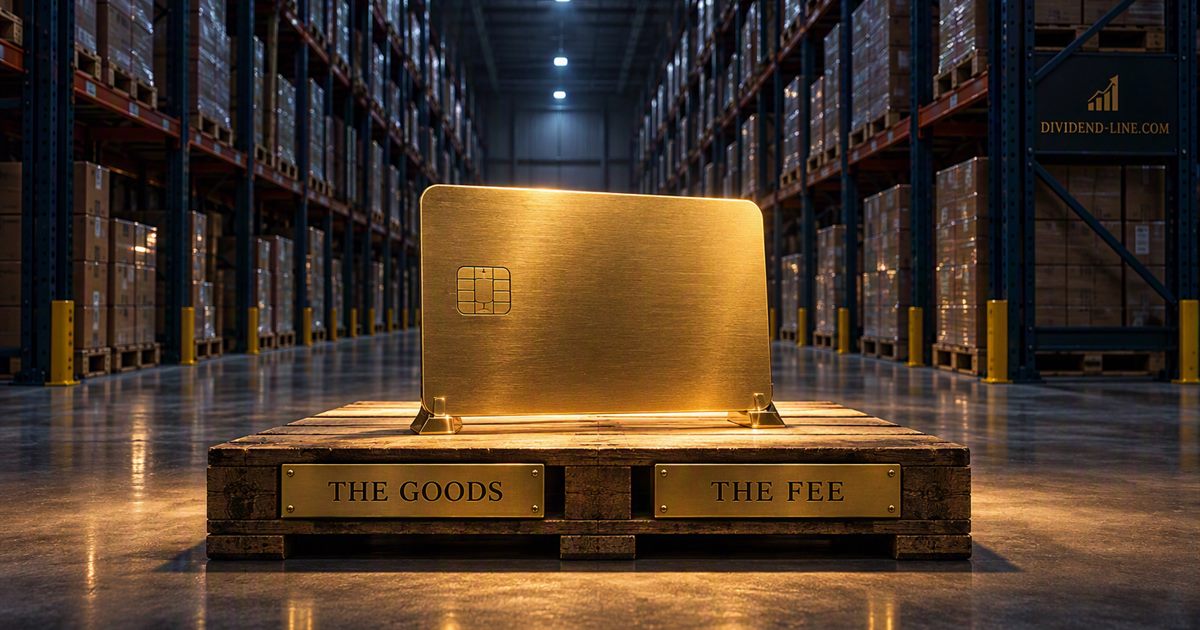
Costco sells its goods at almost no profit on purpose, and makes roughly half its operating profit from the annual fee people pay for permission to shop there. Once you know that, the question "is it overvalued?" changes shape — because the multiple is not being applied to a retailer.
As at our X-Ray of 21 July 2026 at $956, the shares traded at around 48 times earnings, on a ~92% membership renewal rate and a net-cash balance sheet. Charlie Munger, who called it the company he most admired, also called the price "the trouble with Costco". He never sold.
The shop exists so that the subscription renews
This is the whole model, and it runs backwards from every other retailer
A normal retailer buys at one price, sells at a higher one, and lives on the gap. Costco deliberately shrinks that gap to almost nothing. It caps its markup, hunts scale relentlessly, and defends absurd loss-leaders — the famous $1.50 hot dog is not sentiment, it is advertising the proposition.
The purpose is not the sale. The purpose is that the customer concludes, annually, that the membership pays for itself. 92% of them conclude exactly that, and their fee arrives before they have bought anything.
- The fee is pre-paid and recurring. Money arrives at the start of the year, not at the point of sale. That is working capital in the company's favour, permanently.
- The suppliers finance the shelves. Goods sell before the invoices for them fall due. The inventory is effectively funded by somebody else.
- The cheapness is the moat. Every competitor can copy the warehouse. What they cannot easily copy is a cost base low enough to sell at these margins and still want the customer back.
The groceries are the marketing. The membership is the product.
So what is 48 times actually measuring?
If you treat Costco as a retailer, 48 times earnings is indefensible. Supermarkets trade in the teens, and for good reason: thin margins, no pricing power, and a customer who will cross the road for a better offer.
If you treat it as a subscription business with a very large delivery operation attached, the multiple is arguable. A 92% renewal rate is a churn figure software companies would envy, on a subscription that has raised its price periodically without losing members.
Both framings are defensible, and the market has spent thirty years choosing the second. That is the uncomfortable fact for anyone who wants to call this a bubble: the multiple has been "too high" for decades, and the people who acted on that have been wrong for decades.
A high multiple is not a safety feature. Our report notes a 21% crash last winter — on a company where nothing fundamental broke. At 48 times earnings, a year of flat results is not a disappointment, it is a de-rating, because the price contains growth that has to keep arriving.
The business can be perfect and the entry point still wrong. Those are separate decisions, and conflating them is how people end up holding wonderful companies at prices that take a decade to grow into.
Hold it, don't chase it
We scored Costco 7.0. That number is a compromise between two very different marks: an exceptional business, and a valuation that leaves no room to be wrong. The verdict was Munger's own paradox made explicit — a perfect business at a permanently imperfect price.
What would change it is not a better story. It is a worse price, or a renewal rate that stops being 92%. The renewal rate is the number to watch, and it is reported. If it ever drifts toward the high eighties, the subscription framing weakens and the multiple has a very long way to fall.
One that sells memberships, one that sells scale, one that sells projects. Same shelves, different businesses.
Business, moat, management, the numbers, valuation and an honest verdict.
What to do with this on Monday
Take any company you think is expensive and ask the Costco question: where does the profit actually come from? Not the revenue — the profit. In this case half of it comes from a recurring fee, which means half the company is not really in the industry its multiple is being compared against.
That test reframes a surprising number of "overvalued" arguments, in both directions. Some expensive companies are cheap once you find the profit. Others turn out to be exactly as ordinary as the sector average, and expensive for no reason at all.
Frequently asked
How much of Costco's profit comes from membership fees?
Roughly half of operating profit, as at our 21 July 2026 report. The retail operation is run close to break-even on purpose: goods are sold at the thinnest margin the company can manage, because cheapness is what makes the membership worth renewing. The fee is the business; the shop is the reason to pay it.
Why does Costco trade at such a high multiple?
Because a 92% renewal rate on a subscription is not retail economics — it is closer to software. Investors are pricing a recurring, pre-paid, extremely durable revenue stream, and treating the shop as the delivery mechanism. Whether they are pricing it correctly is a separate question; at around 48 times earnings the margin for error is thin by any standard.
Did Charlie Munger think Costco was overvalued?
He said the price was 'the trouble with Costco' — and he held it anyway, calling it the company he most admired. That combination is the honest position on a great business at a demanding price: the quality is not in doubt, the entry point is, and those are different decisions.
Is Costco a good buy today?
Our verdict in July was 'hold it, don't chase it', and we scored it 7.0 — a very high mark for the business, pulled down by valuation. A 21% fall last winter is a reminder that a high multiple is not a safety feature, even on a superb company. The live numbers are on the company page.