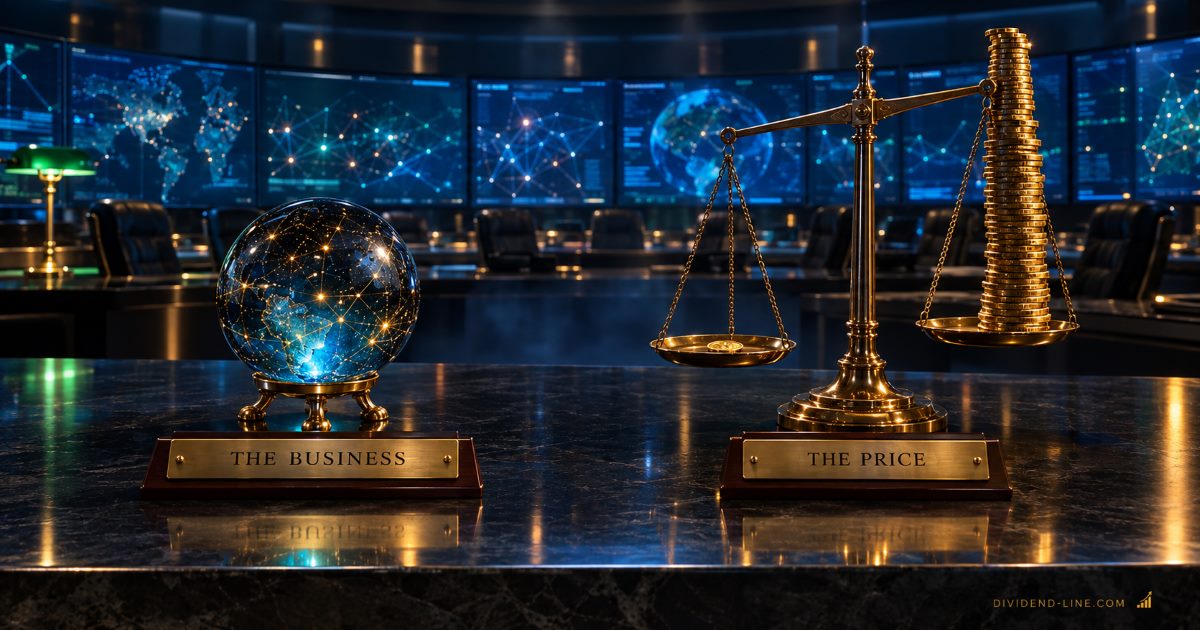
The business, in plain English
Software that lets an army, a hospital or a factory act on its own data — and a share price that has run ahead of even that
Every large organisation is drowning in data it cannot use: the army knows where its trucks, fuel and spare parts are, but in forty different systems; a hospital has its beds, staff and waiting lists in a dozen more. Palantir sells the software that pulls all of it into one live model of the organisation — it calls this the "Ontology" — and then lets people, and now AI agents, make decisions and take actions on it. It began by doing this for American intelligence agencies, still earns half its revenue from governments, and since 2023 has been selling the same idea, rebranded around artificial intelligence, to companies at astonishing speed. A ten-year-old could understand the pitch: we connect everything you know, so you can act on it.
The numbers are as unusual as the company. In the quarter to June 2026 Palantir's revenue was $1.94bn, up 93% on a year earlier — and the growth rate has risen every quarter for two years, which almost never happens to a company this size. It kept 85% of revenue as gross profit and 47% as operating profit under standard accounting, needs almost no capital, carries no debt and holds $9.2bn of cash. In the quarter it made more net profit ($1.06bn) than it had revenue in the same quarter a year before.
At $190.04 on 1 October 2026 the market values it at about $457 billion — some 73 times its sales of the last twelve months and about 162 times its earnings. That is the whole report in two sentences: one of the best businesses we have studied, at one of the highest prices we have seen. The question is whether the first can justify the second.
The history — from a CIA cheque to the S&P 100
Nearly two decades before its first profit, a listing nobody could buy at the reference price, and four years of the most remarkable acceleration in software
| When | What happened | Why it matters now |
|---|---|---|
| 2003–04 | Founded by Peter Thiel, Alex Karp, Stephen Cohen, Joe Lonsdale and Nathan Gettings; Thiel's money and about $2m from In-Q-Tel, the CIA's venture arm. Named after the seeing-stones of The Lord of the Rings. | Born inside the national-security state, and still shaped by it. |
| 2008–2019 | Gotham for governments; Foundry for companies. In 2019 it takes over the Pentagon's Project Maven after Google walks away. | The company that said yes where Silicon Valley said no. |
| 30 Sep 2020 | Direct listing: reference price $7.25, first trade $10, first close $9.50. Losses every year: $1.17bn in 2020 alone, when stock-based pay was 116% of revenue. | A listing designed for insiders to sell, not for the company to raise money. |
| Jan 2021 – Dec 2022 | Meme-era peak of $45 (intraday); then a fall of 87%, to $5.92 in December 2022 — below the reference price. | The same share can halve, or lose seven-eighths, with the business intact. |
| Feb 2023 | First profitable quarter (Q4 2022: $31m). Karp: "With this result, Palantir is profitable." In April, AIP — its AI platform — and the five-day "bootcamps" that sell it. | The pivot that created today's growth. |
| 2024 | Joins the S&P 500 (September) and the Nasdaq-100 (December). The best performer in the S&P 500: +340%. Karp sells about $2bn of stock during the year. | The retail investor's favourite stock. |
| Jul 2025 | US Army enterprise agreement: up to $10bn over ten years, consolidating 75 contracts. 2025: +135%. | A ceiling, not committed spending — but a moat in procurement form. |
| Nov 2025 – Jun 2026 | All-time high of $207.52 on 3 November; then −49% to $106.37 on 25 June, in the software sell-off and a run of European rejections — while revenue growth accelerated from 63% to 93%. | The price and the business moved in opposite directions. |
| Aug – Sep 2026 | Q2 results on 3 August: shares +29.5% in a day and +51.5% in the month. $190.04 on 1 October. | Back within 8% of the peak. |
Two lessons for an owner. The first is that Palantir's business and Palantir's share price have been only loosely connected. The shares fell 87% while revenue grew; they fell 49% while growth went from 63% to 93%. An owner who cannot sit through a halving should not own this stock, whatever he thinks of the company — it has happened twice in five years, and nothing in the price today makes a third less likely.
The second is that the people who know it best have been steady sellers. A listing designed for insiders to sell, $2bn of sales by the chief executive in 2024, and about $1.9bn by insiders across 2025 and 2026 so far (Part VIII). Much of it is tax on vesting shares, and founders are entitled to diversify. But it is a fact, and it sits beside another: the company has bought back almost none of its own stock.
The circle of competence
The machine is clear. Its price depends on a decade nobody can see
- That Palantir's revenue compounds at about 30% a year for ten years — to well over $100 billion by 2036, more than Oracle sells today — while keeping 40% net margins.
- That the AI labs and the cloud giants, now selling their own agent platforms to the same companies, do not turn Palantir's layer into a feature of theirs.
- That governments — half the revenue — keep buying through changes of administration, budgets and the European backlash against American software.
How it makes money
America is the engine; the rest of the world is slowing
| Measure | Q2 2026 | Read |
|---|---|---|
| Revenue · growth | $1.935bn · +93% | ▲ Eighth straight quarter of acceleration |
| Net dollar retention | 157% | ▲ Existing customers spend 57% more than a year ago |
| Customers (trailing twelve months) | 1,049 · +24% | ◆ Growth comes mostly from spending per customer |
| Top-20 customers, average annual revenue | $124m · +67% | ▲ Big accounts getting bigger |
| Remaining performance obligations (non-cancellable) | $4.9bn | ◆ Small for the valuation — most contracts can be ended for convenience |
| US commercial remaining deal value | $6.24bn · +124% | ◆ Assumes every option is exercised |
| FY2026 guidance (raised 3 Aug) | $8.15bn · +82% | ▲ Adjusted free cash flow $4.5–4.7bn |
How the sale is made. Palantir's most effective salesman is a five-day "bootcamp", in which its engineers solve a real problem on a prospect's own data — "generally at our own expense and without a guarantee of future returns," as its 10-Q puts it. It is an expensive way to sell and a powerful one: when it works, the customer has seen the software change an operation before signing anything. Sales and marketing has nevertheless fallen from 24% to 18% of revenue in a year, because existing customers are doing the buying.
What the contracts are, and are not. The headline numbers — "up to $10bn", "remaining deal value" — are ceilings. The Army agreement is at most $1bn a year and consolidated work Palantir already had. The legally binding backlog is $4.9bn, and the company itself warns that it "allows many of its customers to terminate contracts for convenience prior to the end of the stated term." That is normal for government software; it means the revenue is renewed by performance every year, not locked in.
The moat
Real, measurable, widening at home — and being copied from two directions
| The claim | The evidence | Width · trend |
|---|---|---|
| Switching costs — the Ontology | Net dollar retention 157%; top-20 customers spending 67% more than a year ago. Once workflows, permissions and AI actions run through it, removing it means rebuilding the operation. | Wide · widening |
| Government incumbency and accreditation | Two decades of classified work; the Army's 75 contracts folded into one; Maven at NATO. Top-secret accreditation takes years to win. | Wide in the US · narrowing in Europe |
| Process know-how — forward-deployed engineers | Palantir invented the job title. By 2026 OpenAI, Anthropic, Google, Microsoft and ServiceNow all hire "forward-deployed engineers" (Fortune, 3 Sep 2026). | Eroding as a differentiator |
| Economics | 85% gross margin; capital spending under 1% of revenue; adjusted operating margin 62%. The fingerprints of a moat, in the accounts. | Wide · improving |
| Brand and mission | "We have chosen sides" (Karp, 2020) wins defence work in Washington and loses it in Berlin and Paris. | Polarising |
Buffett's test is that "a truly great business must have an enduring 'moat' that protects excellent returns on invested capital" (2007 letter). The returns are not in doubt — Palantir needs almost no capital at all. The moat is real, too: a retention rate of 157% is something customers do with their money, not something a company says. The question is endurance. The method that built it — engineers embedded in the customer — is now being copied by the richest companies in the world, and the AI labs are selling their own "context layers" to the same chief executives. We score the moat 8: wide today, and the trend at home is still widening; but it is being attacked from more directions than any moat we have scored that high.
★★ The central question — what does $190 assume?
Run the arithmetic backwards, and then look at what happened to the last great companies priced like this
Buffett's way of valuing a business is the one John Burr Williams set down in 1938: "The value of any stock, bond or business today is determined by the cash inflows and outflows — discounted at an appropriate interest rate — that can be expected to occur during the remaining life of the asset" (1992 letter). So instead of arguing about a multiple, we ask what Palantir would have to become for a buyer at $190 to earn 10% a year for ten years.
Start from the company's own 2026 guidance, $8.15bn of revenue. Assume it compounds for a decade; that by 2036 Palantir earns a 35–40% net margin — about Microsoft's today — and that it is then valued at 25–30 times earnings, a premium for a mature company; dilute shareholders by 2% a year, as stock-based pay has done; and discount at 10%. At 20% a year the shares are worth about $54 today. At 25%, about $112. To justify $190 you need about 32% a year for ten straight years — revenue of some $131bn in 2036, roughly twice what Oracle sells today, at margins far above Oracle's.
Is that impossible? No — and that is the honest difficulty. Palantir is growing at 93% now, on a rising curve. But very few companies in history have compounded revenue at 30% for a decade from a base of $8bn, and the price requires Palantir to be one of them with no stumble long enough to matter.
| Case | Peak | Multiple at the peak | What followed |
|---|---|---|---|
| Cisco | 27 Mar 2000 · ~$555bn | ~201× earnings · ~39× sales | Fell 89% by October 2002. The business kept growing; the share price did not regain its March-2000 close until 10 December 2025 — 25.7 years later. |
| Microsoft | 27 Dec 1999 · ~$615bn | ~31× sales | One of the greatest businesses of all time. Its shareholders waited about 17 years — to October 2016 — to see that price again. |
| Sun Microsystems | 2000 | ~10× sales | Its chief executive, Scott McNealy, later asked those who had bought at ten times revenue: "What were you thinking?" (BusinessWeek, 2002, as widely quoted). |
| ★ Palantir | 1 Oct 2026 · ~$457bn | ~73× sales · ~162× earnings | Growing far faster than any of them, at far higher margins. The bull case is that this time the business is good enough. The record says the business can be right and the price still wrong for a very long time. |
★ The Microsoft lesson, not the Cisco one. The danger at Palantir is not that it fails; on everything we can see, it is a superb business. The danger is that it succeeds and you still earn nothing for a decade, because the price had already counted the success. That is what happened to buyers of Microsoft in 1999, and Microsoft did everything right.
The competition — the labs, the clouds and the sovereigns
Palantir is winning the budgets it competes for today. Tomorrow's competitors are richer
| Competitor | What they sell | Where Palantir stands | Threat |
|---|---|---|---|
| OpenAI, Anthropic | Agent platforms for companies — OpenAI's Frontier (launched 5 Feb 2026) connects to company data, runs agents and governs them; launch customers include HP, Oracle and State Farm. | Karp's August letter accused the labs of trying to "capture the means of production of their purported partners" — the loudest sign of where management sees the threat. Palantir also uses their models. | High · rising |
| Microsoft, Amazon, Google | Data platforms, agents, and the cloud that Palantir itself runs on. | Distribution into every enterprise; partners as well as rivals. Cloud hosting costs rose $89m on the year in Q2. | High · long term |
| Databricks | Data and AI platform; ~$7bn revenue run-rate, +80% (July 2026). | Valued privately at $190bn in August — about 27× run-rate revenue, against Palantir's ~73× trailing. The private market prices a similar grower at a third of Palantir's multiple. | Medium–high |
| Snowflake | Data cloud: revenue $1.55bn in the July quarter, +35%; contracted backlog $9.0bn. | More complement than substitute. Its non-cancellable backlog is nearly twice Palantir's $4.9bn. | Medium |
| Anduril | Defence software (Lattice) and hardware; valued at $61bn in May 2026. | Partner on Golden Dome and the Army's TITAN, rival for the same budgets — and won a $20bn Army enterprise contract in March 2026, twice Palantir's. | Medium · partner and rival |
| European "sovereign" alternatives | ChapsVision (France) and others. | France's DGSI and Germany's BfV chose ChapsVision; the Bundeswehr said Palantir "is not being considered at all right now" (May 2026). | Medium in Europe |
| C3.ai | Enterprise AI applications. | Revenue fell to $250m in fiscal 2026 with a $470m loss. The other AI-application pure play lost; Palantir won. | Low |
The pattern. On today's evidence Palantir is beating everyone it meets: US commercial +149%, against +35% at Snowflake and +80% at Databricks, while C3.ai shrinks. The competition that should worry an owner is not on that scoreboard yet. It is the AI labs and the cloud giants moving up from the model to the "layer that acts" — exactly where the Ontology sits — with balance sheets that dwarf Palantir's, and with the method Palantir invented. The irony is too good to leave out: the company that coined the "forward-deployed engineer" now competes with labs that hire them by the hundred, and calls their strategy Marxist.
Abroad, the moat runs the other way. The same American identity that wins work in Washington is costing it work in Europe, and the numbers show it: rest-of-world revenue grew 34% against 115% in the United States. A company that sells "sovereignty" to its customers is discovering that Europe wants its own.
Management, ownership & governance
Brilliant operators, a founders' veto, and a steady stream of selling
| Insider | 2025 | 2026 to date | Note |
|---|---|---|---|
| Alex Karp (CEO) | $224m | $206m | Quarterly, mostly sell-to-cover on vesting; ~$2bn in 2024. |
| Stephen Cohen (President) | $561m | $87m | $337m in March 2025 alone. |
| Shyam Sankar (CTO) | $250m | $75m | Plus gifts of 350,000 shares in August 2026. |
| Peter Thiel (director) | — | $290m | 2.0m shares in March 2026, at about $145. |
| All insiders | ≈ $1.20bn | ≈ $0.70bn | Computed from 120 Form 4 filings. |
| Company buybacks | — | $1.5m (H1) | Token. Dilution has stopped rising, not reversed. |
Integrity: no veto. The disclosures are thorough, the selling is mostly pre-planned and tax-driven, and founders who built a business over twenty years are entitled to diversify. Capital allocation: excellent in the business, indifferent to shareholders. Palantir reinvests brilliantly — it needs almost no capital and grows at 93% — but returns nothing, buys back nothing of consequence, and has paid its staff in stock worth some $5.2bn since 2019, against cumulative profits of about $1.6bn. Owner mentality: divided. The founders have a tenth of the economics and half of the votes, and the shareholders paid the chief executive's antitrust filing fee. We score management and capital 5: a great operating team, run for its founders first.
The numbers
Among the best in software — once you put stock-based pay back in
| Metric | Value | Read |
|---|---|---|
| Revenue — TTM · FY2026 guide | $6.16bn · $8.15bn | ▲ +82% guided for the year |
| Gross margin · GAAP operating margin (Q2) | 85% · 47% | ▲ Software economics at scale |
| Adjusted operating margin · Rule of 40 (Q2) | 62% · 155% | ◆ Both exclude stock-based pay |
| GAAP net margin (Q2) | 55% | ◆ Above operating margin: interest and investment gains |
| Free cash flow — TTM | $3.36bn | ▲ Capex under 1% of revenue |
| Stock-based pay — TTM · Q2 growth | $835m (13.6%) · +66% | ◆ Falling as a share, rising in dollars |
| Diluted shares, 2021 → 2025 · last year | +33% · +0.2% | ◆ The dilution has paused |
| Cash & Treasuries · debt | $9.4bn · none | ▲ Fortress |
Two adjustments. Palantir's favourite measure, the "Rule of 40" — growth plus margin — scored 155% in the second quarter, against 40% for a good software company. But the margin in it is the adjusted one, which leaves out $265m of stock-based pay. Buffett asked the question in 1992 and repeated it in 1998, having "not yet received an answer": "If options aren't a form of compensation, what are they? If compensation isn't an expense, what is it? And, if expenses shouldn't go into the calculation of earnings, where in the world should they go?" On the GAAP margin the score is 140% — still extraordinary, and the honest number.
The second adjustment is smaller: the 55% net margin is above the 47% operating margin because Palantir earns interest on its $9bn of cash and booked gains on investments. Neither is wrong; neither is the business.
| What the feed says | Value | What is true |
|---|---|---|
| Market capitalisation | $436bn | Counts only the Class A shares. With 101m Class B and the founders' Class F the company is worth about $457bn at $190 (basic), $488bn on diluted shares. |
| 52-week low | $122.68 | The low was $106.37 intraday on 25 June 2026; $123.06 was the 31 July close. |
| DCF value | $9.22 | −95%. A model that cannot see growth of 93% is as useless here as one that extrapolates it. Reported, not used. |
| Owner earnings / share | $0.50 | One quarter. Annualised about $2.00 — before stock-based pay is deducted. |
★ Valuation — a wonderful business at a price that needs a miracle
Every lens says the same thing, which is rarer than it sounds
| Measure | Value | Reading |
|---|---|---|
| Price · market value (1 Oct 2026) | $190.04 · ~$457bn | 8% below the November 2025 high; 79% above the June low. |
| Price to sales — TTM · FY2026 guide | ~73× · ~55× | Cisco peaked at ~39×. |
| P/E — trailing GAAP | ~162× | On ~$1.17 of earnings per share. |
| Forward P/E — FY2026 · FY2027 · FY2028 | 119× · 83× · 56× | Consensus $1.60 (19 analysts), $2.29 (19), $3.42 (9). |
| Forward P/E — FY2029 · FY2030 | 28× · 13× | $6.70 and $14.38 — three analysts each. The dream years. |
| Free cash flow yield | ~1.0% · ~0.8% after SBC | On the $4.5–4.7bn FY2026 guide; the ten-year Treasury pays 5%. |
For once, the three lenses agree. At Microsoft and Alphabet we have argued that free cash flow understates earning power because it charges growth investment as if it were upkeep. Palantir has almost no capital spending to argue about, so earnings, owner earnings and free cash flow land in the same place — between about 145 and 195 times. There is no accounting distortion hiding a cheaper company underneath. The price is simply high.
Our three paths in Part VI put a value of about $54 a share on 20% growth for a decade and about $112 on 25%, using margins as high as Microsoft's. We take $112 as the top of a fair range for one of the best businesses we have studied, and our own rule (playbook §5.8, born in our Microsoft follow-up) says that for a business of this quality the buy zone is where the price becomes fair, not where it becomes a bargain. The shares touched $106.37 in June.
Risks, lawsuits & controversies
Verified 2 October 2026 — the price first, the politics second, the courtroom third
The risk we rank first is the price. Between November 2025 and June 2026 the shares fell 49% while revenue growth accelerated from 63% to 93%. Nothing went wrong with the business; the market simply paid less for it. At 73 times sales the price can halve again on a change of mood, and an owner should size a position so that he can watch it happen.
Second, government. Government customers are 51% of revenue, the US government 42%, and most contracts can be ended for convenience. The federal fiscal year began on 1 October under a stopgap law that runs to 11 December, which blocks new programmes. Palantir's favour in Washington is also a risk in itself: an August 2026 memo from the Deputy Secretary of Defense authorised up to $243.9m of Palantir services without competitive bidding, and The Register reported it lacked the written justification the law requires. What one administration grants without a tender, another can review.
Third, the courtroom, verified today. The consolidated securities class action filed in 2022 (Cupat v. Palantir, D. Colo.) was dismissed with prejudice on 4 April 2025; the lead plaintiff, the California pension fund CalPERS, appealed, and the Tenth Circuit heard argument on 16 March 2026, with the plaintiffs pointing to about $2.2bn of insider sales in 2021–22. We found no ruling as of 2 October. We found no new securities suit filed in 2025 or 2026. In Europe, Palantir lost the French domestic intelligence service to ChapsVision in June and was told by Germany's armed forces in May that it was "not being considered at all right now".
| Matter | Status on 2 October 2026 | What is at stake |
|---|---|---|
| <i>Cupat v. Palantir</i> — securities class action (D. Colo.; 10th Cir. 25-1178) | Dismissed with prejudice 4 Apr 2025; CalPERS appealed; argued 16 Mar 2026; no ruling found. | Damages for 2020–22 buyers. A reversal would reopen discovery into ~$2.2bn of insider sales. |
| No-bid Pentagon memo | Up to $243.9m without competitive bidding through March 2027, signed 4 Aug 2026; criticised for lacking the written justification 10 USC 3204 requires. | Revenue in the near term; reputational and oversight risk after the November midterms. |
| Federal budget | Fiscal 2027 began on a continuing resolution to 11 Dec 2026; FY2026 included a 43-day shutdown. | New programme starts delayed in Palantir's seasonally biggest quarters. |
| Europe's sovereignty push | France's DGSI and Germany's BfV chose ChapsVision; the Bundeswehr shortlisted European vendors (award by end-2026); a Swiss army report raised data-access concerns. | International government growth — already the slowest line. |
| ICE / ImmigrationOS | $30m (Apr 2025) + $29.9m (Sep 2025); employee protests in January–February 2026; Karp: protesters "should be out there protesting for more Palantir" (CNBC, 2 Feb 2026). | Recruiting, European sales, shareholder proposals. |
| Short sellers | Citron (Aug 2025); Michael Burry's puts (Nov 2025, $9.2m of premium). Short interest 2.8% of the float (15 Sep 2026). | Volatility, not solvency. |
In 1999 I spent a good part of a speech at Sun Valley explaining why I would not buy the technology shares everyone else was buying, and I was treated, for a year or so, as a man who had missed the century. Several of those companies turned out to be wonderful businesses. Their shareholders still did badly for a very long time, because the price had already paid for the wonder. I have been thinking about that speech all week.
Let me be clear about the business first, because it deserves it. Palantir is growing at ninety-three per cent, and faster each quarter than the one before — on a base of nearly two billion dollars a quarter. It keeps eighty-five cents of each sales dollar as gross profit, needs almost no capital to grow, has no debt and nine billion dollars in the bank, and its existing customers spent fifty-seven per cent more with it this year than last. Customers do not do that for software they could easily replace. If you asked me to name the companies on our board with the best current economics, Palantir would be on a very short list.
Now the rub, and there are three. The first is that the AI laboratories and the cloud giants, with far more money than Palantir, are now selling their own versions of the layer Palantir sells, and they have hired the very kind of engineer Palantir invented. The second is that half the revenue comes from governments, and Palantir's standing in Washington is a political asset that a change of administration could revalue, while Europe is already showing it the door. The third is the arrangement with its owners: the founders hold a tenth of the shares and half of the votes, insiders sold close to two billion dollars of stock in the last twenty-one months, the company buys back almost none, and the shareholders paid the chief executive's antitrust filing fee. I would not call any of that dishonest. I would call it a company run for its founders first.
And then the price. At a hundred and ninety dollars you pay seventy-three times sales and about a hundred and sixty times earnings. Earnings, owner earnings and free cash flow all agree, because there is almost no capital spending to argue about — so there is no hidden cheaper company to find. Run the arithmetic backwards and the price asks for revenue to compound at about thirty-two per cent a year for ten years, to well over a hundred billion dollars, at margins as good as Microsoft's. Perhaps it will. I can name very few companies that have done it, and none that did it while being priced as though they certainly would. Microsoft did everything right after 1999, and its shareholders waited seventeen years to see their price again.
So we pass at a hundred and ninety dollars. This is not the Microsoft mistake we graded ourselves for last week — there the price sat inside our estimate of value, and here it sits well above it. Our own rule says that for a business of this quality we should name the price at which it becomes fair, not a bargain: about one hundred and ten dollars, where a decade of twenty-five per cent growth earns you ten per cent a year. The shares were a little below that in June. If they return there, begin — and do not wait for less.
— The Buffett Lens · Dividend Line Research · from a man who once explained to a room in Sun Valley why he was not buying
Begin Near $110One of the best businesses we have studied — revenue +93% and accelerating, 85% gross margin, net dollar retention 157%, no debt — at ~73× sales, a price that assumes ~32% growth a year for a decade. The three lenses agree; there is no cheaper company hiding in the accounts. ★ Under our own rule the zone we name is where it becomes fair: ~$110, the 25%-a-year path. The shares were $106 in June. Q3 results in early November.