NVIDIA Corporation
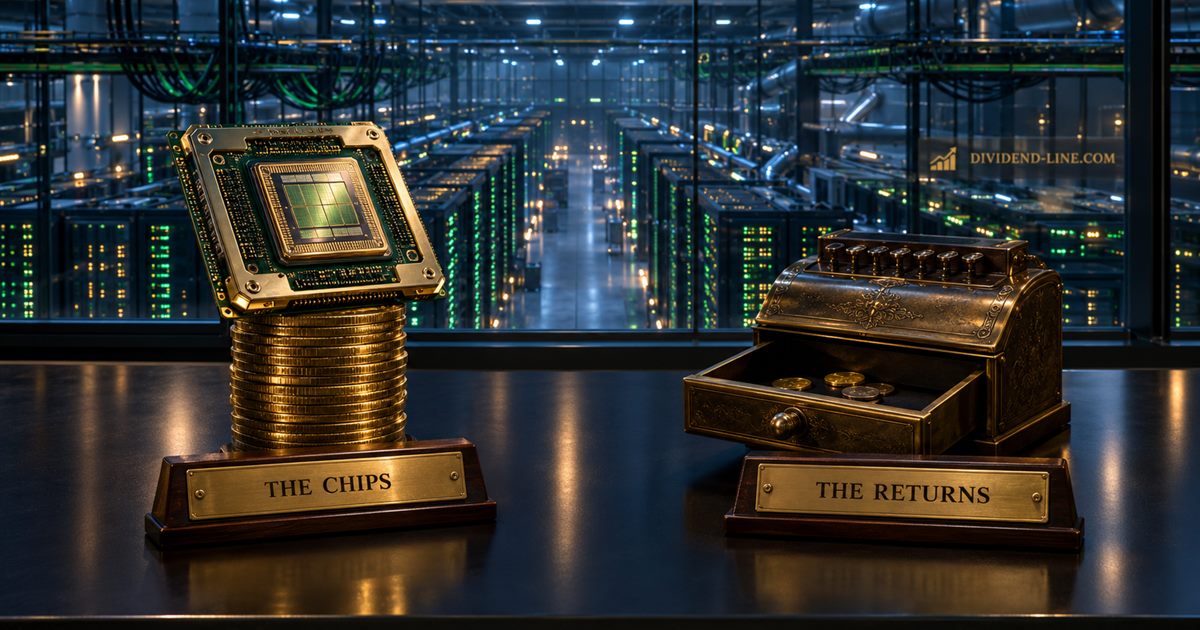
What we said in June — and what happened
Eight claims, graded in public
On 30 June we published NVIDIA at $200.09 and concluded "Too hard": a magnificent business we could not value with the confidence we demand. For those who bought anyway, we suggested a margin of safety nearer the low $150s, with an alert at $155. The shares are $225.07 today. Here is the account.
| What we said on 30 Jun | What happened by 27 Sep | Grade |
|---|---|---|
| 'The best economics on the board — 63% net margin, revenue doubling' | Q2 FY27 revenue $96.2bn, +106%; gross margin 75.0%; trailing net margin 63.7%. Q3 guided to $108bn. | ✓ Right |
| 'Demand is cyclical — capex could pause to digest' | Not yet. Demand accelerated. The risk is unchanged; it simply has not arrived. | ◆ Untested |
| 'Customers are building their own chips' | True — Broadcom's AI revenue grew 221% on exactly that. But NVIDIA grew faster still. The alternative is real; it is not yet a substitute. | ◆ Half right |
| 'Dangerous concentration — two customers ~39% of a quarter' | Worse. The 10-Q shows three direct customers at 16%, 15% and 13% of first-half revenue — 44%. | ✓ Right, understated |
| 'Free cash flow trails earnings — inventory and receivables' | Still true. Free cash flow $5.25 a share against earnings of $7.97; receivables grew from $23.1bn to $38.5bn in the fiscal year. | ✓ Right |
| Dividend chip: 'Token (buybacks)' | Missed. On 18 May 2026 — six weeks before our report — NVIDIA raised the quarterly dividend from $0.01 to $0.25 and added $80bn of buyback authorisation. Our June data showed the old rate and we did not check. The yield is still small (0.44%), but the report was wrong. | ✗ Wrong |
| 'On forward earnings it is cheap: ~22× FY27, ~16× FY28' | Earnings rose faster than the price. FY27 consensus is now $9.27 — 24.3× at $225; FY28 $15.74 — 14.3×. | ✓ Right |
| 'Too hard — alert at $155 for those who buy anyway' | The alert never triggered. The shares rose 12.5%. The cost of discipline was real but modest — not the 43% our Microsoft caution cost the same summer. | ◆ Unrewarded |
Four right, three partly right, one wrong — and the wrong one is embarrassing rather than expensive. The calendar check that now opens every report on this site exists because of mistakes like it: a dividend changed in May, our data showed April's rate, and nobody looked.
One grade needs more than a row. Two days ago we wrote a new rule into our playbook after Microsoft: we will not demand a bargain for a wonderful business trading inside our own estimate of its value. Does June's NVIDIA verdict break it? We think not, and the reason matters. "Too hard" is not "too expensive". It says we cannot estimate the value with confidence — so there is no range to be inside. The rule governs verdicts about price; this one was about knowledge. The $155 alert, though, sat below the $247 our own DCF showed in June, and we should not have offered a number we did not believe in. We will not do that again.
★★ The shovel seller is buying the mines
What NVIDIA's $99bn portfolio does to its earnings — and to its demand
In June we described NVIDIA as the seller of shovels in a gold rush: it did not need to know which miner would strike gold, because every miner needed shovels. That was the heart of its appeal. It is no longer quite true.
Over the past year NVIDIA has become one of the largest investors in artificial intelligence. Including public holdings, its equity investments stood at about $99bn on 26 July, with roughly $25bn more committed. The largest single cheque, about $30bn, went to OpenAI; it has also taken part in funding rounds for Anthropic and xAI, among many others, and on 26 September it was reported to be weighing a $10bn stake in Anthropic's planned IPO. Many of these companies are among the largest buyers of NVIDIA's chips.
Now look at what that does to the income statement. When a company NVIDIA owns raises money at a higher valuation, NVIDIA marks its stake up and books the gain. In the second quarter those gains on equity securities were $7.8bn before tax. For the first half of the fiscal year, NVIDIA's GAAP profit was $118.0bn; its own adjusted figure, which strips out those gains, was $99.5bn. About $18.5bn — roughly 16% of reported profit — came from the rising value of stakes, not from selling chips.
★ This is not an accounting trick; it is disclosed, and NVIDIA's own adjusted numbers exclude it. It is something subtler — a loop. NVIDIA invests in AI companies. Those companies use the money, and money raised from others on the strength of NVIDIA's endorsement, to buy NVIDIA chips. Their growing chip purchases make them look more valuable at their next funding round. That higher valuation becomes a gain on NVIDIA's books. Each step is rational. Together they mean that part of NVIDIA's demand and part of its profit now depend on the same thing: the continued willingness of investors to fund AI laboratories at rising prices.
Buffett has a view on vendor financing, which is what this resembles at one remove: the seller's profits look best exactly when the buyers are most dependent on the seller's own money. A business that finances its own demand has made its earnings more cyclical, not less. NVIDIA's core economics are no less extraordinary than they were in June. But the question "who is paying for all these chips, and with whose money?" now has NVIDIA's name in the answer.
The business, three months on
Faster, bigger, more concentrated
The second quarter of fiscal 2027 (to 26 July) produced revenue of $96.2bn, up 18% on the previous quarter and 106% on the year; gross margin was 75.0%; GAAP earnings were $2.46 a share and adjusted $2.22. NVIDIA guided the third quarter to $108bn ±2% at a 74% gross margin — and, notably, assumes no data-centre compute revenue from China at all. Jensen Huang's summary on the day: AI "has reached its inflection point… compute is revenue."
Capital returned: about $26bn in the quarter; about $99bn of buyback authorisation remaining after May's additional $80bn; and the quarterly dividend, now $0.25, is next paid on 1 October.
Management & capital allocation
Brilliant operators — now also venture investors
Integrity: no veto. Capital allocation: we lower it from 9 to 8. Buybacks and the new dividend are unimpeachable. The equity portfolio is the reason for the point: it is a large, growing, lightly disclosed book of stakes in private companies that are also customers, and it now moves reported earnings by tens of billions a year. We do not think NVIDIA is doing anything improper. We think it is doing something that makes its own numbers harder to read, and that is the opposite of what we want from the companies we own.
The numbers
The best income statement in the world — read with two adjustments
| Metric | Value | Read |
|---|---|---|
| Revenue, TTM · FY2026 | $303.0bn · $215.9bn | ▲ Q2 FY27 +106% |
| Gross · net margin (TTM) | 74.7% · 63.7% | ▲ Unmatched in hardware |
| EPS, H1 FY27 — GAAP · adjusted | $4.85 · $4.09 | ◆ The gap is gains on equity stakes |
| Free cash flow, FY2026 | $96.7bn | ▲ Capex just 2.4% of revenue |
| Receivables · inventory (FY-end) | $38.5bn · $21.4bn | ◆ Both up sharply; why FCF trails profit |
| Cash · debt (FY-end) | $62.6bn · $11.4bn | ▲ Altman-Z 40.9; interest cover 427× |
| Equity investments (26 Jul) | ~$99bn + $25bn committed | ◆ New since 2025, and growing |
| What the feed says | Value | What is true |
|---|---|---|
| Trailing P/E | 28.2× | On GAAP earnings that include equity gains. On adjusted earnings the multiple is a few points higher — roughly 32× on our approximate trailing figure. |
| Owner earnings per share | $1.05 | One quarter's figure. Not used. |
| Return on equity | 110% | True arithmetic, inflated by buybacks shrinking equity; return on invested capital, 59.5%, is the better measure — and still astonishing. |
| Dividend history in June | $0.01 | The May raise to $0.25 was missing from the data we used in June. It is present now. |
The dividend
Up 25-fold — and still a token
On 18 May 2026 NVIDIA raised its quarterly dividend from $0.01 to $0.25, an increase of 2,400%, and approved another $80bn of buybacks. At $225 the yield is 0.44%. The six tests are almost trivial: cover on free cash flow is about 21× ($5.25 of trailing free cash flow per share against $1.00 of annual dividend); it is funded entirely from operations; the balance sheet holds net cash; nothing short of a collapse in AI spending could force a cut. The dividend is safe because it is small. Nobody should own NVIDIA for income; the signal is that the board now thinks the cash generation is durable enough to promise some of it back.
Risks, lawsuits & controversies
Verified afresh, 27 September 2026
The risk we rank first is new since June: circularity. Part II. A meaningful share of NVIDIA's customers are funded partly by NVIDIA, and a meaningful share of its reported profit comes from the valuation of those customers. If AI funding tightens, both the demand and the gains fall together.
Second, concentration: three direct customers were 44% of first-half revenue. Third, the cycle: NVIDIA's profits fell 55% in fiscal 2023; the conditions that caused it — customers building inventory ahead of demand — are exactly what receivables of $38.5bn and inventory of $21.4bn should make an owner watch.
Fourth, the courtroom and regulators, verified this week. ① Securities class action (crypto): the long-running case alleging NVIDIA concealed more than $1bn of GPU sales to cryptocurrency miners in 2017–18 continued after the Supreme Court declined to decide it in December 2024; the district court certified the class on 25 March 2026. ② China: the State Administration for Market Regulation found in a preliminary ruling in September 2025 that NVIDIA breached the conditions attached to its Mellanox acquisition, and said it would investigate further before any penalty; NVIDIA's guidance assumes no data-centre compute revenue from China. ③ Export controls: US prosecutors have brought several smuggling cases involving servers built with NVIDIA chips, including charges in March 2026 against a Super Micro co-founder; NVIDIA itself has not been charged. None of these is material to a company earning $190bn a year; together they describe a company operating at the centre of a geopolitical contest.
★ Valuation
Cheap on forecasts, as it was in June — with one more thing to believe
| Measure | June | Today | Reading |
|---|---|---|---|
| Share price | $200.09 | $225.07 | Market value ~$5.45tn. 4.8% below the $236.54 high. |
| P/E, trailing (GAAP) | 30.5× | 28.2× | ~32× on adjusted earnings (approx.). |
| Forward P/E, FY27 · FY28 | ~22× · ~16× | 24.3× · 14.3× | Consensus $9.27 (33 analysts) and $15.74 (33). |
| Forward P/E, FY29 | — | 10.5× | $21.35 (20 analysts). The consensus assumes revenue near $915bn. |
| Free cash flow yield | — | 2.3% | Price to free cash flow 42.9×. |
| Our DCF feed | ~$247 | $224.46 | −0.3%: the model now agrees with the price. |
| Street target | $317 | $345.21 | +53%. 2 strong buy · 58 buy · 16 hold · 3 sell. |
On forecasts NVIDIA is cheaper than it looks: 24 times this fiscal year, 14 times next, 10 times the year after. On the question of what those forecasts rest on, it is harder to own than in June. They now assume not only that AI spending keeps compounding and that customers keep choosing NVIDIA over their own chips, but also that the laboratories NVIDIA has invested in keep raising money at rising valuations — because that is where part of the demand, and part of the profit, now comes from.
I put NVIDIA in the 'too hard' pile in June and I owe you an account of what that cost. The shares were two hundred dollars; they are two hundred and twenty-five. Discipline cost twelve and a half per cent in three months. I can live with that; it is the price of admitting what I do not know. What I am less happy about is a smaller thing — NVIDIA raised its dividend twenty-five-fold six weeks before our report, and we called it a token. We did not check. We check now.
The business did better than anyone forecast. Revenue in the last quarter was ninety-six billion dollars, more than double a year earlier, at a gross margin of seventy-five per cent. Next quarter the company expects a hundred and eight. I have never seen a company of this size grow like this, and I doubt I will again.
But I said in June that I could not see ten years ahead, and I can see a little less far now, for a reason I did not anticipate.
NVIDIA has become one of the largest investors in artificial intelligence. It owns about ninety-nine billion dollars of stakes in AI companies, with twenty-five billion more committed — thirty billion in OpenAI alone — and many of those companies are among its biggest customers. When they raise money at higher valuations, NVIDIA books the gain. In the first half of this year that added about eighteen and a half billion dollars to its reported profit, roughly one dollar in six.
I want to be careful here. None of this is hidden; NVIDIA strips those gains out of its own adjusted figures, and every investment can be defended on its merits. But step back and look at the shape. The seller of shovels is buying shares in the mines. The miners use the money — and money others lend them on the strength of NVIDIA's backing — to buy more shovels. Their growing orders make them look more valuable. And their higher value turns up as profit at the shovel seller. When the gold rush is running, every link strengthens the next. When it slows, they weaken together.
Add to that three customers supplying forty-four per cent of revenue, and a company whose profits fell by more than half the last time its customers stopped buying, and you have an extraordinary business whose next decade depends on the financing decisions of a handful of laboratories it partly owns.
So: still too hard. Not because the price is high — on next year's forecasts it is fourteen times earnings, which would be cheap for almost any business I know. But those forecasts now assume more than they did in June, and I cannot underwrite the extra assumption.
For those who are inside this circle and want a number, I will give one I believe in this time: around a hundred and eighty dollars, nineteen times this year's expected earnings and eleven times next year's, where you would be paid for a pause in AI spending rather than exposed to it. That is not a recommendation. It is a margin of safety.
And watch one thing when the third quarter arrives in November: how much of the profit comes from gains on stakes, and whether the largest customers are the ones NVIDIA has invested in. The day that number stops growing, the loop is slowing.
— The Buffett Lens · Dividend Line Research · still admiring, still outside the circle
Now It Owns Its CustomersThe business beat every forecast — revenue +106%, 75% gross margin, $108bn guided — and we missed a 25-fold dividend rise in June. ★ But NVIDIA now holds ~$99bn of stakes in AI companies, many of them customers, whose gains supplied ~16% of H1 profit, while three customers are 44% of revenue. At $225.07 (24× FY27, 14× FY28) it is not expensive; it is harder to know. For readers inside the circle: ~$180 pays you for a pause. Q3 FY27 results late November.
Articles that take this apart
 Companies in FocusIs Nvidia's growth sustainable? One line in the accounts is trying to tell youNvidia earned in six months what it took the whole of last year to earn. That is not the interesting part. The interesting part grew faster than revenue did.
 Companies in FocusSpaceX is public. Its first 10-Q is not about rockets.The SEC does not classify SpaceX as an aerospace company. It classifies it under data processing — and the first set of public accounts explains why.
You've just read NVIDIA Corporation the way we read every company.
The terminal that produced these numbers is free to use: 30 years of statements drawn as flows, a screener built around moats, Buffett's Desk, and an earnings feed read through the same lens. Opening an account takes a minute. No card.