The business, in plain English
Breakfast, baking, snacks and pet food, sold mostly through American supermarkets
General Mills makes the food in the middle of the supermarket. Cheerios and other Big G cereals, Pillsbury dough, Betty Crocker and Bisquick baking mixes, Nature Valley bars, Old El Paso, Progresso soups, Totino's pizza rolls, Annie's, and in pet food Blue Buffalo. It sells them mainly in the United States, which provides 80% of sales, and mostly through large retailers: Walmart alone bought 22% of everything General Mills sold last year.
What it earns. In the fiscal year to May 2026 sales were $18.4bn, down 5%, partly because the company sold its yogurt business. Adjusted operating profit was $2.8bn and adjusted earnings per share $3.55, down 16%. Free cash flow was $1.63bn, and the company paid $1.32bn of it out as dividends. GAAP earnings were a small loss after a $1.5bn write-down of the pet business and a $1.0bn loss on selling the Brazilian business.
What the price says. At $36.25 the shares are 60% below their May 2023 record of $90.61 and yield 6.7%. Over the same five years the fund of American consumer-staples shares rose. The market has decided that General Mills' brands are worth much less than they were, and it has done so while rivals such as Mondelez rose. This report asks whether the market is right.
"An economic franchise arises from a product or service that: (1) is needed or desired; (2) is thought by its customers to have no close substitute and; (3) is not subject to price regulation." — Warren Buffett, Berkshire Hathaway 1991 letter
| At a glance | Value | Read |
|---|---|---|
| Sales, fiscal 2026 (to May) | $18.4bn | −5%; organic −2% |
| Adjusted EPS: FY25 → FY26 → FY27 guide | $4.21 → $3.55 → $3.00–3.20 | Two years of decline |
| Free cash flow, 12 months to Aug 2026 | $1.55bn ($2.87 a share) | 12.5× at today's price |
| Net debt | $13.2bn | ~4.0× adjusted EBITDA; target 3× |
| Largest customer | Walmart, 22% of sales | Also its largest store-brand rival |
| Dividend | $0.61 a quarter · 6.7% | Held, not raised, in 2026 |
The history
From a Minneapolis flour mill to a portfolio being reshaped
| When | What happened | Why it matters |
|---|---|---|
| 1866–1928 | Cadwallader Washburn builds a flour mill in Minneapolis; Gold Medal Flour (1880) and Betty Crocker (1921) follow; in 1928 the company merges with other millers to form General Mills. | Brands built over a century. |
| 1941 | Cheerios launched, as CheeriOats. | Still the core of the business. |
| 1960s–80s | Diversification into toys and restaurants (Red Lobster, Olive Garden), later unwound. | A first round of capital misallocation. |
| 2001 | Pillsbury bought from Diageo for about $9.7bn in shares, cash and debt: Pillsbury dough, Green Giant, Old El Paso, Progresso. | The shape of today's company. |
| 2017–18 | Jeff Harmening becomes chief executive. Blue Buffalo bought for about $8.0bn, roughly 25 times its operating profit before depreciation, funded with $6bn of debt; the dividend is then frozen for three years. | The big bet on pet food. |
| 2024–26 | North American yogurt sold for $2.1bn; Whitebridge pet brands bought for $1.4bn; Brazil sold at a $1.0bn loss; a $1.5bn write-down of the pet business. | Reshaping, at a cost. |
| Feb–Sep 2026 | Forecast cut in February; results beat in July; in September Dana McNabb is named chief executive from 1 January 2027, with Harmening as executive chair. | Where we start. |
Two lessons for an owner. The first is that General Mills has spent heavily to change its shape and has not yet been paid for it. It paid about $8bn for Blue Buffalo in 2018 and $1.4bn for more pet brands in 2025. In May 2026 it wrote down the pet business by $1.5bn and a further $250m of brands, and announced it would close two of the plants it had just bought. Pet food is a good business, and Blue Buffalo still earns a 19% segment margin. But the price paid was high, and the write-down says so.
The second is that brands do not protect a price by themselves. In 2022 and 2023 General Mills raised prices sharply as costs rose, and shoppers paid. In 2025 and 2026 shoppers stopped paying: the company had to cut base prices across much of its American range to win back volume. The shares are down 60% from their record because the market has concluded that what looked like pricing power was partly inflation.
The circle of competence
Easy to understand; the hard question is pricing power
- That owner earnings, about $2.78 a share on this year's guidance, stop falling and grow 2–3% a year, after two years of decline.
- That the price cuts of 2026 were a one-off reset, and that price/mix turns positive without volumes falling again.
- That debt comes down to three times operating profit without a dividend cut, as management intends.
How it makes money
North American retail is three-fifths of sales and most of the problem
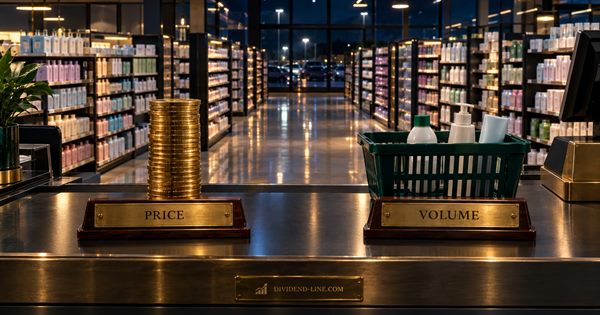
The line that matters. A branded food company grows its profit in two ways: by selling more (volume) and by selling at higher prices or richer products (price/mix). In 2022 and 2023 General Mills grew almost entirely on price. Since the spring of 2025 price/mix has been negative or flat in five of six quarters, and volume has fallen as well. The company calls fiscal 2026 the year of "price investment": it cut base prices across "a large portion of the U.S. retail portfolio". It says that base volumes in the categories where it cut prices went from −10% to +1%. In other words, it bought back its shoppers with its margin. The adjusted gross margin fell from 34.8% in fiscal 2024 to 33.5% in fiscal 2026, and the adjusted operating margin from 18.1% to 15.3%.
| Product class, fiscal 2026 | Sales | Note |
|---|---|---|
| Snacks (bars, fruit snacks, salty snacks) | $4.14bn | Most exposed to weight-loss drugs |
| Cereal | $3.09bn | Protein cereals growing double digits |
| Convenient meals | $2.87bn | Old El Paso, Progresso, Totino's |
| Pet | $2.77bn | $1.5bn goodwill written off |
| Dough / baking mixes | $2.40bn / $1.93bn | Pillsbury, Betty Crocker |
| Super-premium ice cream | $0.78bn | Häagen-Dazs outside the US |
The moat
Strong brands, weaker pricing power
| The claim | The evidence | Width · trend |
|---|---|---|
| Brands shoppers trust | Still first or second in many American categories; the company held or gained share by volume in 65% of its top ten US categories in fiscal 2026 — after cutting prices. | Moderate · narrowing |
| Pricing power | Price/mix negative or flat in five of six quarters; base prices cut in 2026; the chief executive conceded that 'value is a core expectation that is here to stay' (Reuters). | Narrow · narrowing |
| Shelf space and distribution | Walmart buys 22% of sales; shoppers 'buying more on promotion and less at everyday prices' (Harmening, Q4 call). | Moderate · retailer has the upper hand |
| Scale in costs | Cost savings of 4–5% a year and a $3bn programme to 2030; but they only offset inflation and price cuts. | Real · not enough |
| Pet: Blue Buffalo | 19% segment margin, but organic sales −3% and $1.75bn of write-downs. | Moderate · narrowing |
Franchise or strong business? In 1991 Buffett distinguished franchises, which can "regularly price" their product "aggressively", from businesses that must win customers on cost and execution, and wrote that some once-great properties had become "weak franchises or strong businesses". That is the right description of General Mills today. Its brands are strong: shoppers still recognise them, retailers still stock them, and the company still earns 15% on its sales. But a franchise raises prices and keeps its customers. For two years General Mills has cut prices to keep them. Its moat is still there, but it now has to defend it with money, so we score it at 5.
The Kraft Heinz lesson. Berkshire learned this the hard way. In February 2019, after Kraft Heinz wrote down its brands, Buffett told CNBC: "We overpaid for Kraft" (as reported). In 2025 Berkshire took a further write-down of $3.8bn on the investment (AP, as reported). The lesson was not that brands are worthless. It was that brands bought at a high price, in a market where retailers and store brands are gaining power, earn less than the price assumed. General Mills' Blue Buffalo purchase and its $1.5bn write-down are a smaller version of the same story.
★★ The central question — cyclical or structural?
A squeezed shopper, weight-loss drugs and store brands
Everything about General Mills' value depends on one question: is the fall in volumes and prices a cycle, caused by American shoppers squeezed by years of inflation, or a permanent change in how they eat and what they will pay for a brand? Management leans to the cycle; the market to the change. The evidence supports some of each.
| Evidence for 'cyclical' | Evidence for 'structural' |
|---|---|
| Management cites 'weaker consumer sentiment' and shoppers 'buying more on promotion'. | Volumes kept falling after the price cuts: organic sales are guided at −1.5% to +0.5% for fiscal 2027, after the 'investment' year. |
| Foodservice (+4% organic) and International (+4%) are growing; the weakness is in American supermarkets. | Weight-loss drugs: households with a user cut grocery spending ~5% within six months, and savory snacks ~10% (Cornell study, as reported). |
| Base volumes in categories with price cuts went from −10% to +1%. | Walmart, General Mills' largest customer, is also its largest store-brand competitor in the same aisles. |
| Protein cereals (Cheerios Protein, Ghost) are about $200m of retail sales, growing double digits. | The 10-K now names 'the impact of weight loss drugs' among changes in eating habits; management assumes its categories grow below their long-term rate in fiscal 2027. |
Our answer. A cyclical squeeze exposed a structural loss of pricing power, and we think the structural part is larger than management says. The test is simple and comes every quarter: price/mix positive without volume falling. In the first quarter of fiscal 2027 price/mix was zero and volume −1. Not yet.
What drove the fall this year. The shares fell from $49.01 on 11 February to $31.67 on 1 October in two stages. On 17 February, at an industry conference, the company cut its forecast for the year to a fall of 16–20% in adjusted earnings, and the shares fell 7.0% (Reuters). They slid through March, and the third quarter, reported on 18 March, showed organic sales down 3%. In July better-than-expected results lifted them 8.5% in a day. In September they lost 21.9%, as analysts cut their targets after the first-quarter results and the board named an internal successor as chief executive; the shares fell 4.9% on the day of that announcement.
The yogurt irony. General Mills sold its North American yogurt business in 2024–25 to concentrate on faster-growing categories. In the Cornell study of households using weight-loss drugs, yogurt was the category whose spending rose most.
The competition
The retailer's own brands, and a crowded aisle
| Rival | Where it bites | The latest | Threat |
|---|---|---|---|
| Store brands (Walmart, Costco, Aldi, Kroger) | Cereal, baking mixes, snacks, frozen pizza, pet food. | The 10-K names generic and private-label products 'generally sold at lower prices'; Walmart is 22% of General Mills' sales. | High |
| Mars (with Kellanova) | Snacks, bars and pet food. | Mars completed its purchase of Kellanova in December 2025 (as reported), combining Pringles and Cheez-It with Royal Canin and Pedigree. | Medium-high |
| Nestlé Purina | Pet food. | General Mills' pet sales fell 3% organically in FY26 and lagged the market; dog food fell in Q1 FY27. | High |
| Post Holdings | Value cereal and pet food. | Shares −17% in a year (our feed): the whole aisle is under pressure. | Medium |
| PepsiCo (Quaker) | Bars, oatmeal and snacks. | Cut prices on core brands in 2026 (Reuters, as reported). | Medium |
| Protein and 'better-for-you' brands | Breakfast and snacks. | General Mills' answer: Cheerios Protein and Ghost cereal. | Medium |
The pattern across the rows. The rivals that hurt most are not other brand owners but the retailers themselves. Buffett observed in 2019 that "the retailer and the brands have always struggled as to who gets the upper hand", and that retail had gained power, "particularly in the case of Amazon and Walmart" (as reported). Walmart is General Mills' largest customer by far and sells its own cereal and baking mixes next to Cheerios and Betty Crocker. Over the past year the other American packaged-food makers have fared nearly as badly: in our feed Campbell's is down 20%, Post 17% and Conagra 12%, against 23% for General Mills, while Mondelez, which sells chocolate and biscuits around the world, rose 19%. The problem is the American centre aisle, and General Mills is the most exposed to it.
Management, ownership & capital allocation
Buybacks at $67, a write-down in pet food, and an internal successor
The record on capital. Between fiscal 2022 and 2026 General Mills spent $5.99bn buying back 89m of its own shares, at an average of about $67. Today they are worth $36.25: a paper loss of about 46% on the money spent. It also paid about $8bn for Blue Buffalo and $1.4bn for Whitebridge, and has written $1.75bn off the pet business. Over eleven years it returned 90% of its free cash flow to owners, and from fiscal 2023 to 2026 it returned 109%, borrowing the difference. The diluted share count fell 12% in ten years.
The new policy. Buybacks stopped after the first quarter of fiscal 2026. The finance chief now says the company will "maintain the current rate per share" of the dividend "while we prioritize deleverage", that acquisitions are "deprioritized", and that "we do not expect to repurchase shares in the near term". Debt is about four times operating profit before depreciation, against a target of three. In April 2026 the company issued €1.7bn of junior subordinated 'hybrid' notes that rating agencies treat partly as equity. This is the right order of priorities. It also tells you that the balance sheet, not the board, now decides how much owners receive.
The succession. On 30 September the board named Dana McNabb, a 27-year veteran and chief operating officer since June, as chief executive from 1 January 2027. Harmening becomes executive chair. Some investors saw an internal choice as a sign of continuity rather than change (Motley Fool, as reported); the shares fell 4.9% that day. Senior executives also received retention awards in June, which shows the board wanted to keep its team in place during the handover.
Insiders. In the twelve months to November no director or officer bought a share on the market. Four executives sold about 55,000 shares, about $1.9m.
The numbers
Two years of decline, a loss on paper, and six faults in our feed
| Metric | Value | Read |
|---|---|---|
| Net sales FY2026 (53 weeks) | $18.42bn | ▼ −5%; organic −2% |
| Adjusted operating profit FY2026 | $2.81bn | ▼ −16% at constant currency |
| Adjusted / GAAP EPS FY2026 | $3.55 / −$0.16 | ▼ −16%; GAAP after $2.8bn of write-downs and losses |
| Q1 FY27: sales / adjusted EPS | $4.39bn / $0.75 | ▼ −3% (organic flat) / −13% |
| FY2027 guide: organic sales / adjusted EPS | −1.5% to +0.5% / $3.00–3.20 | ▼ a third year of decline |
| Free cash flow FY2026 / 12 months | $1.63bn / $1.55bn | ◆ 85% of adjusted earnings, against 95% guided |
| Adjusted operating margin FY24 → FY26 | 18.1% → 15.3% | ▼ price cuts and inflation |
| Net debt / adjusted EBITDA | $13.2bn / ~4.0× | ▼ target 3× |
| Cash interest paid FY2026 | $574m | ▼ +21% |
| Goodwill + intangibles | $20.8bn | ◆ 69% of assets; equity $7.5bn |
| Diluted shares FY16 → FY26 | 612m → 538m | ▲ −12% |
The seams. Fiscal 2026 had 53 weeks, which flatters its sales and profit against both years around it; management counts the extra week among about 9 points of "mechanical" headwinds in its fiscal-2027 forecast, with the reset of staff bonuses and the businesses sold. The GAAP loss comes from three non-cash or one-off items: a $1.5bn write-down of the pet business, driven "primarily by an increase in the discount rates" after the share price fell; $250m on two pet brands; and a $1.0bn loss on selling Brazil. Fiscal 2025 GAAP profit was flattered the other way by gains on selling yogurt. Stock-based pay is small, about $86m a year, so owner earnings are close to free cash flow: $2.71 a share over twelve months, and about $2.78 on this year's guidance.
| What the screen shows | What is wrong, and the number to use |
|---|---|
| P/FCF 16.6×; free-cash-flow yield 6.0% | The twelve-month figure counts the third quarter of fiscal 2026 twice and drops the second. Free cash flow was <b>$1.55bn</b>: P/FCF <b>12.5×</b>, yield <b>8.0%</b>. |
| Two rows for several quarters | Duplicate quarters with different dates and conflicting values (e.g. Q3 FY26 operating income $545m and $525m; the filed figure is $524.6m). The cause of fault one. |
| Diluted shares FY2026: 547.5m | The filed figure is <b>537.7m</b>. |
| Dividend summary empty; latest declaration missing | Four payments of $0.61 in twelve months; the $0.61 declared on 16 November (payable 1 February 2027) is not yet listed. |
| Business description: five segments, yogurt | General Mills has four segments, has sold North American yogurt and Brazil, and the text has an encoding error ('Häagen-Dazs'). |
| Geographic segments total $12.7bn | Only two business segments are listed as 'geography'. Sales were <b>$18.4bn</b>: $14.7bn in the US and $3.7bn outside it. |
★ The dividend
Paid for 128 years, frozen while the debt comes down — tested
General Mills says that it and its predecessor have "paid dividends without interruption for 128 years". That is a record of payments, not of raises. The quarterly rate was held at $0.49 for about three years after the Blue Buffalo purchase in 2018, held again in fiscal 2022, and in July 2026 the board declared the dividend "at prevailing rate": $0.61 a quarter, the same as a year earlier. On 16 November it declared $0.61 again, payable on 1 February 2027. At $2.44 a year the yield is 6.7%. The dividend per share grew from $1.92 in fiscal 2017 to $2.44 in fiscal 2026, about 2.7% a year.
| Test | General Mills | Result |
|---|---|---|
| 1. Covered by free cash flow | 81% of FY26 free cash flow; 85% over twelve months; ~82% of the FY27 guide | ◆ Thin |
| 2. The trend of that cover | 53% (FY16) → 37% (FY20) → 54% (FY24) → 81% (FY26): the highest in the series | ✗ Worsening |
| 3. Funded by operations, not borrowing | Dividends + buybacks 109% of free cash flow FY23–26; buybacks now stopped, so the dividend alone is covered | ◆ Now, yes |
| 4. Balance-sheet room | Net debt ~4.0× EBITDA vs a 3× target; $2.7bn credit line undrawn; $1.05bn due in FY27, $1.4bn in FY28 | ◆ Stretched |
| 5. What would force a cut | Free cash flow below ~$1.3bn a year (FY26 $1.63bn; 12 months $1.55bn) or a downgrade with leverage stuck above 4× | ◆ Within reach |
| 6. Growth rate and direction | 2.7% a year FY17–26; frozen in 2018–20, 2022 and 2026 | ✗ Frozen |
Our read. The dividend is safe for now and not safe forever. Free cash flow of $1.55bn covers it by about 1.2 times, the buybacks that used to compete for cash have stopped, and management has made the dividend its first commitment. But the margin for error is small. A further fall of 15–20% in free cash flow would leave the dividend uncovered, at a time when the company is trying to reduce debt. We would not count on a raise before leverage is near three times, which on the company's plan is at least two years away. A 6.7% yield that does not grow, from a business whose profit is falling, is not the same thing as a 6.7% yield from a growing one.
★ Valuation
Cheap on the past, fair on the present, dear if the decline continues
Our method. We value General Mills on owner earnings, free cash flow after interest and stock pay, over ten years, with a multiple on the tenth year. Because the cash flow is already after interest we do not deduct the debt again; the debt shows up instead in the need to use cash to repay it. We start from about $2.78 a share, this year's guided earnings converted to cash at the company's 95% target, and discount at 9–10%, a little lower than for a technology company because the business is steadier.
| Path | Owner earnings start | Growth a year | Exit multiple | Value at 9% / 10% |
|---|---|---|---|---|
| Volumes keep falling; margins erode | $2.78 | −3% | 9× | ~$23 / ~$22 |
| No growth at all | $2.78 | 0% | 10× | ~$30 / ~$28 |
| Central case: savings offset inflation ◆ | $2.78 | +1% | 12× | ~$34 / ~$32 |
| Price/mix returns; debt repaid | $2.78 | +3% | 14× | ~$43 / ~$40 |
| What $36.25 implies | $2.78 | ~2–3% a year | 12× | $36.25 |
What is priced in? At $36.25 the shares assume owner earnings grow about 2–3% a year for a decade: 1.8% at a 9% discount rate, 2.7% at 10%. That sounds modest. But the business has shrunk for two years, is guided to shrink again this year, and has had to cut prices to do even that. The price assumes the decline ends now and growth resumes. It is a reasonable hope, not a margin of safety.
Cheap or fair? Measured against its own past, General Mills looks cheap: 12.5 times free cash flow against an average of 15.9 times at the last five fiscal year-ends, and a yield near the highest of the last five years. Measured against what the business is doing now, it is about fairly priced: our central case is worth $32–34. The low multiple is the market's way of saying that the past is not a guide. For once we agree with the market more than with the history.
Our level. For a business with strong brands, falling pricing power and high debt, we want a margin of safety of about 15–20% below our central value. That gives $28: about 9 times this year's earnings guidance, 10 times free cash flow, a yield of 8.7%, and a price at which our central case earns about 12% a year. The shares were at $31.67 on 1 October, so it is not far away. Owners who hold General Mills for the income can keep it; the dividend is covered and management has put it first. Hold for the income. Buy below $28.
Risks, lawsuits & controversies
Verified 27 November 2026 against the Q1 fiscal 2027 10-Q, the FY2026 10-K, 8-Ks and attributed reports
Legal. The 10-K says no pending claim is "reasonably likely to have a material adverse effect", and it discloses no securities class action. The company says it has removed certified food colours from its US cereals (Q1 fiscal 2027 remarks).
Debt. Total debt was $13.6bn at 30 August 2026, including €1.7bn of junior subordinated hybrid notes due 2056 issued in April. $1.05bn falls due in fiscal 2027 and $1.4bn in fiscal 2028; a $2.7bn credit line is undrawn until 2029. The pet write-down in May was triggered by a "sustained decline in market capitalization and stock price"; a further fall could bring more.
| Test | Today | What would change our mind |
|---|---|---|
| Q2 FY27 results, mid-December | Guide reaffirmed in September | A cut to the $3.00–3.20 guide would push the dividend cover thinner; a reaffirmation with positive price/mix would help. |
| Price/mix with volume | 0 and −1 points (Q1) | Positive price/mix without falling volume for two quarters would say pricing power is returning. |
| Free cash flow | $1.55bn over twelve months | Below $1.3bn would put the dividend at risk. |
| Leverage | ~4.0× EBITDA | Progress toward 3× would allow a raise; a downgrade with leverage stuck would raise the risk of a cut. |
| The new chief executive's plan | From 1 January 2027 | Another large acquisition before debt falls would count against the company. |
| The price | $36.25 | Below $28 with the dividend covered: buy. |
In 1991 Warren Buffett wrote that some once-great businesses had become "weak franchises or strong businesses". The subject was newspapers and television. I kept coming back to the phrase while reading General Mills' accounts, because it describes this company better than anything I could write. The brands are strong. The franchise is weaker than it was.
The business deserves its due first. General Mills has made Cheerios since 1941 and has paid a dividend every year for 128 years. Its brands are in almost every American kitchen. It needs little capital, turns most of its profit into cash, and has kept its factories efficient enough to cut costs by four or five per cent a year. Its food-service and international businesses are still growing. These are real virtues, and few companies have them.
Now the rub. A franchise can raise its prices and keep its customers. For two years General Mills has done the opposite: it cut prices across much of its American range to win back shoppers who were drifting to store brands, and volumes are still lower. Its largest customer, Walmart, sells its own cereal on the same shelf. Weight-loss drugs are changing what some households buy, and snacks are among the first things they cut. Profits fell sixteen per cent last year and are guided down again this year. And past decisions have left a mark: about eight billion dollars for Blue Buffalo, now partly written off, and six billion dollars of buybacks at an average of sixty-seven dollars a share, against thirty-six today. The debt that paid for some of that now comes first, and the dividend has stopped growing.
At thirty-six dollars you are paid a 6.7% yield, and the price assumes that the decline ends and growth of two or three per cent a year resumes. That may happen; the new chief executive starts in January with a clear brief. But I cannot tell you it will, and a business whose profits are falling is not one I would buy at a full price because its yield is high. High yields have a way of becoming lower ones.
So hold it for the income, and buy below twenty-eight dollars. That is about nine times this year's expected earnings, with a yield near nine per cent, and a price at which even our modest central case pays well. If the company shows two quarters of rising prices without falling volumes, or brings its debt down faster than planned, I will happily think again.
— The Buffett Lens. A brand is worth what customers will pay for it over a store brand; when that gap has to be bought back, the moat is being spent, not defended.
Buy Below $28Strong brands whose pricing power is visibly weakening, carrying more debt than it wants and a dividend it has frozen. ★ At $36.25 — 12.5× free cash flow, 6.7% yield — the price is slightly above our central value of ~$32–34, within a range of ~$22 (volumes keep falling) to ~$41 (price/mix returns), and assumes the decline ends now. Holders can keep it for the covered dividend; new buyers should wait for $28. Watch the December results, price/mix and free cash flow.