The business, in plain English
What it does · what it earns · what the price is assuming
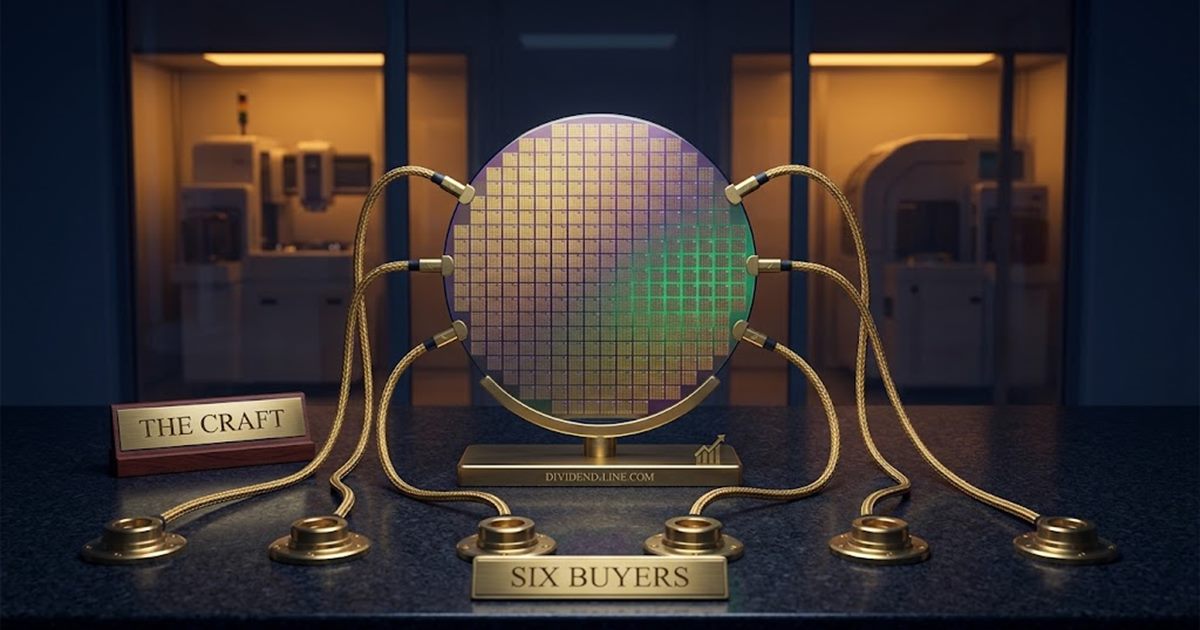
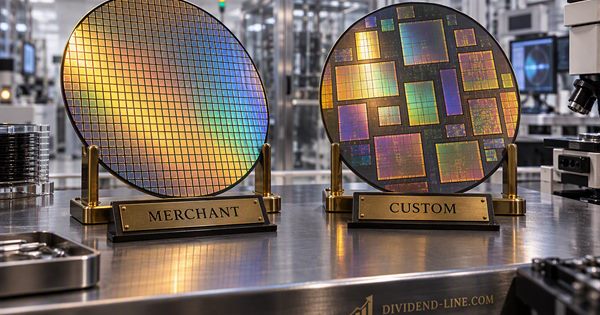
Broadcom does two things that have nothing to do with each other, run by one man who treats them the same way. The first is infrastructure software — VMware, the mainframe tools of CA Technologies, Symantec's enterprise security — bought cheaply from owners who had given up, stripped to the customers who cannot leave, and run for cash at an 84% operating margin. The second is semiconductors: the radio filters in every iPhone, the switch chips inside most of the world's data-centre networks, and — the reason the company is worth $1.7 trillion — custom AI accelerators, which Broadcom designs and manufactures for six customers who want a chip built for their own models rather than Nvidia's chip built for everyone.
The numbers are the kind you read twice. In the quarter to 2 August, revenue rose 86% to $29.6 billion. AI semiconductor revenue rose 221% to $16.7 billion — more than the entire company earned in a quarter two years ago. Operating margin, on the company's preferred measure, was 68%. Free cash flow was $13.7 billion in ninety days. Management guided AI revenue to roughly $58 billion this fiscal year, $115 billion next, and $230 billion the year after, and said it has secured the supply to deliver it (approx. — Q3 call). Hock Tan, who has run this company for twenty years and never once guided to a number he did not hit, called the demand roadmap "very much on target to exceed $30 in EPS in fiscal 2028."
And the stock is 27% below its June high. That is the puzzle this report exists to solve, and the honest description of a share of AVGO today is the answer: a wonderful, cash-gushing toll bridge, bolted to a growth business with six customers, priced at eleven times a year that has not happened yet. We scored Nvidia "Too Hard" in June: a magnificent business, an unknowable price. Broadcom is not too hard — it is legible in every line — but the legibility reveals something Nvidia's does not: the growth has a customer list, and the list is short.
| Founded | 1961 (HP components) → Agilent → Avago (KKR/Silver Lake buyout, 2005; IPO 2009 at $1.50 split-adjusted) → bought Broadcom Corp 2016 and took the name |
| Sector / Industry | Technology · Semiconductors (~70% of revenue) + Infrastructure software (~30%) |
| CEO · CFO · Chairman | Hock Tan (since 2006; contracted 'through 2030 at least') · Amie Thuener (since Jun 2026, ex-Alphabet) · Henry Samueli |
| Makes money from | Custom AI accelerators (XPUs) + AI networking ≈ 56% of revenue · non-AI chips (Apple RF, broadband, storage) ≈ 14% · software ≈ 30% |
| Market capitalisation | ~$1.72T · EV ~$1.76T · net debt ~$35B after Q3 paydown (approx.) · ~4.76B shares |
| Next dates | Ex-dividend 21 Sep ($0.65) · hyperscaler Q3 capex guides ~27–30 Oct · Q4 FY26 results and the December dividend decision ~10 Dec (approx.) |
The history — buy, strip, harvest, repeat
Twenty years of Hock Tan's playbook, applied to a growth business for the first time
| Year | Milestone |
|---|---|
| 2005–09 | KKR and Silver Lake buy Agilent's chip division for ~$2.7B and call it Avago. Hock Tan — ex-PepsiCo finance, ex-Commodore, an engineer with an MBA — becomes CEO in 2006. The playbook is set on day one: keep the franchises with sticky IP, sell everything else. IPO August 2009 at $15 ($1.50 after the 2024 split). |
| 2013–16 | LSI ($6.6B, storage), then Broadcom Corporation itself ($37B, 2016) — networking, broadband, Wi-Fi. Avago takes the bigger company's name. Around the same time its ASIC group begins co-developing Google's first TPU: the seed of everything that follows. |
| 2018 | The $117B hostile bid for Qualcomm is blocked by presidential order on national-security grounds. Tan redomiciles the company to the U.S. and pivots to software: CA Technologies ($18.9B), margins lifted from the 30s to the 70s by keeping the top 600 accounts and cutting everything else. |
| 2019–23 | Symantec Enterprise ($10.7B). Then VMware, $69B including debt, closed November 2023 after eighteen months of regulatory review. Perpetual licences end, subscriptions begin, the partner programme shrinks from thousands to hundreds, and the price increases become a legend — one customer alleged 1,050% in court. |
| 2024 | Gross debt peaks near $76B. The 10-for-1 split. In December, on the 'AI serviceable market of $60–90B by FY2027' call, the company passes $1 trillion for the first time. |
| 2025–26 | OpenAI (10 GW, Oct 2025), Google through 2031 and Anthropic's ~3.5 GW (Apr 2026), Meta through 2029 (Apr 2026), a $35B customer-financing vehicle with Apollo and Blackstone (Jun 2026), Apple's $30B+ U.S. chip commitment (Jul 2026). Record high $495 on 3 June — the day of the Q2 print. |
| Jun – Sep 2026 | Macquarie downgrades on Google 'diversifying suppliers' (4 Jun). A bank models the financing vehicle's exposure at up to ~$370B (14 Aug, −6%). Marvell discloses a Google agreement with a $12B warrant (19 Aug, −5%). Q3 on 2 Sep beats on everything and guides Q4 ~$200M light; the stock falls again. $362 today. |
Two lessons for an owner. First, the acquirer's record is the rarest kind: Buffett warned in 1981 about managerial "princesses" whose kisses were supposed to turn toads into princes; Tan's trick is that he buys toads and never tries to turn them into anything — he runs them for cash, and CA, Symantec and VMware all delivered. Second, and new: the AI business is the first thing Tan has ever built rather than bought, and it behaves differently from everything in the playbook. It is co-developed with the customer, re-bid every chip generation, carries a lower gross margin, and — since June — is partly financed by Broadcom itself. The company that spent twenty years harvesting cash from other people's software is now underwriting other people's capital expenditure. That is the chapter this report is about.
The circle of competence
A legible business · an unknowable customer list
- The $115B lands — FY2027 AI revenue roughly doubles as guided, because the supply is 'secured' and the customers' data centres get built on time (Tan's own caveat: 'are they going to be deployed on a timely basis?').
- Six customers stay six, and stay Broadcom's — Google's multi-sourcing (MediaTek, Marvell, reportedly AMD) trims share at the edges rather than at the core; Anthropic and OpenAI reach the scale their contracts assume without a funding winter.
- The financing vehicle stays a footnote — the ~$29B of exposure on the first $35B tranche never becomes a claim, and later tranches do not turn a chip company into a lender of last resort to its own customers.
How it makes money — the bridge and the promise
Two businesses, two margin structures, one customer problem
FY2025 revenue by reported segment (year to 2 November 2025), and what has happened to the mix since:
The bridge. Legacy Broadcom is what Buffett meant by a toll bridge: RF filters in every iPhone (Apple was ~20% of revenue before AI swamped it), the switch silicon under most data-centre Ethernet, and software that enterprises would need years and fortunes to leave. Capital expenditure is 1.4% of revenue; research is ~13%; the rest is cash. VMware alone throws off roughly $7 billion of operating income a quarter (approx.) from customers who — in Tan's own careful phrase last year — "bought licences to deploy it, it doesn't mean they are fully deployed."
The promise. The AI business is different in kind. Broadcom does not sell a GPU; it builds the customer's own chip — Google's TPU (co-developed since 2016), Meta's MTIA, OpenAI's Jalapeño — supplying the interconnect, the packaging, the memory integration and, increasingly, the whole rack. It then sells the network around it. In Q3 the custom chips were ~73% of AI revenue and shipped at 3.5× last year's volume (approx. — call). The economics are superb and getting slightly less so: because memory and packaging pass through at cost, gross margin has slid from 78.4% to 75% and is guided to ~73%, while operating margin holds near 68% because opex is only ~10% of revenue. Management's line is "focus on operating margin." Ours is that a gross margin falling five points in a year, while operating margin rises, is the signature of a business turning from a designer into a manufacturer.
The new line item. In June, Broadcom launched a $35 billion financing platform with Apollo and Blackstone to fund its customers' racks — the first tranche for Anthropic's first gigawatt. The 10-Q discloses a maximum exposure of roughly $29 billion on that first transaction, a five-year lease-payment backstop (approx. — 10-Q). The CFO said there is "nothing new to announce regarding residual value guarantees or backstops" and that future tranches are "deal-by-deal." A chip company guaranteeing the leases on its own chips is not unheard of; it is how the telecom-equipment boom ended in 2001. We are not saying that is where this goes. We are saying it is the line to read first in every filing from now on.
The moat — wide where it is old, contested where it is new
Five springs · two of them being tested this quarter
| Spring | Where it lives | The 2026 evidence | Trend |
|---|---|---|---|
| Custom-silicon franchise | Ten years of Google TPU generations; SerDes, packaging, HBM integration, rack design | Six customers, contracts to 2029–31. But Google — historically ~95% of TPU-related revenue (approx. — Macquarie) — now has MediaTek on the v8 inference chip, a Marvell agreement with a $12B warrant tied to up to ~$120B of purchases, and reportedly AMD on a 10th-generation part. One broker models Broadcom's TPU share at 65% by 2028. | ◆ wide, contested at the core |
| Ethernet networking IP | Tomahawk (scale-out), Tomahawk Ultra (scale-up), Jericho; Arista and Cisco build on it | Tomahawk 6 shipping in volume; but Nvidia's Spectrum-X is now the largest data-centre Ethernet-switch vendor by revenue (approx. — IDC, Q1 2026), and NVLink Fusion invites custom chips into Nvidia's fabric. | ◆ growing, no longer alone |
| Switching costs (software) | VMware is the substrate of enterprise IT; CA runs the mainframes; Symantec | Revenue +29%, ARR +15%, >90% of the top 10,000 on the VCF bundle. Being spent down: Gartner expects 70% of VMware enterprises to migrate half their workloads by 2028 (approx.); Nutanix, Red Hat, Proxmox, cloud repatriation; EU antitrust (Part XI). | ▼ high, eroding by design |
| Scale & supply | 68% operating margin, ~10% opex ratio; TSMC/CoWoS access; own substrate fab and laser capacity coming | Strengthening — 'we have secured the supply' for $115B and $230B. Scale now extends to financing customers, which is a strength and a liability in the same sentence. | ▲ widening |
| Customer captivity (the negative spring) | Top five customers ≈ 40% of FY2025 revenue (10-K); six XPU customers drive ~70% of growth | 'We have six customers today. Very concentrated group' — Tan, 8 Sep 2026. The next largest, Anthropic, is a private lab. Apple dropped Broadcom's Wi-Fi chip in 2023 and the stock still went up fivefold — the precedent cuts both ways. | ▼ worsening as AI grows |
Buffett's test for a moat is whether a competitor with money, talent and will can replicate the advantage. For the bridge — the filters, the switch silicon, the mainframe code — the answer has been no for a decade, and it is still no. For the promise, the honest answer is "partly, and the customer is trying". Google designed the TPU; Broadcom implements it; and every generation Google asks whether someone cheaper can implement it too. In 2026 the answer arrived: MediaTek for inference, Marvell for the ecosystem around it, AMD reportedly for a future part. That is not the moat collapsing — Broadcom keeps the training chip, the networking, and five other customers — but it is the moat being priced by the customer, which is what happens to every supplier whose customer owns the architecture. Nvidia's customers cannot do this to Nvidia, because Nvidia owns CUDA. Broadcom's can, because Broadcom sells implementation. Score: 8 — the same as Nvidia's and Alphabet's, wide and contested, and for the first time contested by the customer rather than the competitor.
The central question — six signatures
Durability of the AI ramp · concentration · the financing vehicle · one man
Every business on our board carries one question the price turns on. Broadcom's is not whether AI demand is real — Nvidia's $96 billion quarter settles that — nor whether custom chips work — Google has run on them for a decade. It is narrower and harder: can a $230 billion revenue line rest on six customers, two of whom are private companies that lose money, one of whom is financed partly by Broadcom itself, and the largest of whom is hiring second sources?
The durability case. The contracts are long: Google through 2031, Meta through 2029, OpenAI through 2029, Anthropic to ten gigawatts by 2028. Bookings ran three times shipments in the spring (approx. — press estimates). Hyperscaler capital budgets for 2026 are near $725 billion (approx.), and a co-designed chip runs a customer's own model at, in Tan's words, "less than half the cost" of a GPU. The FY2027 guide of ~$115 billion exceeds the top of the $60–90 billion "serviceable market" Tan set in December 2024 — he has raised, not cut, at every print. And his own record on guidance, over twenty years, is unblemished.
The concentration case. "Depth is not breadth." Six boardrooms determine most of the growth; the top five customers were ~40% of revenue before the AI ramp and are more now. The largest customer by 2027–28 will be Anthropic — not a cash-rich hyperscaler but a private lab with a large and unprofitable revenue base, whose racks are leased through a vehicle Broadcom backstops. Meanwhile the cash-rich hyperscaler that built the business is diversifying: Google's Marvell warrant vests against up to ~$120 billion of purchases (approx. — 8-K). Tan's own words on the call: even as the chips ship, "are they going to be deployed on a timely basis?" — the outlook is "highly sensitised" to land, power and shell. Add a gross margin that has given up five points, a Q4 guide $200 million light, and a ten-year Treasury near 4.8% discounting promises for 2028.
| The bear case | The bull case |
|---|---|
| Six customers, and the biggest is leaving at the margins — Google multi-sourcing (MediaTek, Marvell, AMD); one model has Broadcom's TPU share 95% → 65% by 2028 (approx.) | Six customers on multi-year contracts through 2029–31; bookings ≫ shipments; Google keeps the training chip and the network; Meta, OpenAI and Anthropic are all ramping at once |
| The largest future customer is a private lab financed through a vehicle Broadcom partly guarantees — ~$29B of exposure on the first tranche, no aggregate cap disclosed | The vehicle is senior-secured on racks with residual value, co-funded by Apollo and Blackstone; Broadcom's cash ($24B) and $13.7B of quarterly FCF dwarf the disclosed exposure |
| Gross margin 78% → 75% → 73% — the mix is turning a designer into a manufacturer; each doubling of AI revenue is worth less per dollar | Operating margin at a record 68% because opex is ~10% of revenue; 'focus on operating margin' — and $30+ of FY2028 EPS is the stated target |
| Priced for 2028: 45× trailing, 19× FY27, 12× FY28 — a year that has not happened, from customers who have not yet built the buildings | 27% off the high while the two-year AI guide went from '>$100B' to '$115B then $230B'; at 12× FY28 the market is already discounting a miss |
Our read: the ramp is real and the concentration is the price of it. A business that sells implementation to customers who own the design will always be re-bid; that is not a flaw in Broadcom, it is the definition of the product. What changed in 2026 is that the re-bidding became visible (Google) and the customer list became riskier (Anthropic first, financed in part by the supplier). Neither breaks the thesis; both raise the discount rate. The growth dial is a 10 — nothing on our board is growing faster — and the valuation dial is a 4, because the growth is priced and the customers are six.
The competition — and the customers who compete
Nvidia above · Marvell and MediaTek beside · the hyperscalers' own teams inside
| Rival | Where they fight | Threat | Where Broadcom stands |
|---|---|---|---|
| Nvidia | Accelerators (GPU) · networking (Spectrum-X, NVLink) | HIGH | $96B quarter, 75% gross margin, CUDA. Now #1 in data-centre Ethernet switching by revenue (approx. — IDC). Tan's counter: a co-designed XPU beats any GPU on the customer's own model at less than half the cost. |
| Marvell | Custom silicon (Amazon Trainium, Microsoft Maia, Meta) · now Google | HIGH, rising | FY2028 revenue goal $18B; the 29 Jul Google agreement with a $12B warrant is the single most important competitive event of 2026 for Broadcom. |
| MediaTek | Google TPU v8 inference variant; 2027 AI-ASIC share target 15–20% (approx.) | MEDIUM-HIGH | The first second source on the TPU; mass production from Q4 2026. |
| AMD | MI-series GPUs (6 GW OpenAI deal) · reportedly a 10th-gen TPU | MEDIUM | A GPU rival that is also becoming a custom-silicon rival. |
| The customers' own teams | Google TPU, Amazon Annapurna, Microsoft Maia, Meta MTIA | MEDIUM-HIGH, structural | They own the architecture; Broadcom is the implementation partner. Each generation is a re-bid. |
| Nutanix · Red Hat · Proxmox | VMware alternatives | MEDIUM | Migration takes 18–36 months and costs a fortune — which is why the software still grows 29% while customers complain. |
The pattern is unusual and worth stating plainly: Broadcom's most dangerous competitors are its customers. Nvidia competes with it; Marvell and MediaTek compete with it; but the entity that decides whether Broadcom implements the next TPU is Google, and Google has every incentive to keep two suppliers honest. The mirror image is the software: there, the customers cannot leave in under three years, and the company prices accordingly — which is why the European cloud providers have taken it to the Commission. Broadcom is, in the same quarter, the price-taker in silicon and the price-maker in software. The stock trades on the first; the cash comes from both.
Management, ownership & capital allocation
The best acquirer of his generation · $205M of pay · 34% against · a chairman selling
Integrity: no veto. Tan's guidance record is the cleanest of any large-cap CEO we have scored, and the VMware price increases, however unpopular, were announced, not hidden. Capital allocation is textbook and slightly complicated. Textbook: FY2025 free cash flow of $26.9B went ~$11.7B to dividends (approx.), $6.3B to buybacks and $2.8B to net debt reduction; gross debt is down from ~$76B at the VMware peak to ~$58B after the post-quarter paydown, at a ~4% coupon; the dividend policy — half of the prior year's free cash flow — has produced fifteen consecutive raises. Complicated, on three counts. First, the share count rose 27% in a decade (3.83B → 4.85B) because VMware was paid partly in stock and because stock compensation runs at $7.6B a year, 9.5% of revenue — buybacks here offset dilution; they do not shrink the company. Second, the acquisition machine has stopped: no deal since VMware, and the next one would need to be $100B+ to matter, which is Buffett's "curse of scale" arriving at Broadcom. Third, the financing vehicle: capital that used to buy toads now backstops customers' leases. Dial: 7. A superb operator, an expensive one, at 74, with a $29B footnote.
The numbers
A cash machine with a goodwill balance sheet · four feed faults named · the dividend, proven
| Metric | Value | Read |
|---|---|---|
| Revenue (FY2016 → FY2025) · TTM | $13.2B → $63.9B · $89.1B | ▲ 4.8× in a decade; Q3 FY26 +86% YoY; FY26 consensus ~$106B |
| AI revenue · Q3 FY26 → Q4 guide | $16.7B → $21.7B | ▲ +221% YoY; FY27 ~$115B, FY28 ~$230B guided (approx.) |
| Gross · operating · net margin (TTM, GAAP) | 67.7% · 48.3% · 42.9% | ◆ non-GAAP gross margin sliding 78% → 73%; operating margin at a record ~68% non-GAAP |
| ROE · ROIC · ROCE (TTM) | 43.9% · 24.0% · 25.7% | ▲ on a capital base that is two-thirds goodwill — see below |
| Free cash flow (FY2025) · Q3 FY26 · FCF/share TTM | $26.9B · $13.7B · $8.27 | ▲ 46% of revenue; capex 1.4% of revenue |
| Net debt / EBITDA · interest cover | 0.7× · 14.2× | ▲ $59B gross debt, $24B cash — the VMware debt is being retired on schedule |
| Altman-Z · Piotroski | 13.4 · 8/9 | ▲ the strongest scores on our board |
| Goodwill + intangibles · tangible book | $130B (66% of assets) · −$5.13/sh | ◆ an acquirer's balance sheet: the assets are the deals |
| Stock compensation (FY2025) | $7.6B · 9.5% of revenue | ▼ excluded from non-GAAP; we do not exclude it |
| Shares (decade) · dividend (streak) | 3.83B → 4.85B · $2.60, 15 raises | ◆ +27% dilution; yield 0.7% · 31% of FCF |
Four feed faults, named. First, the DCF: our model prints an intrinsic value of $184, −49%. Yesterday, at Lululemon, the same model said +216% because it capitalised earnings the company was leaving; here it capitalises trailing free cash flow while revenue is doubling — the identical fault, mirrored. Neither number has read the guidance. Second, the P/E of 45 is computed on GAAP earnings that carry ~$8.8B a year of amortisation of acquired intangibles; on the non-GAAP run-rate the multiple is nearer 28×. We show both and note, in the other direction, that non-GAAP also excludes $7.6B of stock compensation, which is real pay. Third, the dividend feed prints 2023's payout as $19.05 a share — it is $1.905; the pre-split history was never adjusted, so the 10-year dividend growth the feed implies is wrong by a factor of ten. Fourth, the estimates feed's FY2030 row shows revenue of $139B below FY2029's $336B, from ten contributors who are plainly not modelling the same company; we stop the forward table at FY2028.
| Question | Answer (approx. where marked) | Read |
|---|---|---|
| 1 · Cover on free cash flow, not earnings | $2.60/yr vs FCF/share $8.27 → 31% of FCF (32% of GAAP EPS) | ▲ covered three times over |
| 2 · Trend of that cover, five years | Dividends paid ÷ FCF: ~50% (FY21) · ~43% (FY22) · ~44% (FY23) · ~55% (FY24, VMware year) · ~44% (FY25) (approx.) | ▲ the policy is the cover: half of last year's cash |
| 3 · Funded by operations or by paper? | FY2025 OCF $27.5B; net debt repaid $2.8B; no equity issued for cash | ▲ operations — the paper went to VMware, not to dividends |
| 4 · Balance-sheet room | Net debt/EBITDA 0.7×; interest cover 14×; $24B cash; 7.4-yr average maturity at ~4% (approx.) | ▲ ample — the $29B backstop is the only line to watch |
| 5 · What would force a cut | FCF would have to fall ~55% from FY2025's level, with buybacks at zero — an AI collapse, not a slowdown | ▲ far from the line |
| 6 · Growth rate and its direction | Raises: +10.2% (Dec 2025) · ~12.5%/yr over 5 yrs · ~30%/yr over 10 (approx., split-adjusted). Policy arithmetic on FY2026 FCF of ~$45–47B implies a December raise far larger than any in the company's history | ▲ RE-ACCELERATING — the Chubb pattern, not the Rexford one |
The dividend is the one place where the concentration risk does not reach. It is paid out of last year's cash, which is already in the bank; at 31% of free cash flow it is covered three times; and the policy — half of the prior year's free cash flow — points to a December raise that, applied mechanically, would roughly double the payout (approx.). Tan's language ("increase dividend and probably do stock buyback") suggests the board will not be mechanical, and a 0.7% yield will not attract income investors either way. But it answers the sixth question in the rare direction: this is Chubb and Altria — a growth rate turning up — not Rexford's decay. Write the exception when the data says so.
Valuation
Separate the bridge from the promise, then price each
| Yardstick | Today | Forward | Read |
|---|---|---|---|
| P/E — GAAP · non-GAAP run-rate | 45× · ~28× | 31× (FY26E $11.61) · 19× (FY27E $19.28) · 12× (FY28E $29.97) | the multiple halves every year IF the guide lands |
| P / Free cash flow | 44× | ~37× on FY26 FCF of ~$46B (approx.) · ~20× on FY27 'mid-40s billions' + growth | expensive on the past, fair on the promise |
| EV / EBITDA · EV / sales | 33.7× · 19.7× | — | the debt barely registers against a $1.76T EV |
| Dividend yield | 0.70% | December raise pending (policy: 50% of FY26 FCF) | not an income stock; a growth stock that pays |
| Price vs 52-week range | $362 | $290 low (30 Mar) · $495 high (3 Jun) | 27% below the high on a guidance raise |
Here is the way to think about the price. The bridge — software plus non-AI chips — earns roughly $35B of revenue a year at margins that put its operating income near $30B (approx.); a slow-growth, unassailable, 84%-margin software franchise deserves 18–20× its ~$24B of net profit, call it $450–480B, or ~$95–100 a share. The promise — everything AI — is therefore being bought for about $265 a share, ~$1.26 trillion, against ~$58B of revenue this year and a guide of $115B next. If FY2028 arrives as guided, with ~$30 of EPS, the whole company at 15× is worth ~$450 and the stock is 20% cheap. If the AI line stalls at FY2027's level — $115B, no doubling to $230B — the earnings power is nearer $19–20 a share, and at 16–18× the stock is worth $300–360: today's price, with no cushion. If Google's diversification and a private-lab funding winter cut FY2027 to, say, $80B, you are looking at ~$15 of earnings and a stock in the low $200s.
So the arithmetic is honest and uncomfortable: at $362 you are paid for 2027 and asked to trust 2028, from six customers. Buffett's margin-of-safety tiers ask 20–30% for a business of very high certainty, 40–50% where uncertainty is real. We would call the bridge very high certainty and the promise real uncertainty; blended, we want ~35% off a ~$430 blended fair value, which is ~$280 — a hair below the March low, and ~15× FY2027 consensus. Above that, the stock can absolutely go up — the street's $510 says it will — but it goes up on the promise, and we do not pay for promises with six signatures.
Risks, lawsuits & controversies
Verified 10–11 September 2026 — the risks are commercial, the docket is European
Verified the day of publication, and the shape of the docket is the finding: nothing in a U.S. courtroom threatens this company; everything that matters is a commercial decision in six boardrooms and one in Brussels. The Netflix patent suits were dismissed for Broadcom in late 2025. The only live customer litigation is VMware's own suit against Siemens over unlicensed copies — Broadcom as plaintiff. The European matters are the ones to watch: the cloud providers' association CISPE has asked the Commission for interim measures against VMware's licensing terms, the Commission has an open case, and Broadcom lost a bid in August to suspend an information request. A remedy that caps VMware's pricing in Europe would dent the software margin, not the thesis.
The genuine risks are the two red pills. Concentration is now a documented event rather than a theory: Google's Marvell agreement, disclosed in an 8-K on 19 August, vests a $12 billion warrant against up to ~$120 billion of purchases through 2033 — the customer that built Broadcom's AI business has told the market, in a filing, that it intends to buy a great deal from someone else. Financing is the newer one: the first $35 billion tranche of the customer-financing vehicle carries a disclosed maximum exposure near $29 billion, future tranches are "deal-by-deal," and the largest future customer is the private lab those racks are for. Both are survivable — the balance sheet could absorb the disclosed exposure twice over — and both are exactly what a 27% drawdown on a guidance raise is pricing.
In 2022 Berkshire bought four billion dollars of the world's most important semiconductor company and sold nearly all of it within a few months. Asked why, I said Taiwan Semiconductor was one of the best-managed companies on earth and that I did not like its location. I mention it because Broadcom is the same problem one layer up: a magnificent business whose fate is decided somewhere else — not on an island this time, but in six boardrooms that own the designs Broadcom implements, and in a financing vehicle whose fine print I have read twice. What follows is an attempt to give a great company its due and still tell you why I would not pay today's price for it.
Its due is considerable. Hock Tan has done, for twenty years, the thing I spend half my letters begging managers to do: he buys ordinary businesses at fair prices, runs them for cash, pays down what he borrowed, and never once guided to a number he failed to hit. The software he bought — VMware, the mainframe tools, the security suite — is a toll bridge in the exact sense I used the phrase in the 1970s: customers who cannot leave, capital that need not be reinvested, eighty-four cents of every dollar dropping to the operating line. On top of that bridge sits the fastest-growing business I have ever scored: sixteen billion dollars of custom AI chips in a quarter, up two hundred and twenty percent, guided to double twice more, with the supply secured and the contracts signed through the end of the decade. Operating margin sixty-eight percent. Free cash flow of thirteen billion dollars in ninety days. Fifteen consecutive dividend increases, and the arithmetic of the policy says December's will be the largest yet.
Now the rub, and it is not the rub the newspapers are writing about. It is not that AI demand is a bubble — Nvidia's ninety-six-billion-dollar quarter settles that for now — and it is not that custom chips are inferior; Google has run on them for a decade. It is that Broadcom sells implementation to customers who own the architecture, and such a customer re-bids the work every generation. In 2026 the re-bidding became visible: the customer who built this business signed a second source for inference, a third for the ecosystem with a twelve-billion-dollar warrant attached, and reportedly a fourth for a future part. Meanwhile the customer who will be Broadcom's largest by 2027 is a private laboratory that loses money, whose racks are leased through a vehicle Broadcom partly guarantees — twenty-nine billion dollars of exposure on the first tranche, no cap disclosed on the next. Tan himself said it at a conference this week: "six customers. Very concentrated group." I have owned businesses with six customers. I have never paid forty-five times earnings for one.
On price, let me separate the two companies, because they deserve different multiples. The bridge — software and the legacy chips — is worth, on my arithmetic, about a hundred dollars a share, and I would pay that with confidence. The promise is therefore being sold for two hundred and sixty-five dollars a share, about one and a quarter trillion dollars, against fifty-eight billion of revenue this year and a guide of a hundred and fifteen billion next. If 2028 arrives as promised, the stock is twenty percent cheap. If the AI line merely stalls at next year's level, it is worth roughly what it trades for today, with no cushion. If two of six customers stumble, it is worth a good deal less. For a business of very high certainty I ask twenty to thirty percent off; for one with real uncertainty, forty to fifty. Blending the bridge and the promise, I want about thirty-five percent off a fair value near four hundred and thirty, which is two hundred and eighty dollars — a hair under March's low, about fifteen times next year's consensus, and the point at which I would own the promise without needing it kept.
So the decision is a discipline, not a doubt: too concentrated at this price — wait for the discount. This is not "Too Hard," which is what I said about Nvidia; Broadcom is entirely knowable, and what is knowable is that the growth has a short customer list and a new footnote. Nor is it a Pass; a Pass is never a short, and shorting the best acquirer of his generation into a guidance raise is a fine way to lose money. Put it on the list at two hundred and eighty; take the December dividend decision as the first free signal, the hyperscalers' October capital budgets as the second, and Marvell's first "custom acceleration" quarter in December as the third — it will tell you how much of Google went out the door. What would change my mind sooner is a seventh and eighth customer, or a cap on the financing. I would rather own the bridge at a fair price than the promise at any price, and for the moment they come only as a pair.
at This PriceTwo companies at one price: the bridge (~$100/share, very high certainty) and the promise (~$265/share, six customers, a $29B footnote). Blended fair value ~$430; we want ~35% off for the concentration: own it below ~$280, a hair under the March low and ~15× FY2027. Not Too Hard, not a Pass — a discipline.
Articles that take this apart
 Companies in FocusBroadcom or Nvidia: two ways to sell the same boomBoth are extraordinary businesses riding the same wave. They are not, however, the same investment — and the thing that separates them is a number you can count on one hand.
 Companies in FocusIs Nvidia's growth sustainable? One line in the accounts is trying to tell youNvidia earned in six months what it took the whole of last year to earn. That is not the interesting part. The interesting part grew faster than revenue did.