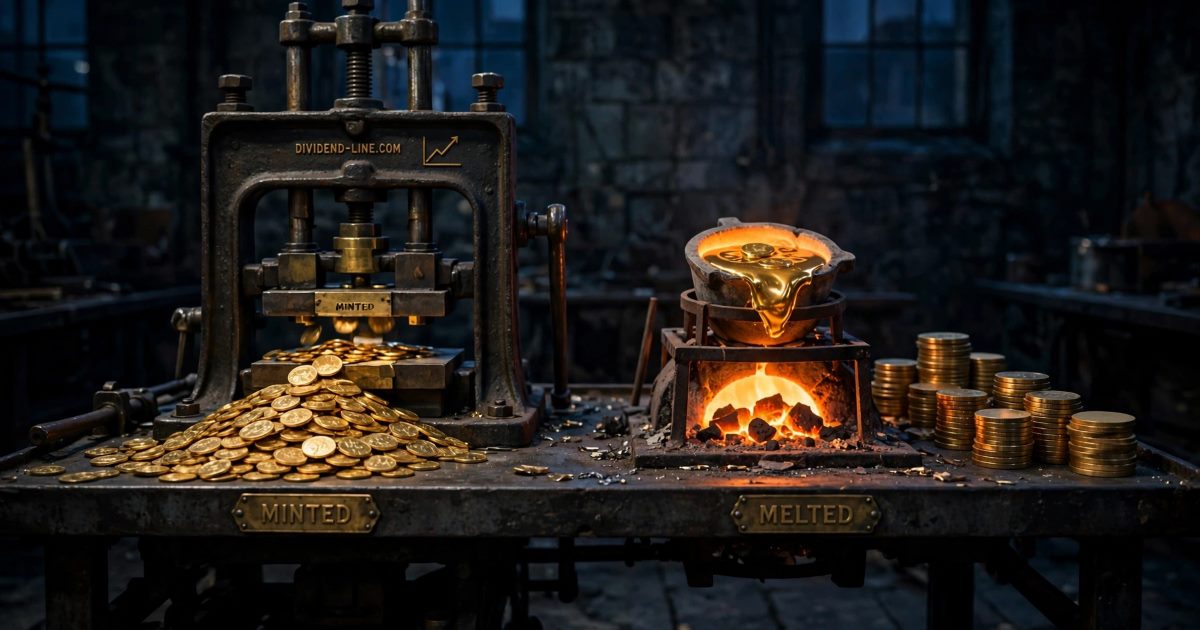
Boeing spent $43.4 billion buying back its own shares, and as at our report the entire amount had been erased.
Not underperformed. Erased — money converted into stock at prices that assumed a company which, it turned out, was not operating as described. Over the same stretch it burned $33.7 billion of cash and had to rebuild the balance sheet from the outside.
A buyback is often described as "returning cash to shareholders". It is not. It is the company using shareholders' money to buy a specific asset — its own stock — and everything depends on what it pays.
The same money, four times the result
What €1,000 million of buybacks actually purchases
| Price paid | Annual free cash flow retired | Relative to 40× |
|---|---|---|
| 8× free cash flow | €125.0m | 5.0× |
| 10× | €100.0m | 4.0× |
| 15× | €66.7m | 2.7× |
| 25× | €40.0m | 1.6× |
| 40× | €25.0m | 1.0× |
| 48× | €20.8m | 0.8× |
Read the first and last rows together. The same board meeting, the same press release, the same €1 billion — and five times the outcome, depending only on when it happens.
No other capital allocation decision has this property so starkly. A factory built at the top of a cycle still produces goods. A share bought at the top of a cycle produces nothing at all except a smaller share count and a poorer shareholder.
A buyback is the company buying one specific stock. The only question that matters is whether it is any good at buying stocks.
Everything pushes towards buying at the top
If buying low is so obviously correct, why is the pattern so consistently the opposite? Because three forces all peak together, and all three point the same way:
- Cash is most abundant when business is best. And business is best when the share price is highest. The money arrives precisely when the asset is dearest.
- Per-share targets are easiest to hit by shrinking the denominator. A management team a few cents short of its earnings-per-share objective can buy the difference. That is not fraud; it is arithmetic, and it is rewarded.
- Buying low requires admitting things are bad. The moment the shares are genuinely cheap is the moment the board is under pressure to conserve cash, and buying aggressively then looks reckless to everyone except a shareholder.
Our September report on Nike found the buyback switched off with the dividend at 104% of clean earnings. That ordering is the norm: the discretionary return goes first, the promised one is defended.
It is also the wrong way round for a shareholder. The company stops buying its own stock at exactly the price where buying it would do the most good — and keeps paying out cash it is not earning, in order to protect a streak.
When it works, it works enormously
The case against bad buybacks is not a case against buybacks. Our September report on Adobe found roughly 7% of the shares retired in a single year, at a valuation around nine times free cash flow.
Look at what that means using the table above. At nine times, every €1,000 million retires about €111 million of annual free cash flow, permanently, for every remaining shareholder. Do that for several years and the per-share results improve substantially even if the business itself does nothing at all.
That is the mechanism working exactly as intended — a company with more cash than ideas, buying a cheap asset it understands better than anyone.
One question to ask of any buyback
Not "is the company buying back stock?" — that number is in every press release. The question is: what is it paying, expressed as a multiple of the cash the business produces?
The company discloses both halves. Cash spent on repurchases is a line in the cash flow statement. Free cash flow is operating cash flow minus capital spending. Divide the market value by the second number and you have the price management is paying on your behalf.
Then ask whether you would buy at that price with your own money. If the answer is no, the buyback is not returning cash to you. It is spending your cash on something you would have declined.
In the financing section of the cash flow statement. Add it up. That total is the size of the bet management has already placed on its own stock.
Total spent divided by the reduction in share count. Compare that with today's price and with the range over the period. A company that consistently paid near the top is telling you something permanent about how it allocates capital.
Repurchases funded from free cash flow are a choice. Repurchases funded from debt at a peak are the Boeing pattern, and the bill arrives in the downturn rather than at the time of purchase.
A bank trading at 2.96 times tangible book value — the level our September report found at JPMorgan — is buying an expensive asset when it repurchases shares, however excellent the bank. Excellence and cheapness are different properties, and a buyback only pays for the second one.
The best capital allocators say this out loud: they will buy below a stated value of the business and not above it. Very few do. That sentence, in a chairman's letter, is worth more than any share count target.
One that erased $43.4bn, one retiring 7% of itself cheaply, one that switched the buyback off, and one buying at nearly three times book.
What each company paid, when, and with whose money.
Frequently asked
Are share buybacks good for shareholders?
Only at the right price. A buyback converts cash into a larger ownership share of the remaining business, so it creates value when the shares are cheap and destroys it when they are expensive — exactly like any other purchase the company makes. The same €1,000 million retires four times as much annual cash flow at ten times earnings as it does at forty.
Why do companies buy back shares at high prices?
Because the incentives point that way. Cash is most abundant when business is good, business is good when the share price is high, and per-share earnings targets are easiest to hit by shrinking the denominator. Every one of those pressures peaks at exactly the wrong moment in the cycle.
What is the worst buyback outcome?
Buying back stock with borrowed money at a peak, then needing the cash afterwards. Boeing repurchased $43.4 billion of its own shares and, as at our July 2026 report, the entire amount had been erased — money spent at prices that assumed a company which was not operating as described, by the same management telling shareholders it was.
Is a buyback better than a dividend?
It is more flexible and more tax-efficient, and it is also easier to get wrong. A dividend is the same whatever the share price; a buyback silently transfers value from continuing shareholders to selling ones when the price is high. Management that cannot judge the price should pay the dividend, and most cannot.