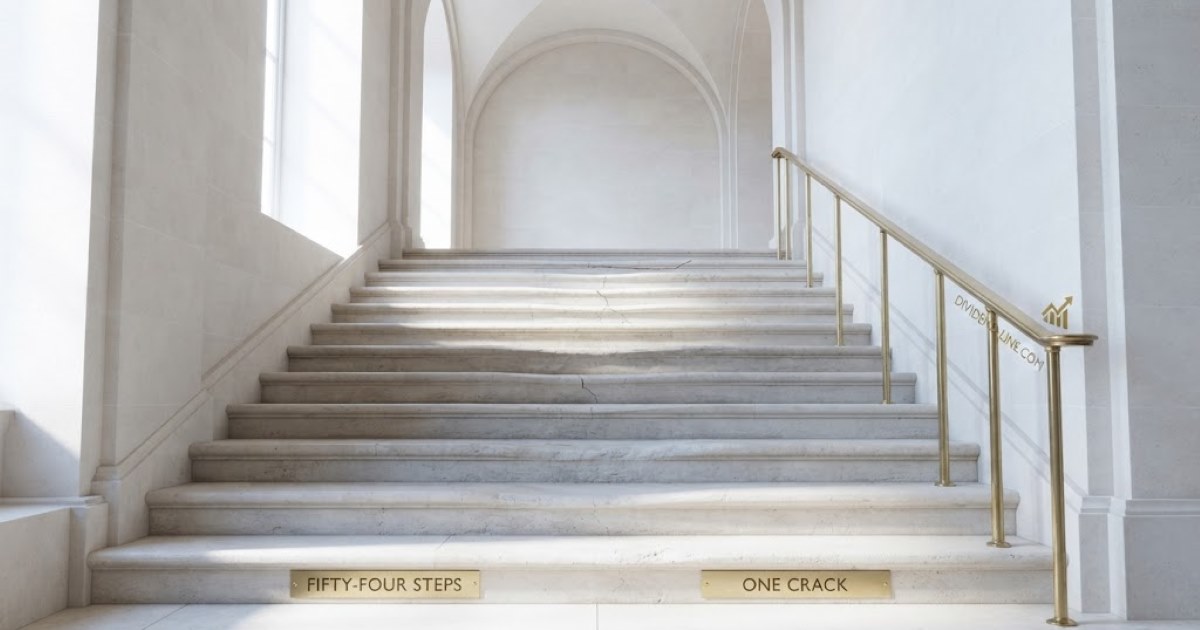
In twelve months this company mispriced its formula and lost customers, watched its sensor business slow while a rival sped up, recalled three million sensors, borrowed $20 billion to buy another company, and settled over a billion dollars of litigation. The shares fell 28%.
It has also raised its dividend for 54 consecutive years — every year since 1972, through 1973–74, 1987, 2000, 2008 and 2020.
Both of those are true at once, and the useful work is not deciding which headline wins. It is sorting the five problems into the ones with an end date and the ones without.
Five problems, three categories
| The problem | Kind | Why |
|---|---|---|
| Formula mispriced, customers lost | Passing | A pricing error is fixed by changing the price. The customers are the question, and they are winnable back. |
| China | Passing | A market condition, not a company condition. |
| The COVID testing cliff | Passing | It ends when the comparison laps. Arithmetic, with a date. |
| Libre slowing while Dexcom speeds up | A fight | No end date. A competitor with a better product is resolved by execution, over years, and may not be resolved at all. |
| $20bn borrowed for Exact Sciences | Permanent | A $23bn, debt-funded bet. Whatever happens, the company that emerges is a different one. |
That is the whole method, and it is unglamorous. Five problems arriving together is not five times worse than one problem arriving alone — unless they share a cause, and these do not.
What makes a bad year dangerous is not how many things went wrong. It is whether any of them touches the cash.
Ask of every problem: can you name the date it ends? Three of these five have one. That is a different company from one where none of them does.
None of it reached the dividend
The payment is covered 1.8 times by free cash flow. Read that backwards, which is the useful direction: cash generation would have to fall about 44% before the dividend stopped being covered at all.
Nothing in the list above does that. A recall costs money once. Litigation settles for a known number. A debt-funded acquisition raises interest costs and is still nowhere near 44% of the cash flow of a company this size.
So the 28% fall and the dividend's safety are not in tension. They are answers to different questions — one about what the business is worth, one about whether the cheque clears.
| Cover on free cash flow | How far cash can fall first | |
|---|---|---|
| Abbott | 1.8× | −44% |
| PepsiCo | 1.00× | 0% — no margin at all |
| Nike | 0.91× (110% payout) | Already uncovered |
They look identical and they are not
- The operational bad year. Several things go wrong at once, the cover is intact, and most of the problems have end dates. The share price falls and the dividend does not notice. This is the one that is usually an opportunity.
- The quiet ending. Nothing dramatic happens. The dividend is never cut, the streak never breaks, and the raises shrink to nothing as cover drifts to 1.00×. The headline stays good for years after the investment case has gone.
- The run-up to a cut. Cover falls below one and stays there, the buyback goes off, leverage rises above target, and the finance team turns over. By the time it is announced it has been visible for years.
Not the share price, not the number of bad headlines, not the length of the streak. Free cash flow divided by dividends paid, for five years, in a column.
A line that holds near 1.8 through a bad year is the first kind. A line that has drifted from 1.2 to 1.0 is the second. A line below 1.0 that stays there is the third.
It takes ten minutes and it is the only thing on this page that is not a judgement call.
Fair, and what we would want
At about 24 times owner earnings, our report put the price close to fair — which is neither an endorsement nor a warning, and is the honest answer more often than either.
The conclusion was hold; add near $80. From $96.69 that is a further 17% fall, which would require the market to keep treating five unrelated problems as one.
That is the useful shape of a decision about a long-record company having a bad year: not "is this a buy" but "at what price does the list of problems stop mattering" — and then writing the number down.
Writing that report we found the capital spending sign was wrong in our own data feed and corrected it before running the dividend tests.
It is worth mentioning because capital spending is one of the two inputs to free cash flow — and the whole of this article rests on getting that ratio right. A sign error there does not produce a slightly wrong answer; it produces a confident one in the wrong direction.
One covered 1.8 times through five problems, one covered exactly once, and one paying more than it earns.
Including the six dividend tests run on a 54-year record.
Frequently asked
Is Abbott's dividend safe after a 28% fall?
On the evidence in our October 2026 report, yes. The dividend was covered 1.8 times by free cash flow, which means cash generation would have to fall about 44% before the payment was uncovered at all. Five separate problems hit the company inside twelve months and none of them touched that ratio — the share price fell for reasons that are not the same as the dividend being at risk.
How do you tell a temporary problem from a permanent one?
Ask whether it has an end date you can name. Mispricing a product is fixed by repricing it; a recall is finished when the stock is replaced; a post-pandemic revenue cliff passes when the comparison laps. A competitor with a better product is a fight with no fixed end, and a $23 billion debt-funded acquisition is permanent whatever happens next.
What does dividend cover of 1.8 times actually mean?
That free cash flow is 1.8 times the dividend, so the company could pay it 1.8 times over. Working it backwards is more useful: cash flow would have to fall 44% before the dividend stopped being covered. Compare that with a payout at 100% of free cash flow, where any decline at all means borrowing or selling something.
Should you buy a Dividend King when it falls?
Only after checking which kind of fall it is. A long record tells you about the culture, not about the next decision — and there are three different bad years: one where the cover is intact and the problems have end dates, one where the payment has quietly stopped growing, and one where the arithmetic has run out. They look identical in a headline.