Lockheed's missile backlog is now 1.6 times its fighter backlog, and its operating margin fell from 14.3% to 10.3%. Both of those are true at once, and understanding why is most of what you need to know about defence as an investment.
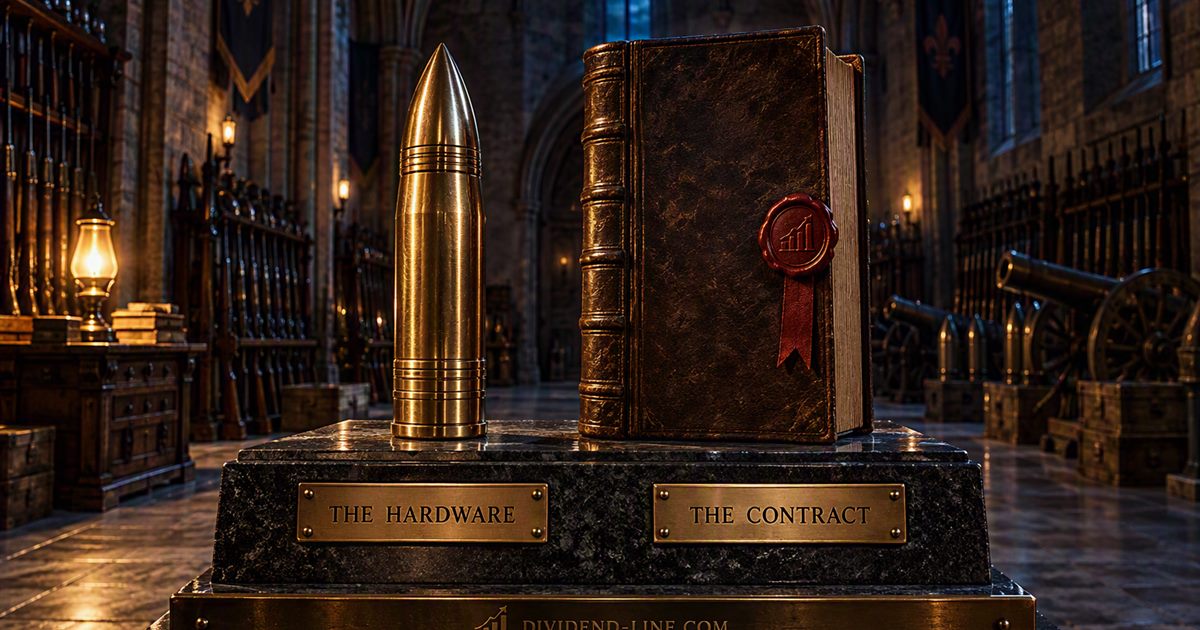
A defence contractor does not really sell hardware. It sells a promise to deliver specified hardware, at an agreed price, over a decade or more. The hardware is the deliverable. The contract is the product — and the contract was signed before anybody knew what steel, labour and titanium would cost in year seven.
A backlog is an obligation, not an asset
"Record backlog" appears in every industrials headline and almost nobody asks the follow-up question: at what price, and who carries the cost risk?
On a cost-plus contract, the customer absorbs overruns and the contractor earns a agreed margin. On a fixed-price contract, the contractor has sold a future at today's estimate — and if costs rise, the difference comes straight out of profit.
Which is why accounting has a specific, brutal mechanism for it. When a contract is expected to lose money across its life, the entire expected loss is recognised immediately — a reach-forward loss. Not spread over the years of delivery. All of it, now.
Lockheed took four of those in three years. That is the bridge between a growing order book and a margin falling four percentage points.
A record backlog signed at fixed prices in an inflationary decade is a record set of promises, made at yesterday's cost estimate.
Boeing: the moat survived, the company that owned it didn't
| Boeing, as at 30 Jul 2026 | Figure |
|---|---|
| Order backlog | $715bn — a record |
| Cash burned over six years | $33.7bn |
| Buybacks completely erased | $43.4bn |
| Our score | 5.6 |
Read those four rows together. The demand was never the problem — $715 billion of orders is as strong a moat as exists in any industry, and it grew throughout. What failed was everything between the order and the cash.
And note the third row, because it is the most instructive number in this article. $43.4 billion of buybacks, erased in full. Money spent buying shares at prices that assumed a company which, it turned out, was not operating as described. That capital is simply gone — and it was spent by the same management that was telling shareholders everything was fine.
Why industrials is our lowest-scoring sector
5.86 across five reports
Industrials scores lowest in our library — below healthcare, below real estate, below energy. That is not a judgement about the importance of the businesses. It is a judgement about a recurring structure:
- Long-dated promises at fixed prices. The company commits to a cost it must estimate years in advance, and carries the error.
- Capital intensity that cannot be paused. A factory half-built is worth less than one not started; commitments compound whether demand cooperates or not.
- Cyclicality that is obvious in hindsight and invisible in advance. Our agricultural machinery report found combine units down 51% in two years — a collapse in demand, from a company that did nothing wrong.
That same structure produces the recoveries. A business whose orders are contracted a decade out does not disappear in a downturn — it underearns and then normalises, which is exactly the shape a patient owner can underwrite. Our machinery report was blunt: the bottom is in, and largely paid for.
The trick is to buy the promise when the market is pricing the underearning, rather than buying the backlog headline when the market is pricing the promise.
Three questions before any industrial
It is disclosed, and it is the single most important thing about an order book. Fixed-price means the contractor owns the inflation risk for a decade.
One is bad luck on a programme. Four in three years is a statement about how this company estimates costs — and estimating costs is the actual business.
Buybacks at the top, funded by debt, are the tell. Boeing's $43.4bn is the extreme case, and the pattern is common enough that it is worth checking before you assume the balance sheet is what it appears.
A contractor rebuilding its arsenal, a manufacturer rebuilding itself, and a cyclical at the bottom of its cycle.
Backlog terms, margin history and capital allocation, worked through.
Frequently asked
Is a big order backlog a good sign?
Only if you know the terms. A backlog is a promise to deliver at an agreed price — so a record backlog signed under fixed-price terms during a period of rising costs is a record obligation, not a record asset. Lockheed took four reach-forward losses in three years while its backlog grew, which is exactly what that looks like in practice.
Why did Lockheed's margin fall while its order book grew?
Because of what a reach-forward loss is: when a contract is expected to lose money over its whole life, accounting rules require the entire expected loss to be recognised immediately. Four of those in three years took the margin from 14.3% to 10.3%. The orders were real; the profitability of fulfilling them was not what the contracts assumed.
Has Boeing recovered?
As at our 30 July 2026 report, genuinely — for the first time in years. But the cost of getting there is the story: $33.7 billion of cash burned in six years, and $43.4 billion of buybacks completely erased. The demand for aircraft never went away; the ability to convert it into cash was destroyed internally and is only now being rebuilt.
Are defence stocks a safe investment?
The revenue is unusually safe; the margin is not. A government customer with a multi-decade programme removes demand risk almost entirely — and replaces it with execution risk on contracts where the price was fixed years before the costs were known. That is a different risk, not a smaller one, and it is why our industrials reports average 5.86.