The Securities and Exchange Commission does not file SpaceX under aerospace. It files it under Services — Computer Programming, Data Processing. That is a clerical detail with no legal weight, and it is also the single most honest summary of the first accounts the company has ever had to publish.
SpaceX listed on Nasdaq in June 2026 under the ticker SPCX. Its first quarterly filing as a public company — Form 10-Q, filed 4 August 2026 for the period ended 30 June — is not a document about rockets. It is a document about an infrastructure build-out on a scale very few companies have ever attempted, funded by the largest pile of cash most investors will see on a balance sheet this decade.
Revenue nearly doubled
And it is no longer a private company's word for it
| Q2 2026 | Q2 2025 | Change | |
|---|---|---|---|
| Revenue | $7.81bn | $4.07bn | +92% |
| Net loss | $0.54bn | $1.01bn | loss cut roughly in half |
Take the second quarter on its own and the shape is unambiguous: revenue doubling year on year while the loss halves, and operating cash flow for the half turning from a rounding error into +$3.47 billion. For a business that spent two decades as a private capital-consumption story, that is a genuine inflection, and it is now audited.
Then you turn the page.
$28.5 billion of capital spending. In six months.
Against $12.5 billion of revenue in the same six months
| First half | 2026 | 2025 | Change |
|---|---|---|---|
| Revenue | $12.51bn | $8.14bn | +54% |
| Operating cash flow | $3.47bn | $0.35bn | ≈10× |
| Capital expenditure | $28.48bn | $6.97bn | 4.1× |
| Research & development | $7.06bn | $3.52bn | 2.0× |
Read that ratio slowly, because it is the whole company. For every dollar of revenue in the first half, SpaceX spent two dollars and twenty-eight cents on capital assets. For every dollar its operations generated, it spent eight.
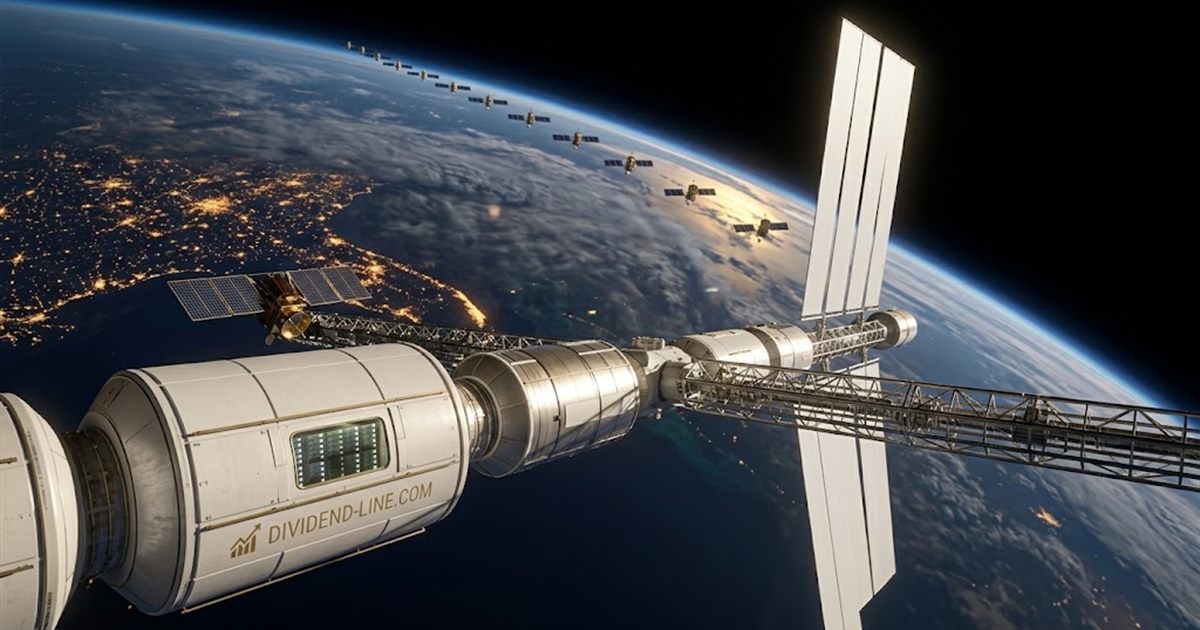
This is not a rocket company's cost structure. Launch is capital-intensive, but it does not consume twice its revenue in six months once the vehicles exist. This is the cost structure of somebody building a network — and the filings say what network.
Two dollars and twenty-eight cents of capital spending for every dollar of revenue. That is not a company flying rockets. That is a company pouring foundations.
Data centres, in orbit
In the company's own filings — not only in the press
The phrase "orbital data center" appears eight times across SpaceX's own registration documents, including the final prospectus published on 12 June 2026. That matters: a prospectus is a document with legal consequences for being wrong, which puts the programme in a different category from the reporting around it.
Worth knowing, too, what is not in the filings. The project name the press has attached to this programme appears zero times in any document the company has filed. When coverage gives something a brand the company has never used, that is usually a sign the specifics are coming from somewhere other than the company — and the specifics are exactly what an investor would need.
The case for computing in orbit is not silly. Power is continuous and free above the atmosphere, cooling is a radiator rather than a water supply, and land, permits and grid connections — the three things now rationing data centre construction on Earth — do not apply. A company that has driven the cost of getting mass to orbit down further than anyone is the one party for whom the arithmetic could conceivably work.
The case against is equally simple: everything is harder in orbit, nothing can be repaired by a technician, and the hardware ages in radiation. Neither case is settled by argument. It is settled by the return on $28 billion, and that number is not in this filing.
How long the money lasts
Arithmetic on the filing, not a forecast
The June listing changed the balance sheet beyond recognition. Shareholders' equity went from $34.5 billion at the end of March to $127.2 billion at the end of June. Cash went from $24.7 billion at the end of December to $93.5 billion.
Now put the two halves together. In the first half, capital spending of $28.5 billion against operating cash flow of $3.5 billion is a net outflow of $25.0 billion in six months — about $4.2 billion a month. Hold that rate still, and $93.5 billion of cash funds roughly twenty-two months.
That is arithmetic, not a prediction, and both inputs will move: revenue is growing at something like 90% a year, which lifts the cash coming in, and capital spending is lumpy by nature. But it frames the question precisely. SpaceX has around two years of runway at its current rate to turn the largest private infrastructure programme in the world into revenue — or to go back to the market, which it can now do, because it is listed.
What an owner is actually buying
Stripped of the romance, the proposition is this: a business with genuinely doubling revenue and newly positive operating cash flow, spending more than twice its revenue on an asset base whose return nobody can yet compute, funded by a cash pile that lasts about two years at the present rate.
That is not a bad business. It is an unpriceable one — and the two are not the same thing. Every valuation method we use on the rest of the board needs something this filing does not provide: a normalised level of capital spending, or a return on the capital already spent. Until one of those exists, any number someone gives you for what SpaceX is worth is a preference dressed as arithmetic.
The honest position is to watch two lines and ignore everything else. Does capital spending ever fall below revenue? That is the quarter the build-out starts paying for itself. Does operating cash flow keep compounding the way it did this half? That is whether the existing network — the satellites already up, already earning — is the annuity it appears to be. The rest is a story, and stories are what this company has never been short of.
SpaceX files quarterly now, like everybody else. Both of these sit at the centre of the same build-out.
Frequently asked
Is SpaceX profitable?
Not yet, but the direction is improving at the operating line. In the quarter ended 30 June 2026 the net loss was $541 million, down from $1,008 million a year earlier, and operating cash flow for the first half was positive at $3.47 billion against $0.35 billion. The first-half net loss is much larger, at $4.82 billion, because of the first quarter rather than the second.
How fast is SpaceX growing?
Revenue in the June quarter was $7.81 billion against $4.07 billion a year earlier — roughly a doubling. For the first half it was $12.51 billion against $8.14 billion. Those are the figures in the Form 10-Q filed on 4 August 2026.
What are SpaceX's orbital data centres?
A programme the company describes in its own registration documents — the phrase appears eight times across its filings, including the final IPO prospectus of 12 June 2026. The press has attached a project name to it that appears in no filing, so treat the branded version with care. What the accounts show is the spending: $28.5 billion of capital expenditure in six months.
How long can SpaceX fund this level of spending?
It held $93.5 billion of cash at 30 June 2026, most of it raised at the June listing. In the first half it spent $28.5 billion of capital expenditure against $3.5 billion of operating cash flow, a net outflow of about $4.2 billion a month. At that unchanged rate the cash funds roughly twenty-two months. Both halves of that will move — revenue is growing quickly and capital spending is lumpy — but it sets the clock the company is working against.