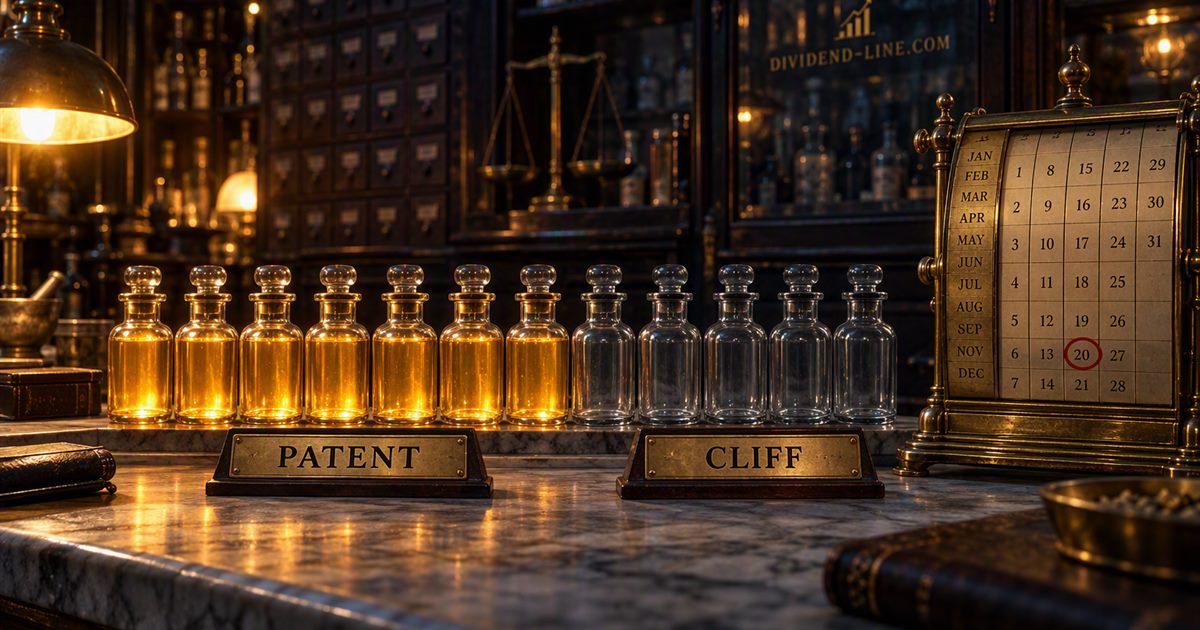
A patent expiry is the rarest thing an investor ever gets: a large, certain loss with a date printed on it. No estimate, no scenario — the month is in the filings, and everyone can read it.
Which makes it a perfect test of what markets actually do with known risks. The answer, in Johnson & Johnson's case, is that they overpriced it and then stopped. As at our X-Ray of 24 September 2026, the shares had risen 54% in twelve months to a record — having spent three years at a discount for three reasons that all expired at once.
Three fears, all resolved inside nine months
| The fear | How it resolved | When |
|---|---|---|
| Stelara loses its patent | Revenue fell 55% — and the rest of the pharmaceutical business grew 15.5% in the latest quarter, more than covering it | Absorbed |
| Talc litigation | Settled for $5.5bn — less than the $9–10bn the company had itself offered two years earlier | Settled |
| Washington on drug pricing | A pricing agreement struck with the White House | Agreed |
Read the first row again, because it is the whole lesson. The cliff was exactly as bad as advertised — the drug lost more than half its revenue. What the discount had priced was that the loss would hurt. What it had not priced was that the rest of the company would grow 15.5% while it happened.
The market priced the hole correctly. It forgot to price what was being built beside it.
Three questions, in this order
They apply to every pharma company you will ever look at
Not revenue — profit. A drug at 8% of revenue and 20% of profit is a different animal from one at 15% of revenue and 15% of profit. Concentration is the variable; the expiry is just the trigger.
It is published. The useful version of this question is how many years of cash the company collects before it arrives — because a cliff six years out is six years of funding for whatever replaces it.
The only one that is genuinely hard. It is a judgement about research productivity, and the honest proxy is history: what has this company's R&D actually produced per dollar over the last decade? A cliff is dangerous when the answer is 'nothing much'.
A patent cliff is legible. It can be written as a headline, put in a spreadsheet, and argued about. What replaces it — a pipeline of things that mostly fail — cannot. So the market prices the number it can see against a replacement it cannot, and the gap becomes the discount.
That asymmetry is real and it is recurring. It is also not a licence to buy every company facing an expiry: the same asymmetry exists at companies whose pipeline genuinely is empty, and there the discount is correct.
The fear expired, and so did the bargain
We scored J&J 6.8 in September — a good business, fairly priced, which is a less interesting place to be than a good business mispriced. At 23.1× adjusted earnings and a 1.98% yield, the shares now require the growth to continue rather than merely the fears to be wrong.
That is not a criticism of the company. It had an exceptional year and earned the re-rating. It is an observation about when the opportunity existed: it existed while three legible fears were being argued about, and it closed when they were settled. Nothing about the business changed on the day of the settlement. Only the price did.
One that walked off the cliff and recovered, one living with a large one, one that has not replaced what it lost, and one the market believes has.
Business, moat, management, the numbers, valuation and an honest verdict.
What to do with this on Monday
If you own a pharmaceutical company, go and find the expiry dates of its three largest products. They are in the annual report and they take ten minutes to locate. Then ask what share of profit those three represent.
If the answer is "most of it, and the first date is inside three years", you are holding a position whose central risk is on a schedule — and a risk on a schedule can be planned around, which is the rarest luxury in this business. If you do not know the dates, you are not holding a pharmaceutical company. You are holding a story about one.
Frequently asked
What is a patent cliff?
The date a drug's exclusivity ends and competitors can sell copies. Because most of a drug's cost is research already spent, the copies arrive far cheaper and revenue falls very quickly — often by half or more within two years. Unlike almost every other corporate risk, the date is known years in advance and printed in the filings.
How did Johnson & Johnson handle losing Stelara?
It absorbed it. As at our 24 September 2026 report, Stelara revenue had fallen 55% — and excluding it, the pharmaceutical business grew 15.5% in the latest quarter. The loss was real and large; what the market had not priced was the rest of the portfolio growing fast enough to cover it.
Is Johnson & Johnson still cheap?
No, and that is the honest answer. Three fears — the Stelara expiry, the talc litigation and Washington's pricing threat — all resolved within about nine months. The shares rose 54% to a record and traded at 23.1 times adjusted earnings on a 1.98% yield at the date of our report. The discount existed because of the fear; the fear expired, and so did the discount.
How should I think about a company facing a patent cliff?
Ask three questions in order: how big is the drug as a share of profit, what is the date, and what is behind it in the pipeline. A cliff is only dangerous when the answer to the third is nothing — and that is a question about research productivity, which is visible in the accounts years before the expiry arrives.