JPMorgan just had the most profitable quarter any American bank has ever had — $21.2 billion — and $4.2 billion of it came from selling shares in Visa.
Strip the one-off out and the quarter was $16.9 billion. That is still extraordinary: a 23% return on tangible equity, at a scale where 12% is respectable. But it was produced in what the bank's own chairman called a particularly favourable environment, alongside a warning that the trading boom behind much of it would not last.
So the question for an owner is not whether this is the best bank in America. It plainly is. The question is what you are paying for that fact, and what the price assumes about the years after the favourable environment ends.
A bank is the one business where the balance sheet is the product
Which is why nothing you know about valuing companies transfers cleanly
For an ordinary company, the balance sheet is the equipment and the income statement is the business. For a bank it is the reverse. A bank takes in deposits, lends them out, and earns the difference — so its assets are its operations, and its equity is the buffer that decides how much of that it is allowed to do.
That gives a valuation shortcut you cannot use anywhere else. A bank is worth, roughly, its tangible book value, multiplied by how much it earns on that book, divided by what investors demand in return. Three numbers. Everything else is detail.
| The three numbers | JPMorgan, as at 24 Sep 2026 | What it does to the value |
|---|---|---|
| Tangible book | The base the price is quoted against | The anchor — what the bank would be worth if it earned an ordinary return |
| Return on it (ROTCE) | 23% clean · 29% including the Visa gain | Every point above the industry's cost of capital multiplies the anchor |
| What investors demand | 10-year Treasury at 5.12% | The divisor. When it rises, every bank is worth less, however good |
Now put the three together, because that is where the argument lives. 2.96 times tangible book is not an aggressive price for a bank earning 23% on its equity — it is roughly what that return is worth. It is an aggressive price for a bank earning 15%.
So the multiple is not a bet on JPMorgan being excellent. That is established. It is a bet on how long excellence at this particular level lasts.
The price does not assume JPMorgan is the best bank in America. It assumes the best quarter in American banking history is closer to normal than to a peak.
Capital is the only defence that works in the dark
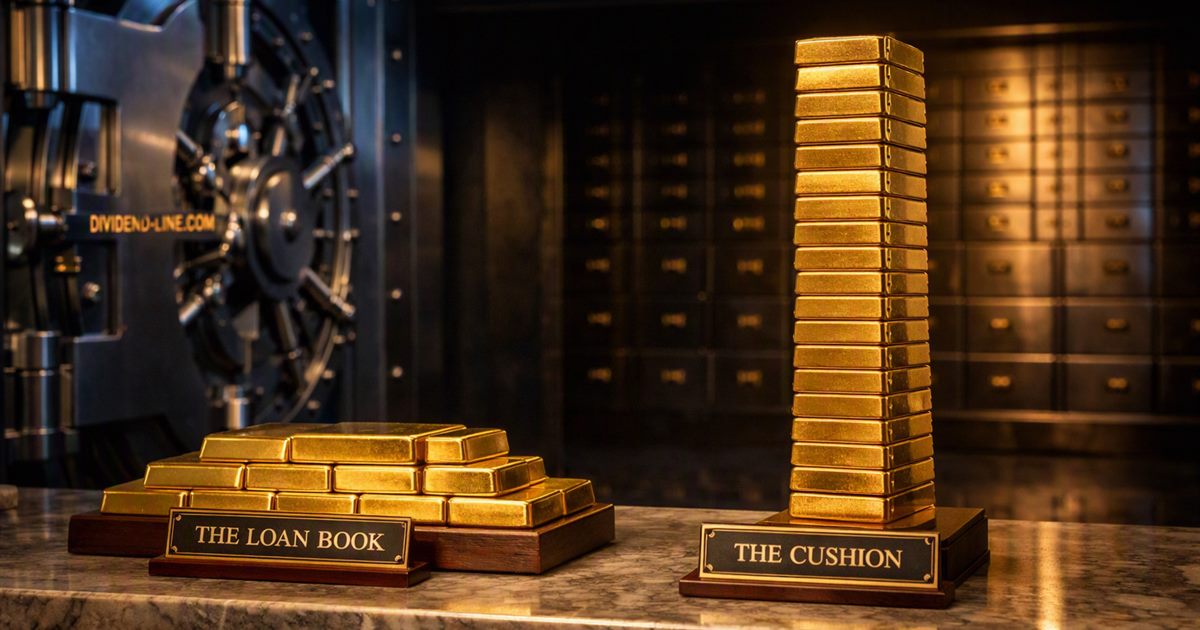
CET1 of 14.1% against a requirement of 11.5%
Here is where the word fortress earns itself, and it has nothing to do with the record. Banks do not fail because earnings fall. They fail because something they own turns out to be worth less than they thought, and they do not have enough capital to absorb the difference before depositors notice.
JPMorgan's common equity tier 1 ratio was 14.1% against a requirement of 11.5%. That surplus — a couple of hundred basis points on a balance sheet of this size — is tens of billions of dollars of capacity to be wrong without being in trouble. It is also, not coincidentally, what let the bank buy failing rivals in the last two crises rather than become one.
Excess capital lowers return on equity in good years — it is money sitting idle — and it is the only thing that matters in bad ones. A bank that optimises away its cushion will out-earn JPMorgan for several years and then, once, spectacularly not.
That is the real reason the premium exists. You are not paying for 23%. You are paying for 23% produced without borrowing against the future.
Gravity returns as a number, not a headline
The 10-year Treasury at 5.12% is the quietest and most important figure in our report. It is the denominator in every valuation on the board, and banks feel it twice: once because their own securities reprice, and once because it sets what investors demand from bank equity.
Which gives you a clean way to hold the position. Three things would change the argument, in order:
- Clean ROTCE settling below the high teens. Not one soft quarter — a level. That is the number the 2.96× multiple is capitalising, and it is the one the chairman effectively pre-announced would come down.
- Credit costs normalising. Loan losses are the lagging indicator in every cycle. They look best immediately before they stop looking best.
- The CET1 surplus being spent. Buybacks at three times tangible book are not obviously a good use of shareholder money — the same capital buys far more book value in a crisis than it does at a record.
The best bank, a cheaper one, and a lender that earns like a network. Same industry, three different economics.
Business, moat, management, the numbers, valuation and an honest verdict — each stamped with the date and price it was written at.
What to do with this on Monday
If you own a bank, find two numbers in its last report: return on tangible equity, and the CET1 surplus over its requirement. The first tells you what the business earns; the second tells you whether it can survive being wrong. Most bank commentary discusses neither.
And when you see a record quarter, look for the one-off before you look at the total. Here it was $4.2 billion of Visa shares — a fifth of the headline, clearly disclosed, and absent from almost every account of the result.
Frequently asked
How do you value a bank?
Differently from any other business, because the balance sheet is the product. The short version: a bank is worth its tangible book value multiplied by how much it earns on that book (return on tangible common equity), divided by what investors demand for the risk. That is why banks are quoted as a multiple of tangible book rather than of sales — and why a rising return on equity justifies a higher multiple, while a rising cost of capital pulls it down.
Was JPMorgan's record quarter real?
The $21.2 billion headline was real but flattered. About $4.2 billion of it was a one-off gain on Visa shares. Strip that out and the quarter was $16.9 billion — still a 23% return on tangible equity, still the best in American banking, but produced in what the chairman himself described as a particularly favourable environment, with a trading boom he warned would not last.
What does 2.96 times tangible book mean?
It means the market is paying almost three dollars for every dollar of tangible net assets the bank holds. That is a premium reserved for banks that earn far more on their capital than the industry does, which JPMorgan demonstrably has. The question is not whether the premium is deserved — it is whether the return that justifies it persists once conditions normalise.
Is JPMorgan's dividend safe?
Dividend safety at a bank is a capital question, not a cash-flow one. As at our 24 September 2026 report its CET1 ratio was 14.1% against a 11.5% requirement — a surplus measured in tens of billions. A bank with that much excess capital does not cut its dividend because of the dividend; it cuts because a regulator makes it, and this one is a long way from that conversation.