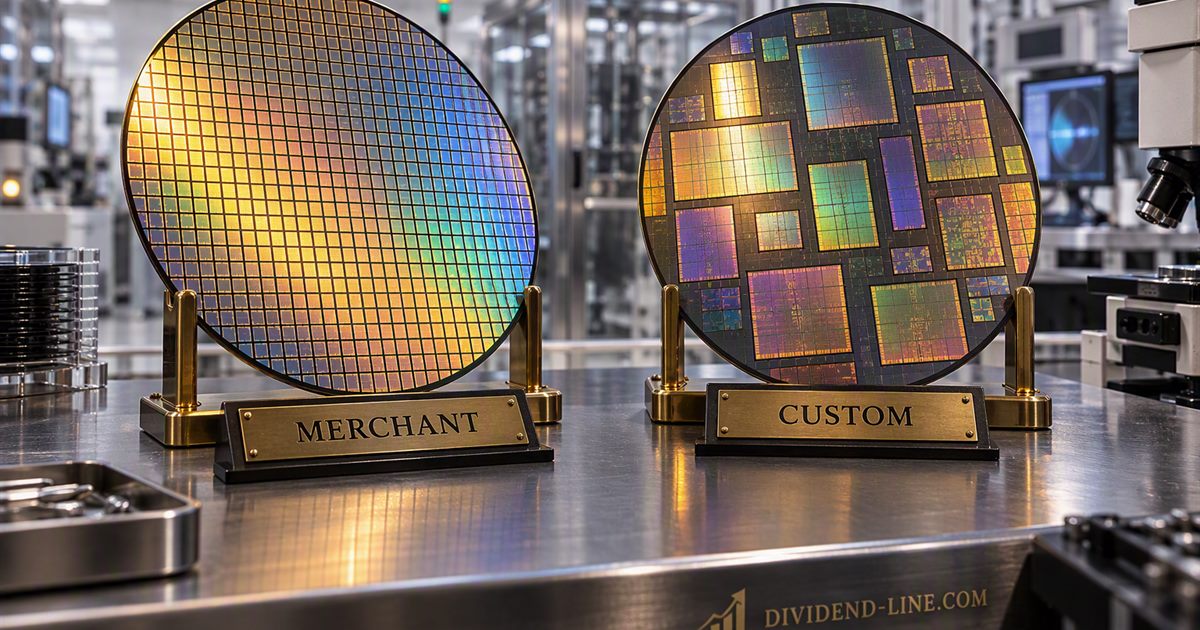
Nvidia sells the same chip to everyone. Broadcom builds a different chip for six people. That sentence contains almost everything an investor needs to understand about the difference, and neither business is the safer one.
Both are magnificent. As at our reports, Nvidia grew revenue 106% to $96.2 billion in a quarter at a 75% gross margin; Broadcom grew revenue 86%, with AI revenue up 221% to $16.7 billion at an operating margin near 68% and $13.7 billion of free cash flow in three months. These are not companies to choose between on quality.
They are companies to choose between on what happens when the spending slows — and there they are opposites.
Merchant silicon and custom silicon
The same boom, sold two different ways
| Nvidia — merchant | Broadcom — custom | |
|---|---|---|
| What it sells | One product line, to anyone | A bespoke accelerator, co-designed with one customer |
| Who owns the design | Nvidia | The customer |
| Customer count | Many — concentrated, but a market | Six |
| Switching cost | The software ecosystem built around it | Years of joint engineering, per customer |
| How it goes wrong | The cycle turns and everyone slows at once | One of six leaves — or cannot pay |
| Our score | 7.6 | 7.2 |
The custom model looks like the stronger moat, and in one sense it is: a customer who has spent two years co-designing a chip does not casually switch. But look at what that moat is made of. It is six relationships. Each one is deep, and each one is also a single point of failure that no amount of engineering excellence can diversify away.
A moat made of six relationships is very deep and very narrow. Both of those words matter.
The largest customer is financed by the seller
Our September report found the largest of those six customers to be a private laboratory whose racks Broadcom helps finance. That is not hidden and it is not unusual in a capital build-out — but it changes the nature of the revenue.
When a supplier helps fund its own customer's purchases, some of what appears on the income statement as a sale is closer to an investment in that customer's success. It is excellent business while the customer thrives. It concentrates two exposures into one name if it does not.
And the second detail from the same report: the biggest of the old customers is quietly hiring second sources. That is the normal behaviour of a large buyer who has become uncomfortable with dependence — and it is what erosion looks like in its earliest, most deniable form.
One is priced for a cycle, the other for a calendar
| Broadcom, as at 11 Sep 2026 | Multiple |
|---|---|
| Trailing earnings | 45× |
| FY2027 estimate | 19× |
| FY2028 estimate | 12× |
Twelve times earnings is cheap. Twelve times 2028 earnings, for a business whose 2028 depends on six customers delivering against guidance given in 2026, is a different sentence. Our verdict was blunt: a magnificent business, priced for a year that has not happened yet — too concentrated at that price.
Nvidia's problem is the opposite shape. Not six customers but a handful of capital budgets; not a calendar but a cycle. And its warning light is in a different line: inventory rose 47.5% in six months, growing faster than revenue in the latest quarter.
Nvidia asks you to believe that a handful of enormous buyers keep spending at this rate. Broadcom asks you to believe that six specific relationships hold, and that two years of guidance is delivered.
Neither is a question the accounts can answer. Both are questions you can monitor — and the monitoring is different for each, which is the practical point of telling them apart.
Two chip businesses and the company that sells both of them their machines.
Business, moat, management, the numbers, valuation and an honest verdict.
What to watch, for each
- For Broadcom: the customer count. Six going to seven is the thesis working. Six going to five is the thesis breaking, and it will be disclosed quietly if at all. Watch also for any change in how the financed customer is described.
- For Nvidia: inventory against revenue. If stock outgrows sales a second quarter running, and the gross margin slips, the cycle has turned a quarter before the headlines notice.
- For both: the customers' capital budgets. These two companies sell to roughly the same dozen buyers. When those buyers guide their spending down, both stories end on the same afternoon — which is worth knowing before you own them as though they were diversification.
Frequently asked
What is the difference between Broadcom's and Nvidia's AI business?
Nvidia sells a standard product to anyone who will buy it — merchant silicon. Broadcom co-designs a bespoke accelerator for one customer, who then owns the design and buys it only from Broadcom. The first is a market; the second is a set of marriages. Both are enormously profitable, and they fail in completely different ways.
How concentrated is Broadcom's AI revenue?
As at our 11 September 2026 report, it had six custom-accelerator customers. AI revenue grew 221% to $16.7 billion in the quarter, with company revenue up 86% and an operating margin near 68% — but that growth rests on six relationships, the largest of which is a private lab whose infrastructure Broadcom helps finance.
Which is the better AI investment?
They are different bets, not better and worse. Nvidia's risk is the cycle: its revenue is a handful of capital budgets and its inventory has been growing faster than sales. Broadcom's risk is concentration: six customers, one of them financed. We scored Nvidia 7.6 and Broadcom 7.2 — close, and for opposite reasons.
What does 'priced for 2028' mean?
Broadcom traded at 45 times trailing earnings, 19 times the 2027 estimate and 12 times the 2028 estimate. The multiple only looks reasonable on the furthest number — which means the price already contains two years of guidance being delivered. That is not an argument against the business; it is a statement about what has to happen for the price to be right.