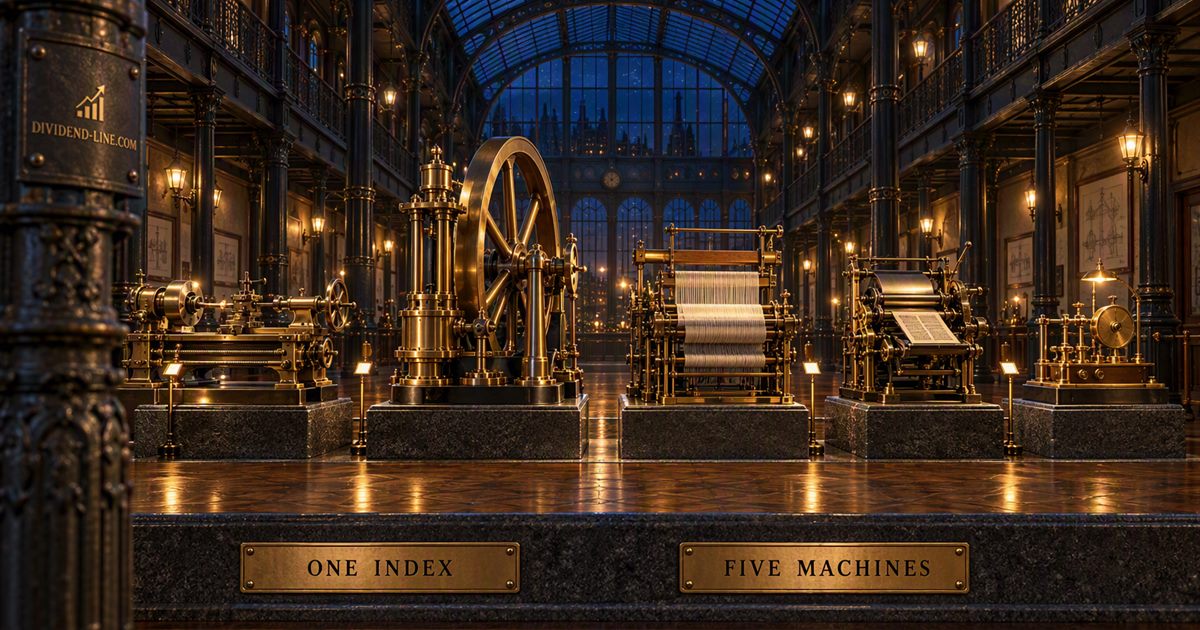
They are bought as a group, indexed as a group, and argued about as a group. Their accounts have almost nothing in common.
One sells a physical object and the walled garden around it. One sells advertising against what people are trying to find. One sells advertising against what people cannot stop looking at. One rents computing to corporations on multi-year contracts. One sells hours of entertainment for a monthly fee.
Calling that a sector is like calling a lathe, a loom and a printing press "machines". True, and useless.
What each one actually sells
Our own scores, and the figure that defines each business
| Score | The business | The number that defines it | |
|---|---|---|---|
| Alphabet | 8.0 | A toll booth on intent | Search +17%, Cloud +82% — and $6.26 of $9.11 of quarterly EPS came from stakes in other companies |
| Meta | 8.0 | The most profitable attention machine ever built | 3.56 billion people daily, 41% operating margin, ~21× forward |
| Apple | 7.6 | A consumer franchise wearing technology's clothes | The largest buyback in corporate history — and a demanding price |
| Microsoft | 7.6 | Rented computing, on contracts | Order book $678bn — of which at least a third is one customer |
| Netflix | 7.6 | Hours of attention, by subscription | Free cash flow $12.5bn — with view hours growing just +2% |
Three of them stopped generating cash
And it is not a problem with the businesses
Here is the thing the group framing hides completely. In the same few months:
Alphabet's capital spending was heading to $205 billion, and its second-quarter free cash flow was minus $5.8 billion. Microsoft's capital spending reached 35% of revenue, with free cash flow down 6.5%. Meta committed $125–145 billion and paused its buyback.
Meanwhile Netflix produced $12.5 billion of free cash flow, and Apple continued the largest buyback in the history of corporations.
Two of these five are returning cash. Three are consuming it at a scale without precedent. That is not a sector. That is a fork in the road.
Profit spreads the cost of a building over twenty years. Cash leaves the day you buy it. This year, that distinction stopped being academic.
A company that spends heavily and earns a good return on the spending is doing exactly what an owner should want — it is the whole mechanism of compounding. Negative free cash flow during a build-out is a description, not a verdict.
The verdict arrives later, in the return on the assets once they are built. Which means the honest position today is that nobody knows — and that anyone telling you confidently either way is describing a belief, not a number.
Two of the five have earnings that are not what they look like
Our September revisit of Alphabet found that $6.26 of $9.11 of a quarter's earnings per share came from stakes in other companies — SpaceX and Anthropic — rather than from operations. The toll booth held; the profits were partly paper.
That is not an accounting irregularity. It is a mark-to-market gain on holdings, entirely legitimate and entirely disclosed. But it means a price-to- earnings ratio computed on the headline number is measuring something other than the search business, and it will reverse if the marks reverse.
At Microsoft the concentration is different but the principle is the same: an order book of $678 billion looks like an unassailable moat until you learn that at least a third of it is one customer — and that customer's ability to pay is itself a function of the same AI build-out that Microsoft is financing.
The question to ask of each, separately
- Alphabet: what are the operating earnings, with the investment gains stripped out? That is the number the search business actually produces, and it is the one to value.
- Meta: does the 41% operating margin survive the capital programme? It is the highest margin of the five and the one with most room to fall.
- Apple: is the buyback shrinking the share count faster than growth is slowing? That has been the engine of the returns, and it is arithmetic you can check.
- Microsoft: what share of the order book is one customer, and is that share rising? Disclosed, and decisive.
- Netflix: are view hours growing? At +2% they were barely moving. Subscription businesses die of engagement long before they die of subscribers.
Compare the cash flow statements rather than the share prices. That is where these five have stopped resembling each other.
Each stamped with the date and the price it was written at.
What to do with this on Monday
If you own an index-like basket of these five, you are not diversified across technology. You are concentrated in a single bet — that an enormous, simultaneous, industry-wide capital programme earns its cost of capital — held through three of the five names.
That may well be right. But it is one decision, not five, and it should be sized as one.
Frequently asked
Are the big tech companies really that different?
Structurally, yes. One sells a physical object and the ecosystem around it. One sells advertising against search intent. One sells advertising against attention. One rents computing to enterprises. One sells hours of entertainment by subscription. The only thing they share is that their products arrive through a screen — which is a statement about distribution, not about economics.
Why is free cash flow falling at companies whose profits are rising?
Capital spending. As at our reports, Alphabet's capital expenditure was heading to $205 billion with second-quarter free cash flow at minus $5.8 billion; Microsoft's capex reached 35% of revenue with free cash flow down 6.5%. Profit is an accounting measure that spreads the cost of an asset over years. Cash leaves when the asset is bought.
Which of them has the best economics?
On our own scoring, Alphabet and Meta both scored 8.0, with Apple, Microsoft and Netflix at 7.6. But the scores hide the interesting part: Meta earns a 41% operating margin from 3.56 billion daily users at about 21 times forward earnings, while Microsoft trades near 28.8 times with a third of its order book resting on a single customer. Same score, very different risks.
Is the AI capital spending a problem?
It is the central question for three of the five, and it is unresolved. The spending is real, enormous and simultaneous — and unlike the profits it funds, it is being paid for now. The honest position is that nobody yet knows what return it earns, including the companies making it, and that the cash flow statement is where the answer will appear first.