Articles
Investing written the way we would explain it across a table: what the number means, why it moves, and what an owner should do about it. Every article links down to the company pages and the X-Ray reports that carry the evidence.
What happens to a moat when a new competitor arrives
A moat is a reason competitors cannot reach you. It fails the moment someone arrives who does not need to come the way you are defending.
Companies in Focus
Opinion, with the evidence attached: what is actually happening inside a business people are arguing about.

Is Disney stock cheap?
The market still prices this company on the business that is dying. Two-thirds of the profit now comes from the two that are not — and one of them is growing 20%.

Big Tech is five companies, and only one of them is a technology business
The index treats them as a sector. Their accounts say otherwise — and this year the difference has started showing up where it matters most, in the cash.

Cheap, or cheap for a reason? Two companies that look identical from outside
A low price is the easiest thing in the world to find and the hardest thing to interpret. There is one question that separates a bargain from a trap, and it is not about the multiple.

What a defence contractor actually sells (it isn't weapons)
Defence looks like the safest business on earth: a government customer, decade-long contracts, no competition. Our industrials reports average 5.86 — our lowest sector. Here is why.

Why healthcare is the hardest sector to own
Everything about healthcare looks like a wonderful business until you notice who sets the price — and that it is almost never the company that invented the thing.
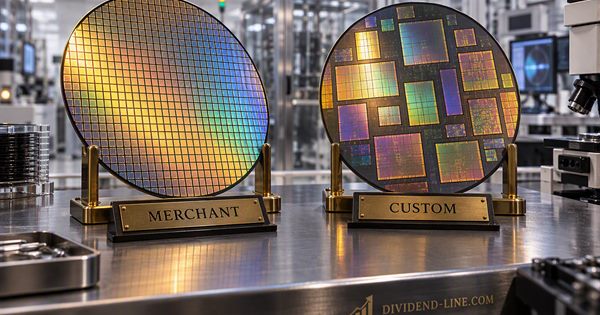
Broadcom or Nvidia: two ways to sell the same boom
Both are extraordinary businesses riding the same wave. They are not, however, the same investment — and the thing that separates them is a number you can count on one hand.
Is Costco overvalued? It has been for thirty years
Charlie Munger called the price the trouble with Costco and never sold a share. Both halves of that sentence are instructive, and most people only quote one.

Is JPMorgan still a fortress? The record quarter, taken apart
A bank is the one business where the balance sheet is the product. JPMorgan's just produced a record — and its own chairman told you why it will not repeat.

The patent cliff: how to price a loss you can see coming
A patent expiry is the rarest thing in investing: a large, certain loss with a date attached. Which is exactly why the market gets it wrong in both directions.

Is Nvidia's growth sustainable? One line in the accounts is trying to tell you
Nvidia earned in six months what it took the whole of last year to earn. That is not the interesting part. The interesting part grew faster than revenue did.

SpaceX is public. Its first 10-Q is not about rockets.
The SEC does not classify SpaceX as an aerospace company. It classifies it under data processing — and the first set of public accounts explains why.

Nike: what is actually going on?
The share price has halved and the explanations are all vibes: brand fatigue, On and Hoka, China. The accounts say something more specific, and it was hiding inside a headline everyone read as good news.

Can Adobe beat AI? The question already changed
The bear case used to be that AI makes Photoshop unnecessary. The September numbers retired that argument and replaced it with a duller, more dangerous one.

How do you run a business designed to shrink?
Every business school teaches growth. Almost none teach the harder discipline: how to run something profitable that will be smaller every year for the rest of its life.
Dividends & Income
Yield, safety, growth — and how to tell a durable payout from a trap.

Will VICI cut its dividend? The 2027 Caesars reset, in numbers
Two completely different things are being discussed as if they were one: a contractual clause that is small and knowable, and a negotiation that is neither.

When a Dividend King has a bad year
A long record does not stop bad years happening. It changes what they mean — and the work is separating the problems with an end date from the ones without.

When a dividend stops growing
Everyone watches for the cut. The far more common ending is quieter: the dividend is never cut, the streak is never broken, and the increases shrink to nothing.

What the year before a dividend cut looks like
Cuts feel sudden. They almost never are. In every case in our library the arithmetic ran out of room years before the board admitted it — in public, in the filings.

Do oil majors still belong in a dividend portfolio?
The dividend is paid by the barrel. The share price is set by events nobody can forecast. Owning one means accepting that those are two different things.

6% now or 2% growing: which one actually pays you more
Everyone says growth beats yield. The arithmetic agrees, and then adds a detail nobody mentions: it takes two decades, and most people are not investing for two decades.

The ex-dividend date, and why buying the day before doesn't work
Everyone learns the rule: own it before the ex-date and the dividend is yours. Almost nobody is told what the market does to the share price that same morning.

Monthly dividend stocks: what you gain, and what you pay for it
Twelve cheques a year instead of four is a genuine convenience. It is not a genuine edge — and the screen that starts with 'monthly' is selecting for something other than quality.

Why a REIT's payout ratio looks impossible
A payout ratio above 100% would be a red alert at any normal company. At a REIT it is the default, and the reason is an accounting entry that costs nobody a cent.

How to tell if a dividend is safe
A high yield is not a reward for patience — it is usually the market's way of saying it does not believe the payout. Here is how to check, in the order that matters.
Valuation
What a business is worth, and what you are being asked to pay for it.

How long you wait when you overpay
The punishment for buying a wonderful business too dear is not a loss. It is a decade of being right about the company and getting nothing for it.

How to value a cyclical
With a cyclical, the price-to-earnings ratio is lowest exactly when the shares are most dangerous — and highest when they are cheap. Here is the way round it.

Stock-based pay is a real cost
It is excluded from the figure the company leads with, excluded from most screens, and paid entirely by you. The cheapest fix in investing is to add it back.

When a wonderful business finally gets cheap
The thing every value investor says they are waiting for almost never looks like they imagined. It arrives attached to falling guidance, and it feels like a mistake.

Why a utility is not a bond substitute
Utilities get bought as bonds that grow. They are not bonds at all — and the three numbers a screener shows you about one are all category errors.

When a stock screener lies to you
A screener is a very fast way to be confidently wrong. The ratio can be right and the model wrong, the model right and the data wrong — and every failure tends to point the same way.

When buybacks destroy value
A buyback is not a reward to shareholders. It is the company buying its own stock — and like any purchase, everything depends on the price paid.

How much growth is already priced in?
People argue about whether a stock is expensive. The more useful question has an answer: what would have to be true for today's price to be right?

Three ways a stock falls 60%, and only one of them is a bargain
The question people ask is 'why is it down?'. The question that pays is 'which of the three kinds of down is it?' — because two of them are traps and they look identical from the outside.
Moats & Business Quality
Why some businesses keep their profits and others give them away.

A shortage is not a moat
Scarcity and pricing power produce identical numbers for a year or two. Then capacity arrives, and only one of them is still there.

What a brand is actually worth
A brand is not awareness, affection or a logo people recognise. It is a quantity: the price you can take without losing the customer. It shows up in two numbers.

What insurance float actually is
It is the idea Berkshire Hathaway was built on, and almost nobody explains it properly. Borrowed money is expensive. Float is money you are paid to keep.

Why no one can compete with ASML
Most moats are a matter of degree. This one is a matter of kind: there is no second supplier, there is no substitute, and there has been no serious attempt in twenty years.

Pricing power: the only part of a moat you can actually measure
Everyone claims a durable advantage. Inflation is the audit: it asks every company the same question at the same time, and the gross margin publishes the answer.

We scored 71 moats. Only three got full marks.
Everyone can define a moat. Far fewer can tell you which companies have one, which is why it is worth counting rather than theorising.
Portfolio & Temperament
Position sizing, holding periods, and the behaviour that decides returns.

How much cash should you hold?
Cash is not a forecast and it is not cowardice. It is an option on future prices — and for the first time in fifteen years, you are paid to hold it rather than charged.

The cost of waiting for a better price
Discipline is supposed to protect you. Sometimes it is simply a way of being right about a company and owning none of it, and the only honest thing is to price that too.

What insider buying actually tells you
It is the most over-read signal in investing. Insiders buy for reasons that have nothing to do with what the shares are worth — and the most famous buys are often the least informative.

The risk you cannot diversify away
Some risks get smaller when you own more things. A few do not get smaller at all, and for those there is exactly one tool — and it is not diversification.

When should you sell?
We have re-examined eight companies and lowered our score on six of them. Not one became a sell — and the reason is the most useful thing we have learned about selling.

How many stocks should you own?
The maths of diversification has a very clear answer, and almost nobody's portfolio reflects it — in either direction.

Why trading doesn't pay
Most arguments against trading are about psychology. The stronger argument is arithmetic, it is not close, and you can work it out on the back of an envelope.
Markets & Macro
Rates, cycles and sentiment — read as an owner, not a trader.

Does AI kill per-seat software?
If software is priced per person and the work stops needing people, the arithmetic looks grim. The place to check is not the theory — it is the renewal rate.

Should you just buy the index?
A research house is the last place you would expect an honest answer to this. So here is ours, with our own scorecard attached and nothing removed.

Who actually gets paid in the AI build-out
Enormous sums are moving. Following where they settle, rather than where they are announced, separates the businesses collecting cash from the ones committing it.

How to read a record quarter
Every record is made of two things: what you earned and what the tide gave you. Companies report the total. Separating them takes one subtraction.

What a 5% risk-free rate does to everything else
A hurdle rate is not an opinion. When the safest asset available pays 5.12%, every other asset has to explain itself — and most of ours currently cannot.

What 71 company reports say about this market
Forget whether the market is expensive. Our own scores say something more actionable: the gap between two companies in the same sector is twice the gap between sectors.

What is actually taking the return out of REITs
Property is supposed to be the simple part of a portfolio: buy buildings, collect rent, get paid. Three things sit between the rent and your return, and only one of them is in the news.