Verizon Communications
The business, in plain English
What it sells · who it competes with · what changed this year
Verizon sells connections: mobile phone plans on one of America's three national networks, home internet over fibre (its own Fios network, and since January the Frontier network it bought for $20 billion) and over its 5G wireless network, and services to businesses and governments. In 2025 it took in $138 billion and earned $17 billion. It is worth about $195 billion.
The American wireless market is effectively shared by three companies — Verizon, AT&T and T-Mobile — with cable companies selling mobile plans on Verizon's own network at the edges. That structure keeps prices rational most of the time. It does not produce growth: service revenue grows two or three per cent a year, and every new generation of network requires tens of billions of dollars of spending before it earns anything.
What changed is the management. Dan Schulman, formerly chief executive of PayPal, took over in October 2025, announced more than 13,000 job cuts within weeks, closed the Frontier purchase in January and in July delivered the best consumer second quarter for phone subscribers in five years.
★★ The yield, the debt — and the turnaround
Who pays the dividend, what it stands on, and whether the new CEO has changed the arithmetic
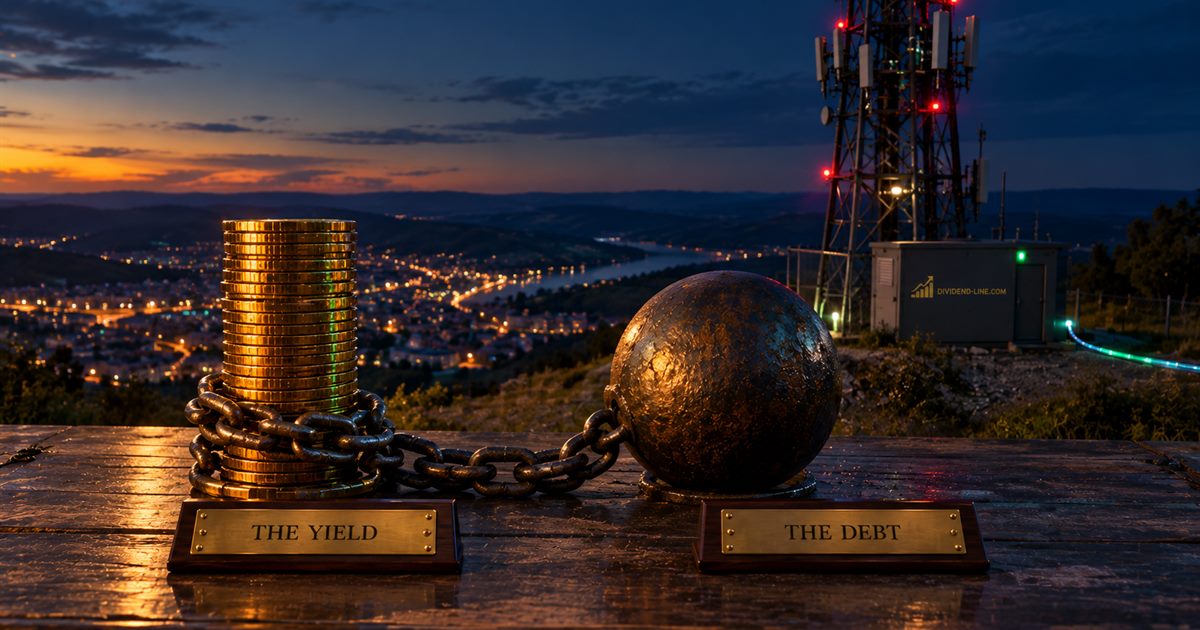
The yield is paid by the business. Verizon generated $20.1 billion of free cash flow in 2025 and paid $11.5 billion in dividends. For 2026 it guides to free cash flow growth of 9–10%, about $22 billion, against dividends of about $12 billion: cover of roughly 1.8 times. The one year it was not covered, 2022, was the year it rushed to build out the C-band spectrum it had bought for $45 billion. First-half 2026 free cash flow was $10.2 billion, up 16%.
But it stands on debt. Total debt, including leases, rose to $200.6 billion at the end of 2025 as Verizon raised money for Frontier; net unsecured debt was $128.7 billion in June, 2.5 times adjusted EBITDA, with interest covered about four times. Much of that debt paid for spectrum — the airwaves that are Verizon's most durable asset — and it is long-dated. Still, a company whose debts exceed the market value of its shares has less room to manoeuvre in a price war or a recession than its dividend suggests.
And the turnaround is real, so far. In the second quarter adjusted EBITDA grew 7.2% to a record margin of 40.1%, adjusted EPS grew 6.6% to $1.30, the company added 184,000 postpaid phone subscribers and 348,000 broadband customers, and guidance was raised for adjusted EPS ($4.99–5.04), free cash flow and phone net additions. Much of the improvement is cost: 13,000 fewer employees and less outsourced labour. Cost cuts can be done once; growth has to be earned every year.
What Buffett did
A telecom in Berkshire's portfolio, briefly
In the fourth quarter of 2020 Berkshire Hathaway bought about $8.6 billion of Verizon shares, a surprise for a man who had long avoided capital-hungry, regulated businesses. It had sold almost all of them by 2022. Berkshire never explained the trade at length, but the shape of it fits Buffett's long-held view of telecoms: essential services, reasonable returns, and a need for constant heavy investment that leaves little for owners to compound.
That is our view too. Verizon is a fine source of income for someone who needs income. It is not the kind of business whose value grows much faster than inflation over a decade, and its debt means an owner is, in effect, holding a leveraged position in American mobile service.
Management & ownership
Verified on the day of writing
Verizon's capital-allocation record is uneven: expensive detours into media (AOL and Yahoo, since sold at a loss) and a record $45 billion spectrum purchase in 2021 that has taken years to earn its return. The new management has made the dividend its first commitment — Schulman called it "ironclad" in June — and has restarted buybacks under a $25 billion authorisation, targeting up to $4.5 billion this year. Ownership is broad and institutional.
The numbers — and three things our feed gets wrong
Sourced from the live pull · TTM unless noted
| Metric | Value | Read |
|---|---|---|
| Revenue 2025 · Q2 2026 | $138.2bn · $34.3bn (−0.7%) | ◆ Service revenue +2.8% |
| Adjusted EPS Q2 · 2026 guide | $1.30 · $4.99–5.04 | ▲ +6–7% |
| Adjusted EBITDA margin, Q2 | 40.1% | ▲ A record |
| Free cash flow 2025 · H1 2026 | $20.1bn · $10.2bn (+16%) | ▲ Strong |
| Capex 2026 guide | $16.0–16.5bn | ◆ ~12% of revenue |
| Total debt incl. leases · net unsecured / EBITDA | $200.6bn · 2.5× | ▼ Heavy |
| Return on invested capital | 5.8% | ▼ About its cost of capital |
| What the feed says | Value | What is true |
|---|---|---|
| Trailing P/E | 12.2× | On GAAP EPS cut by severance and integration charges. On 2026 adjusted guidance, 9.3×. |
| DCF value | $94.41 | +103%. A model that ignores $200bn of debt and constant spectrum spending. Not used. |
| Altman Z-score | 1.22 ('distress') | Built for manufacturers; meaningless for a regulated network owner with long-dated debt and steady cash flow. |
The dividend
Twenty years of increases — slow, and covered
Verizon pays $0.7075 a quarter, $2.83 a year — a 6.1% yield. It has raised its dividend for twenty consecutive years, though slowly: the September 2025 increase was 1.8%, and in January 2026 the board raised it again by 2.5%, moving the annual increase to the start of the year.
Is it safe? On the cash, yes: about 55% of this year's guided free cash flow and about 56% of adjusted earnings. On the balance sheet, it depends on Verizon continuing to refinance $200 billion of debt at reasonable rates — which, for a company of its size and credit rating, it has always done. We would expect small increases every year and no cut, barring a severe shock. Do not expect growth: at 2–3% a year, the dividend roughly keeps pace with inflation.
| Dividend test | Value | Read |
|---|---|---|
| Dividends / 2026 FCF (guide) | ~55% | ▲ Covered ~1.8× |
| Payout of 2026 adjusted EPS | ~56% | ▲ Covered |
| Latest increase (Jan 2026) | +2.5% | ◆ Slow |
| Consecutive annual increases | 20 | ▲ Long record |
Risks, lawsuits & controversies
Verified afresh, 28 September 2026
First, leverage. Verizon must refinance large amounts of debt every year; higher interest rates for longer raise its costs and slow any deleveraging. The Frontier purchase added to the load just as the company was starting to reduce it.
Second, competition. T-Mobile and AT&T, and cable companies selling mobile service, all want the same customers. A price war would hit the margins that the new management has just improved.
Third, the courtroom. ① On 29 May 2026 a federal court in New Jersey dismissed the securities class action alleging Verizon misled investors about lead-sheathed cables left in its network, and closed the case. ② A separate class action on behalf of utility workers alleging lead exposure is pending. ③ Verizon agreed a $100 million settlement with consumers over administrative fees charged between 2016 and 2023. None is material to a company of this size, but the lead-cable issue could resurface through regulators.
★ Valuation
Cheap on cash — for good reasons
| Yardstick | Value | Reading |
|---|---|---|
| Share price · market value | $46.62 · ~$195bn | 52-week range $38.39–$51.68. |
| P/E — 2026 adjusted guide · 2027e | 9.3× · 8.9× | Consensus $5.26 for 2027. |
| Free cash flow yield (2026 guide) | ~11% | Before debt repayment. |
| EV / EBITDA | ~8.0× | Enterprise value ~$382bn including debt. |
| Our value range | ~$45–55 | 9–11× adjusted earnings; 9–11% FCF yield on ~$5.20 of FCF a share. |
| Street target (mean · range) | $48.58 · $46–52.50 | +4%. |
What does $46.62 assume? Very little: that the dividend continues and grows slowly, and that earnings creep up a few per cent a year. At today's price the owner's return is roughly the 6% yield plus 1–3% growth, minus whatever the debt costs if rates stay high. That is a good bond-like return with some equity upside — and some equity risk.
Some businesses compound. Others simply pay. Verizon is the second kind, and there is nothing wrong with that as long as you know which one you own.
It sells something almost everyone needs — a mobile connection — in a market it shares with two rivals, and it throws off about twenty billion dollars of free cash a year. It pays out a little over half of that as a dividend that has risen for twenty years in a row and yields six per cent at today's price. This year a new chief executive has cut costs hard, bought a large fibre network, and delivered the best quarter for new phone customers in five years. The numbers are moving in the right direction for the first time in a while.
Now the other side. Verizon owes about two hundred billion dollars — more than the whole company is worth on the stock market. Much of that paid for airwaves that will be valuable for decades, and the lenders are patient. But debt of that size means that when something goes wrong — a price war, a recession, a spike in interest rates — the shareholders feel it first. And the business grows slowly; you should expect the dividend to keep pace with inflation, not to beat it.
Berkshire owned Verizon for less than two years and left. I understand why. It is not the kind of business in which you want to put a great deal of capital for a long time. It is, however, a perfectly respectable place to collect a six per cent income, covered almost twice by cash, while a capable new management tidies the house.
Own it for the income, in moderation. Do not expect growth. If the market offers it near forty dollars — a seven per cent yield — buy more with both hands.
— The Buffett Lens · Dividend Line Research · collecting the rent on the airwaves, watching the mortgage
Not for GrowthA 6.1% dividend, raised for 20 years and covered ~1.8× by free cash flow, with a new CEO lifting margins and guidance — at 9.3× adjusted earnings, in the lower part of our ~$45–55 range. But $200bn of debt and 2–3% growth make it an income holding, not a compounder. Own it in moderation; buy more near ~$40 (7% yield). Q3 results in late October.
Articles that take this apart

You've just read Verizon Communications the way we read every company.
The terminal that produced these numbers is free to use: 30 years of statements drawn as flows, a screener built around moats, Buffett's Desk, and an earnings feed read through the same lens. Opening an account takes a minute. No card.