Taiwan Semiconductor Manufacturing
The business, in plain English
What a foundry does · why everyone depends on this one
TSMC does not design chips. It makes them for the companies that do — NVIDIA, Apple, AMD, Broadcom, Qualcomm and hundreds more — which is why it is called a foundry. It founded the model in 1987, and at the leading edge it has since become almost the only practical choice: the most advanced processors in the world's phones and in the data centres training artificial intelligence are, overwhelmingly, made in its factories in Taiwan.
In the second quarter of 2026 it sold $40.2 billion of wafers and services, kept 67.7% as gross profit and 55.6% as net profit — margins more usual in software than in manufacturing. It is worth about $2.3 trillion at the ADR price. Each New York-listed share (ADR) represents five shares traded in Taipei.
★★ The moat, the customers — and the map
Why the lead is so wide, who pays for it, and where it is built
The moat, in nanometres. In the second quarter, 77% of TSMC's wafer revenue came from processes of 7 nanometres or smaller: 3nm (30%), 5nm (33%), 7nm (11%) and the first 2nm wafers (3%), which ramp steeply from the third quarter. At these nodes a competitor needs not just money but a decade of accumulated know-how in yields — how many good chips come off each wafer. Samsung and Intel have spent enormous sums trying; neither has taken meaningful leading-edge share from TSMC. When the customer's product is a $30,000 AI accelerator, a few points of yield matter more than any discount.
The customers are American. By headquarters, customers in the United States accounted for about 82% of TSMC's 2025 revenue; China, 9.5%. The AI boom is TSMC's boom: revenue in August 2026 was a record NT$514.8 billion, up 53% on a year earlier, and management now expects 2026 revenue to grow slightly above 40% in dollars.
The price of staying ahead. TSMC expects to spend $60–64 billion on capital this year — more than a third of revenue. It can afford it: operating cash flow covers capital spending with room left for a growing dividend, and the balance sheet holds more cash than debt. But the moat is not a gift of nature; it is dug again every year, and the day the spending stops earning its return, the margins will tell us.
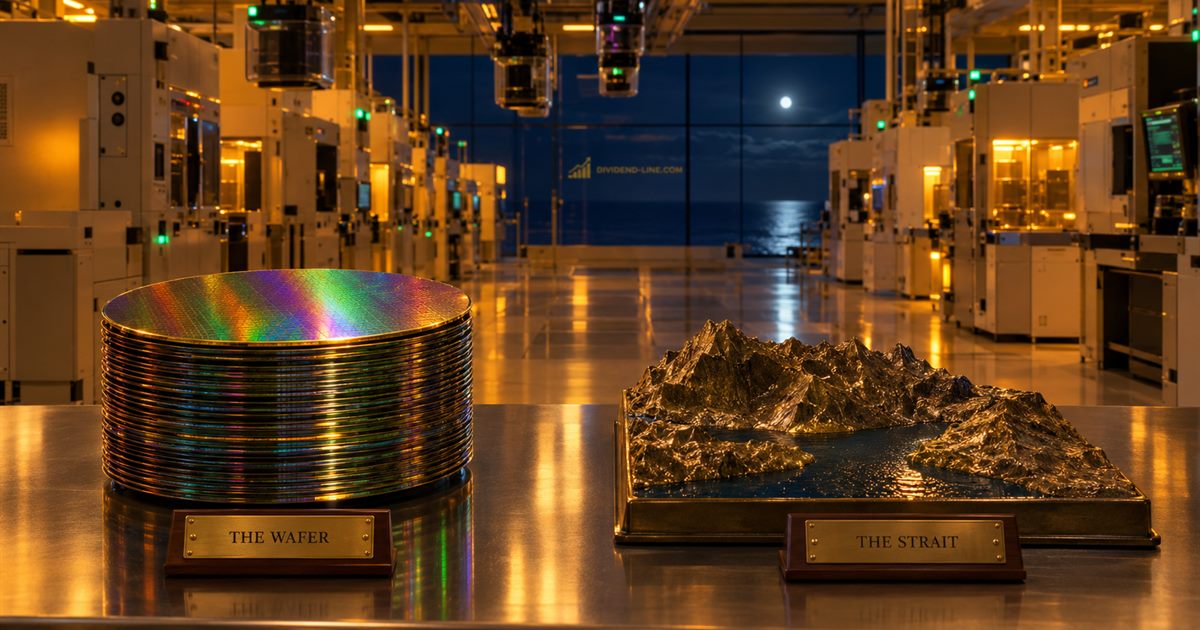
★ The map. The leading-edge fabs are in Taiwan, across a strait about 130 kilometres wide at its narrowest from mainland China, whose government claims the island and whose forces rehearsed encircling it as recently as December 2025. TSMC is building abroad — a US commitment raised this year to $265 billion for twelve fabs and packaging plants in Arizona, plus plants in Japan and Germany — but the most advanced processes will stay concentrated at home for years.
What Buffett did
The purchase, the sale, and the one-word reason
In the third quarter of 2022 Berkshire Hathaway bought about $4 billion of TSMC ADRs. Within two quarters it had sold nearly all of them. Asked why, Buffett praised the company as one of the best-managed and most important in the world — and said he did not like its location. He did not change his view of the business; he decided that the one risk he could not assess was large enough to matter.
That is the whole question for an owner today. There is no model that assigns a sensible probability to a blockade or an invasion, and no margin of safety in the price can protect against it if it happens: the fabs could not simply be moved, and shareholders would face a loss that no diversification inside the stock could offset. What an owner can control is how much of their portfolio depends on it. That is why our verdict speaks of position size, not only of price.
- That no blockade or conflict closes the Strait during your holding period — or that you have sized the position so that it would not ruin you if one did.
- That TSMC keeps its lead at 2nm and beyond, with yields rivals cannot match.
- That AI demand, which now drives most of the growth, does not collapse into a capacity glut.
- That the Arizona build-out earns acceptable returns despite higher costs than in Taiwan.
Management & ownership
Verified on the day of writing
TSMC's management has a long record of under-promising and delivering, of pricing discipline, and of refusing to compete with its customers by designing chips of its own — the neutrality that makes it everybody's foundry. Taiwan's National Development Fund, a government investment vehicle, is the largest single shareholder with about 6%; the rest is widely held, much of it by foreign institutions.
The numbers — in the right currency — and four things our feed gets wrong
Per-ADR figures in US$ from TSMC's releases; consensus converted at NT$32
| Metric | Value | Read |
|---|---|---|
| Revenue, Q2 2026 · 2026 guidance | $40.2bn · growth slightly above 40% | ▲ AI-driven |
| Gross · operating · net margin, Q2 | 67.7% · 60.3% · 55.6% | ▲ Exceptional |
| Q3 2026 guidance | $44.6–45.8bn · GM 65–67% | ◆ 2nm ramp dilutes margin |
| EPS per ADR — TTM · Q2 2026 | $13.86 · $4.31 | ▲ Q3'25 was $2.92 |
| Return on invested capital | 27% | ▲ While spending a third of revenue |
| Net cash · interest cover | Yes · 285× | ▲ Fortress |
| Capex 2026 guidance | $60–64bn | ◆ ~37% of revenue |
| What the feed says | Value | What is true |
|---|---|---|
| EPS, revenue, estimates | 'EPS 333.05' | In New Taiwan dollars, per five-share ADR equivalent. In US$, 2025 EPS per ADR was roughly a thirtieth of that. |
| 52-week high | $390.21 | Stale: the ADR closed at $451.95, a record. |
| DCF value | $130 | Mixes a NT$ cash-flow model with a US$ ADR price. Not used. |
| Largest owners | TSMC entities, BlackRock | The feed lists US filings only; Taiwan's National Development Fund (~6%) does not appear. |
The dividend
Small, rising and quarterly
TSMC pays quarterly. The board declared NT$7.00 a share for each of the first two quarters of 2026 — NT$35 per ADR, about $1.09 at NT$32 — and the ADR dividend paid in September was $1.11. At today's price that is a yield of about 1%. The dividend has risen steadily (the ADR received $0.48 at the end of 2024), and it takes only about a quarter of earnings: safe by any measure. It is not why one owns TSMC; it is a sign of a company that generates more cash than even $60 billion of capital spending can absorb.
ADR dividends are paid in US$ after conversion and may be subject to Taiwanese withholding tax; the US$ amount moves with the exchange rate.
Risks, probes & controversies
Verified afresh, 28 September 2026
First, geography — discussed in Parts II and III. We do not put a probability on it; we size for it.
Second, the AI cycle. Revenue growth of 40% is driven by accelerators for data centres. Chip history is a history of capacity booms followed by gluts; TSMC is more disciplined than most, but its biggest customers' spending plans are not guaranteed.
Third, Washington. In January 2026 the United States imposed a 25% Section 232 tariff on certain high-performance chips, with broad exemptions, and a US–Taiwan agreement cut the general tariff on Taiwanese goods from 20% to 15% in exchange for US$250 billion of Taiwanese investment; companies building US capacity may import up to 2.5 times that capacity duty-free during construction. TSMC's $265 billion Arizona plan is, among other things, its insurance policy against tariffs. Separately, Reuters reported in April 2025 that TSMC could face a penalty of $1 billion or more to settle a US export-control investigation after a chip it made for China's Sophgo turned up in a Huawei AI processor; we found no public resolution.
★ Valuation
A fair price for the business; the discount for the map is yours to choose
| Yardstick | Value | Reading |
|---|---|---|
| ADR price · market value | $451.95 · ~$2.3tn | A record high. |
| P/E per ADR — TTM · 2026e · 2027e · 2028e | 32.6× · 27× · 21× · 16.5× | Consensus $16.7, $21.8, $27.3 per ADR at NT$32. |
| ADR premium to Taipei shares | ~15% | NT$2,475 a share in Taipei × 5 ÷ ~31.5 ≈ $393 per ADR equivalent. |
| Free cash flow yield | ~1.6% | After ~$47bn of capex in the last year. |
| Our value range | ~$420–520 | 20–24× 2027 earnings, trimmed for geography and the cycle. |
| Street target (mean · range) | $578 · $500–700 | +28%. |
What does $452 assume? That earnings per ADR roughly double between 2025 and 2028, as analysts expect, and that nothing happens in the Strait. The first assumption has strong evidence behind it. The second is a matter of judgement, and it is the reason a business of this quality trades at 21 times two-year-forward earnings rather than 30. Buy the business at a fair price; buy the geography only in a size you can live with.
If you asked me to name the most important factory in the world, I would not hesitate. It is TSMC's. Nearly every advanced chip — in your phone, in your car, in the data centres that answer questions put to artificial intelligence — is made there. The companies whose names you know design those chips; this company, which most people have never heard of, makes them.
As a business it is close to perfect. It keeps two-thirds of every dollar of revenue as gross profit. It grows at forty per cent a year. It has more cash than debt. And its lead over its rivals, measured in the few billionths of a metre that separate one generation of chip from the next, has survived tens of billions of dollars spent trying to close it. I cannot think of a manufacturing business with a wider moat.
Warren Buffett thought so too. Berkshire bought about four billion dollars' worth in 2022 and sold nearly all of it within months. His explanation was one word: location. He did not doubt the company. He doubted the map.
I think he was right to take the question seriously and I do not think it has gone away. The most advanced fabs sit on an island that its large neighbour claims, and no price, however low, protects you if that dispute turns violent. What you can control is how much of your wealth depends on the answer.
So here is my advice. At four hundred and fifty-two dollars, TSMC is fairly priced for what it is — about twenty-one times what analysts expect it to earn in 2027. Accumulate, but keep it to a size whose loss you could bear. If the market offers it near three hundred and eighty, add with both hands. And read the geopolitical news as carefully as the earnings.
— The Buffett Lens · Dividend Line Research · admiring the factory, respecting the map
But Size It for the StraitOne of the finest businesses in the world — 67.7% gross margins, revenue +40%, net cash, a lead rivals cannot close — at a fair price, ~21× 2027 earnings, in the lower third of our ~$420–520 range. The risk is not the business but the geography, which no price protects against. Accumulate in a position small enough to survive a crisis; add with both hands near ~$380. Q3 results on 15 October.
You've just read Taiwan Semiconductor Manufacturing the way we read every company.
The terminal that produced these numbers is free to use: 30 years of statements drawn as flows, a screener built around moats, Buffett's Desk, and an earnings feed read through the same lens. Opening an account takes a minute. No card.