Prologis
The business, in plain English
What it owns · who pays · how the money is made
Prologis is a landlord. It owns and manages about 1.3 billion square feet of logistics buildings — the big, plain warehouses near ports, motorways and cities where goods wait between the factory and the shop or the doorstep — across 5,929 buildings in 20 countries. Its tenants are retailers, online sellers, carriers and manufacturers. It is worth about $124 billion, the largest industrial landlord in the world.
It makes money three ways. Rent, from the buildings it owns outright. Fees, from managing billions of dollars of buildings in investment funds it runs for pension funds and sovereign investors ("strategic capital"), in which it also keeps a stake. And development: building new warehouses — and now data centres — on land it owns, then either keeping them or selling them into its funds at a profit.
As a real estate investment trust (REIT), it must pay out most of its taxable income as dividends, and it is judged not on earnings per share, which are distorted by depreciation and property sales, but on funds from operations (FFO) — roughly, the cash its buildings throw off. We follow that convention below.
★★ What it owns — and the rent still to come
The portfolio market by market, the gap between today's leases and today's market, and the new business on old land
Where it is. Every tile above is a market, sized by the square feet Prologis owns and manages there (hover over a tile for the figures). The United States is 63% of the space, and Prologis's own balance sheet — as distinct from its funds — is 96% American by book value. The largest single market is Southern California, 127 million square feet around the ports of Los Angeles and Long Beach and the Inland Empire; with the San Francisco Bay Area and the Central Valley, California produces 31.9% of Prologis's consolidated net operating income. Abroad, the portfolio sits mostly in its funds: Mexico, the big European logistics corridors, Japan and China.
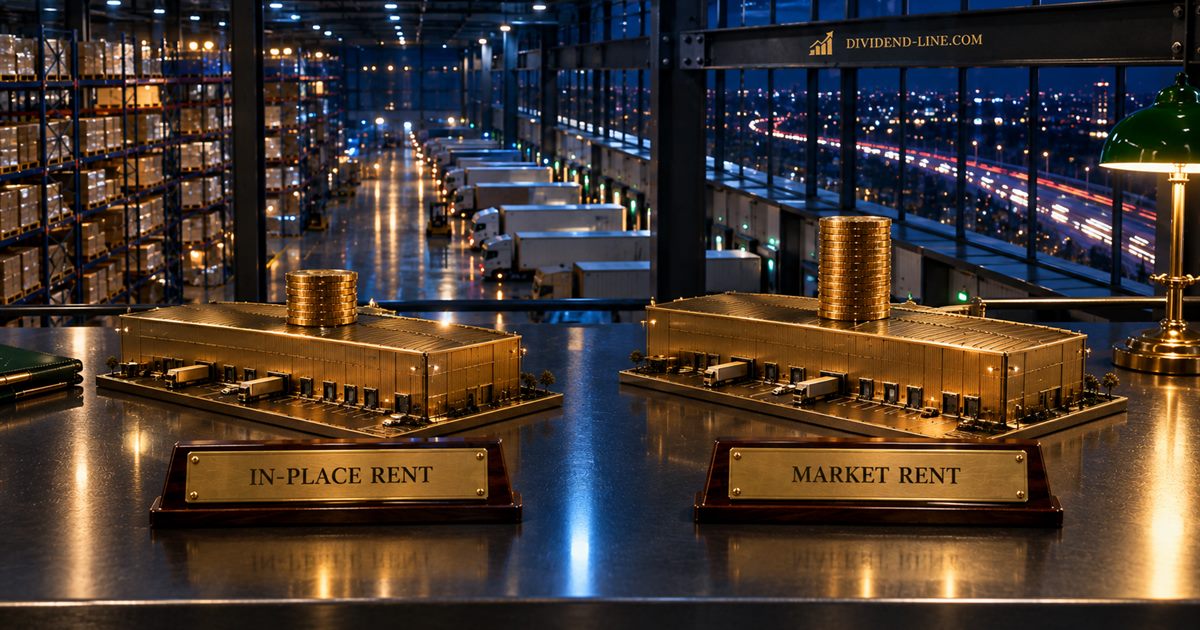
The rent still to come. A warehouse lease runs for years. When market rents rise faster than leases roll, a gap opens between what tenants pay and what the same space would fetch today. At Prologis that gap — the lease mark-to-market — was 17% at the end of June, worth about $750 million of annual net operating income at today's rents. It is income that does not depend on the market rising further, only on leases expiring, which they do every year. In the second quarter, leases that rolled were re-priced 30.4% higher on a net effective basis (17.0% in cash), and occupancy rose to 95.5%.
The gap is narrower than it was; rents in several markets, Southern California above all, fell from their 2022 peaks as new supply arrived. That is why same-store income is growing about 7% this year rather than faster. But a landlord that can raise rents by double digits on every lease it renews, in a market that is tightening again, is in a very comfortable place.
The new business on old land. Modern data centres need what Prologis has — large sites near cities — and, above all, power. Prologis has secured 1.6 gigawatts of electricity connections, including 680 MW on projects under construction, with a further 4.2 GW at an advanced stage. Its new chief executive has called data centres one of the largest value-creation opportunities in the company's history. They are typically built for a handful of very large tenants; the risk is that they are a different business from warehouses — bigger cheques, fewer tenants, and local opposition that has already reached the courts.
The moat
Land that cannot be made again
A warehouse is not hard to build. A warehouse in the right place is: near the ports, inside the ring roads, close to the people who order things in the morning and expect them by evening. Those sites are finite, zoning is slow, and the best of them were bought decades ago. Prologis has been assembling them since 1983, and it owns more of them, in more of the markets that matter, than anyone else.
Scale adds more. Tenants who operate across countries can sign with one landlord; Prologis's funds give it cheap capital and fee income; its size lets it borrow at a weighted average rate of about 3.3% with nearly eight years to maturity. We score the moat 9: the one thing that would weaken it is a long period of too much new supply, which the last two years showed can happen but does not last.
Management & ownership
Verified on the day of writing
The succession was planned for years and executed calmly — the way it should be done. Capital allocation has been disciplined through the cycle: selling or contributing mature buildings to its funds ($1.13 billion in the second quarter alone) and recycling the money into development at higher yields. Ownership is led by BlackRock (10%) and Vanguard. The executive chairman sold 50,000 shares at about $150 in July; after four decades of building the company, we read that as ordinary diversification.
The numbers, the REIT way — and four things our feed gets wrong
Core FFO, occupancy and rents · TTM unless noted
| Metric | Value | Read |
|---|---|---|
| Core FFO per share — Q2 2026 · 2026 guide | $1.63 · $6.22–6.30 | ▲ +11.6% in Q2 (+8.8% without promotes) |
| Occupancy (owned & managed) | 95.5% | ▲ Up 0.2 points in the quarter |
| Rent change on rollover — net effective · cash | +30.4% · +17.0% | ▲ Still double digits |
| Lease mark-to-market | 17% (~$750m NOI) | ▲ Growth already contracted |
| Same-store NOI growth, 2026 guide (cash) | 6.75–7.25% | ▲ Solid |
| Net debt / EBITDA · weighted rate · maturity | 4.2× · 3.3% · 7.9 yrs | ◆ Moderate leverage, cheap and long |
| Liquidity | $7.6bn | ▲ Ample |
| What the feed says | Value | What is true |
|---|---|---|
| P/E | 29.6× | GAAP EPS for a REIT includes property-sale gains and depreciation. On 2026 Core FFO guidance, 21.3×. |
| Capital spending / FCF | $0 · 'FCF' = OCF | Development spending of billions a year sits in investing lines the feed does not map to capex; its free cash flow is overstated. |
| Dividend payout | 93% | Of GAAP EPS. Of 2026 Core FFO, about 68%. |
| Altman Z · DCF | 1.99 · $88 | Neither model is built for a landlord with long leases and appraised assets. Not used. |
The dividend
Paid from rent, and the rent is rising
Prologis pays $1.07 a quarter, $4.28 a year — a 3.2% yield — after a 5.9% increase in February. As a REIT it must distribute most of its taxable income, so the dividend tracks the growth of its rental cash flow.
Is it safe? Yes. It takes about 68% of this year's guided Core FFO, leaving room to fund development and absorb a slower year. The rent gap described in Part II is the best guarantee of future increases: much of the next few years' income growth is already written into leases that will reset at higher rents.
| Dividend test | Value | Read |
|---|---|---|
| Payout of 2026 Core FFO (midpoint) | ~68% | ▲ Covered |
| Increase, Feb 2026 | +5.9% | ▲ Growing |
| Payout of GAAP EPS | 93% | ◆ The wrong yardstick for a REIT |
Risks, lawsuits & controversies
Verified afresh, 27 September 2026
First, concentration. Nearly a third of Prologis's own income comes from California, and Southern California rents fell from their 2022 peak as new supply arrived and port volumes wavered. A long slump in trade through Los Angeles and Long Beach would hurt more here than anywhere.
Second, the data-centre pivot. Powered land is valuable, but data centres are bigger, more specialised projects with fewer, larger tenants, and they have become a political issue. In Coweta County, Georgia, residents filed an appeal on 5 May 2026 against the rezoning that approved Prologis's "Project Sail" data-centre campus; in Washington Township, Michigan, Prologis withdrew a 312-acre rezoning request in May after local opposition. Neither is material to a $124 billion company; both show that the path from powered land to finished data centre runs through town halls and courtrooms.
Third, interest rates. REITs are valued against bond yields. Prologis's own debt is cheap and long, but higher rates for longer would weigh on the value investors put on its buildings.
★ Valuation
A wonderful landlord at a fair price
| Yardstick | Value | Reading |
|---|---|---|
| Share price · market value | $133.05 · ~$124bn | 52-week range $111.03–$153.35. |
| Price / 2026 Core FFO (midpoint $6.26) | 21.3× | For income growing high single digits with the rent gap still to collect. |
| Dividend yield | 3.2% | Covered ~1.5× by Core FFO. |
| Our value range | ~$125–150 | 20–24× 2026 Core FFO — the premium Prologis's quality and growth have usually earned (approx.). |
| Street target (mean · range) | $155.15 · $135–170 | +16.6%. |
What does $133 assume? That Core FFO keeps growing in the high single digits as the rent gap is collected, that occupancy holds near 95%, and that data centres add value slowly rather than transforming the company. Add the 3.2% yield and an owner can reasonably expect about 9–11% a year. If data centres succeed on the scale management hopes, that is conservative; if California stumbles, it is about right.
I have always liked businesses whose future income is written down in advance. Prologis is one. It owns the warehouses that stand between the world's ports and its front doors — more of them, in better places, than anyone else — and it rents them on leases that run for years.
Here is the pleasant arithmetic. Rents for warehouse space rose sharply after 2020. Leases signed before then are still paying the old rent. On average, Prologis's tenants pay about seventeen per cent less than the same space would cost today. Every year, a slice of those leases expires and is re-signed at the market rate — in the second quarter, at thirty per cent more. That gap is worth about seven hundred and fifty million dollars a year of extra income, and collecting it requires nothing more heroic than waiting.
There is a second story forming. Data centres need large sites near cities and, above all, electricity. Prologis has the sites, and has lined up nearly six gigawatts of power. It may become a meaningful business; it may also prove harder than warehouses, and neighbours are already objecting in court. I would treat it as a free option on a business I already like, not as the reason to buy.
What to watch: California, which provides almost a third of Prologis's own income and where rents have softened; the pace at which the rent gap narrows; and interest rates, against which every landlord is measured.
At a hundred and thirty-three dollars you pay about twenty-one times this year's cash earnings, with a dividend of more than three per cent that covers comfortably and keeps rising. That is a fair price for a wonderful landlord. Under our own rule, we do not ask you to wait for a bargain. Accumulate — and if the market offers it near a hundred and fifteen, buy with both hands.
— The Buffett Lens · Dividend Line Research · collecting the rent that is already written
Collect the Rent That Is Already WrittenThe world's best logistics landlord at 21.3× 2026 Core FFO, in the lower half of our ~$125–150 range, with a 3.2% yield covered 1.5 times. Tenants pay 17% below market, so growth is contracted as leases roll; data centres (5.8 GW of power in the pipeline) are an option on top. Watch California and rates. Accumulate; buy with both hands near ~$115. Q3 results mid-October.
You've just read Prologis the way we read every company.
The terminal that produced these numbers is free to use: 30 years of statements drawn as flows, a screener built around moats, Buffett's Desk, and an earnings feed read through the same lens. Opening an account takes a minute. No card.