Procter & Gamble
The business, in plain English
What it sells · why people keep buying it · where it earns
Procter & Gamble makes the things you run out of: laundry detergent (Tide, Ariel), nappies (Pampers), toilet paper and kitchen towels (Charmin, Bounty), razors (Gillette), toothpaste (Crest, Oral-B), shampoo (Pantene, Head & Shoulders), cold medicine (Vicks). Nobody buys them for excitement. Everybody buys them again next month. In the year to June 2026 that produced $87.0 billion of sales and $16.0 billion of profit, and the company is worth about $348 billion.
Its edge is not a secret formula but a system: brands that lead their categories in most of the countries where they sell, an enormous research budget spent on small, real improvements customers notice, and the scale to buy advertising, shelf space and raw materials more cheaply than anyone else. When a shopper pays a little more for Tide than for a store brand, it is because Tide has, over decades, earned the right to that premium.
★★ Price, volume — and a war on the cost line
What grew, what did not, and what fiscal 2027 has to absorb
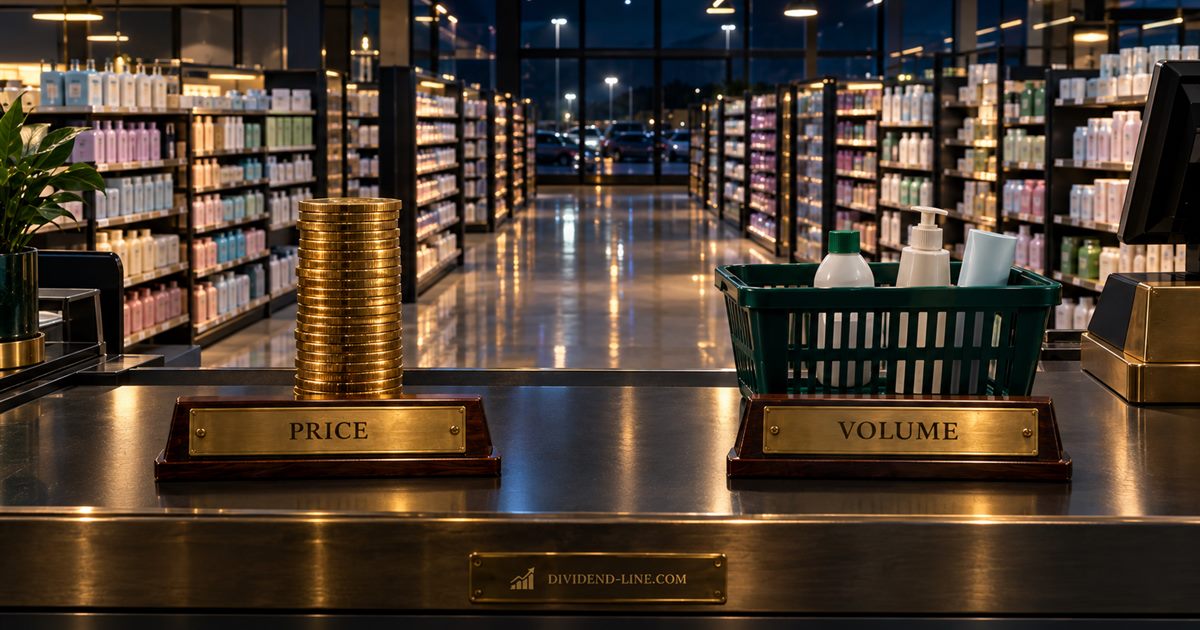
A year of standing still. In fiscal 2026 P&G's organic sales — stripping out currency and acquisitions — grew 1%, and all of it came from higher prices; volume and mix were unchanged. In the fourth quarter, to June, organic sales were flat on every line: no volume, no price, no mix. Only Beauty grew meaningfully. Reported sales rose 3% for the year, but two points of that was the weaker dollar. The chief executive called it, fairly, "a year of foundation building".
For a business like this, volume is the truer signal. Price can be raised for a while on the strength of a brand; volume tells you whether households are still putting the product in the basket. Two things are pressing on it: shoppers stretched by several years of price increases trading down to cheaper brands in some categories, and a deliberate pruning of weaker brands and markets under the restructuring P&G announced in June 2025 — about 7,000 non-manufacturing jobs over two years, with $749m of charges in fiscal 2026.
Then the war. P&G's guidance for fiscal 2027 includes about $1 billion after tax of higher costs for raw materials, energy and transport — much of it tied to oil, through the resins, chemicals and diesel that go into making and moving a bottle of detergent. With higher interest costs, lower non-operating income and currency, the headwinds come to $0.56 a share, about 8% of earnings. The other side of our ExxonMobil report is here: the same Brent near $100 that fills an oil company's cup empties some of a soap maker's.
★ And yet guidance still grows. P&G expects core earnings per share of $6.89–7.11, flat to +3%, after absorbing the $0.56. That means its own savings, pricing and growth are expected to add about $0.67 a share — the sign of a business that can defend its profits in a bad year, which is exactly what a wonderful business should be able to do.
The moat
Why a store brand is not enough
P&G's moat has three layers. Brands that households trust for things that matter to them — a nappy that does not leak, a detergent that gets the stain out. Innovation that is unglamorous but relentless, so that the product on the shelf is usually a little better than the one it replaced. And scale: in advertising, in retail relationships, in purchasing, in distribution across some 180 countries.
The moat is proven by margins that competitors cannot match — a gross margin of about 50% and an operating margin near 23% on everyday products — and by returns on capital of about 16%. Its weak point is the one this year exposed: in a world where shoppers are squeezed, the premium over store brands has to be earned again every year. We score it 9, not 10, for that reason.
Management & ownership
Verified on the day of writing
P&G promotes from within and changes chief executives in an orderly way; this one was announced in July 2025, six months before it took effect. Capital allocation is conservative and predictable: the dividend first, buybacks with most of the rest, few large acquisitions. Ownership is broad and institutional, led by the index funds. Insider transactions in September were routine grants of stock awards to executives and directors, not purchases or sales.
The numbers — and three things our feed gets wrong
Sourced from the live pull · fiscal years to June
| Metric | Value | Read |
|---|---|---|
| Net sales FY26 · organic growth | $87.0bn · +1% | ◆ Price +1%, volume 0% |
| Core EPS FY25 → FY26 → FY27 guide | $6.83 → $6.89 → $6.89–7.11 | ◆ Flat to +3% |
| Gross · operating margin | 50.2% · 22.7% | ▲ Premium economics |
| Return on invested capital | 15.7% | ▲ High for its size |
| Adjusted free cash flow FY26 | $15.8bn (100% of earnings) | ▲ Converts fully |
| Net debt / EBITDA · interest cover | 1.2× · 22.5× | ▲ Conservative |
| Dividends · buybacks FY26 | $10.2bn · $5.0bn | ◆ 96% of FCF returned |
| What the feed says | Value | What is true |
|---|---|---|
| Trailing P/E (GAAP) | 21.7–22.1× | Includes $749m of restructuring charges. On core EPS ($6.89) it is 21.2×. |
| DCF value | $188.95 | +29% — and the same model says Coca-Cola is 18% overvalued. For steady compounders it is too sensitive to its growth input. Not used. |
| Largest holder | Vanguard 7.5% and 10.0% | Two filings by different Vanguard entities at different dates, not two holdings. |
The dividend
Seventy years — and the cash to make it seventy-one
In April P&G raised its quarterly dividend by 3% to $1.0885 — $4.35 a year, a 3.0% yield — its 70th consecutive annual increase. It has paid a dividend every year since 1890. Only a handful of American companies have a longer record of increases.
Is it safe? Entirely. The dividend takes about 62% of the core earnings guided for fiscal 2027, and about $10bn of the ~$14.5bn of free cash flow the company expects. P&G returns nearly all the rest through buybacks, which gives it a cushion: in a hard year, buybacks can shrink long before the dividend is touched. The risk to the dividend is not a cut but slower increases — this year's 3% was below the 5% of 2025, in line with earnings that are barely growing.
| Dividend test | Value | Read |
|---|---|---|
| Payout of FY27 core EPS (midpoint) | ~62% | ▲ Covered |
| Dividends / FY27 free cash flow (approx.) | ~69% | ▲ Covered, before buybacks |
| Increase, April 2026 | +3% | ◆ Slower than 2025's 5% |
| Consecutive annual increases | 70 | ▲ Dividend King |
Risks, lawsuits & controversies
Verified afresh, 27 September 2026
First, volume. A year of flat volume is not a crisis; two or three would be. If shoppers keep trading down, P&G will have to choose between price and share, and either choice slows earnings. Fiscal 2027 guidance of 1–3% organic growth assumes some recovery.
Second, costs. About $1bn after tax of higher raw-material, energy and transport costs is built into guidance; a longer or wider war in the Gulf would add more. P&G has absorbed shocks of this kind before, largely by raising prices — which brings us back to volume.
Third, the courtroom — small. P&G was among the makers of cold medicines sued after an FDA advisory panel concluded in 2023 that oral phenylephrine, used in some Vicks products, does not work as a decongestant. A federal court dismissed the consolidated case in 2024; on appeal the Second Circuit largely agreed but revived some claims about "maximum strength" labels. We see no litigation that is material to a company of this size.
★ Valuation
A fair price for a wonderful business — at the bottom of our range
| Yardstick | Value | Reading |
|---|---|---|
| Share price · market value | $146.23 · ~$348bn | 52-week range $137.62–$167.25. |
| P/E — core FY26 · FY27 guide | 21.2× · 20.9× | Below the ~24–25× it has often commanded in the last five years (approx.). |
| Free cash flow yield (FY26) | 4.6% | $15.8bn adjusted FCF on ~$348bn. |
| Dividend yield | 3.0% | High for P&G. |
| Our value range | ~$145–170 | 21–24× FY27 core EPS; cross-checked with FCF growing ~4% a year at an 8–8.5% required return. |
| Street target (mean · median) | $157.78 · $162 | Range $142–172. |
What does $146 assume? That P&G returns to 3–5% earnings growth once the restructuring is done and costs stop rising, and that volume recovers at least modestly. Add the 3% yield and an owner can expect roughly 7–8% a year with unusual reliability. If volume keeps shrinking, the multiple will not recover and the return falls toward the yield plus a little. That is the whole bet — and at 21 times, it is a reasonable one.
Procter & Gamble sells things nobody gets excited about and everybody buys again. That is the finest kind of business there is, and P&G is one of the finest examples of it: seventy years of dividend increases, margins its rivals envy, and brands that households have trusted for generations.
This year it stood still. Sales grew one per cent, and every bit of that came from charging more; households did not buy a single extra bottle. Now a war in the Gulf has made the oil, resin and diesel that go into its products about a billion dollars dearer. A new chief executive is in the chair, in the middle of cutting seven thousand jobs.
That is a list that would frighten some investors. I find it rather reassuring, for two reasons. First, even with a billion-dollar cost increase, P&G expects its earnings to hold steady or grow a little. A business that can do that in a bad year is a business with real pricing power and real efficiency. Second, the market has noticed the bad news and marked the shares down thirteen per cent from their high, to about twenty-one times earnings — less than P&G has cost for most of the past five years, with a three per cent dividend that has been paid every year since 1890.
What I would watch is not the coins but the basket. Prices can be raised for a while on the strength of a brand. Volume tells you whether people are still choosing it. If volume comes back this year, even a little, today's price will look like a gift. If it keeps slipping, P&G will still be a fine business, but a slower one.
Under our own rule, a wonderful business at a fair price is to be bought, not waited on. Accumulate. And if the market offers it near a hundred and thirty-five dollars, buy with both hands. The first-quarter results arrive on the twenty-second of October; look first at the volume line.
— The Buffett Lens · Dividend Line Research · watching the basket, not the coins
Watch the Basket, Not the CoinsOne of the finest consumer franchises in the world at ~21× earnings — the bottom of our ~$145–170 range — with a 70-year dividend yielding 3.0%. Growth stalled in FY26 (organic +1%, all price) and FY27 absorbs ~$1bn of war-inflated costs, yet guidance still grows. A wonderful business at a fair price: accumulate; buy with both hands near ~$135. Q1 FY27 results on 22 October — read the volume line first.
You've just read Procter & Gamble the way we read every company.
The terminal that produced these numbers is free to use: 30 years of statements drawn as flows, a screener built around moats, Buffett's Desk, and an earnings feed read through the same lens. Opening an account takes a minute. No card.