Oracle
The business, in plain English
Two companies under one name, pulling in opposite directions on the cash
The first Oracle sells database software and business applications. When a bank records a transfer, an airline sells a seat or a government pays a pension, there is a good chance an Oracle database stores the record. Customers pay a licence and then, every year, a support fee of roughly a fifth of it, which they almost never stop paying because moving decades of critical data is risky, expensive and nobody's idea of a promotion. That business, together with Oracle's cloud applications (NetSuite, Fusion, healthcare software from Cerner), brings in roughly $39bn a year at very high margins.
The second Oracle rents computing power — Oracle Cloud Infrastructure, OCI — and has become one of the main builders of data centres for artificial intelligence. It grew 121% last quarter to $7.4bn. To serve that demand, Oracle expects to spend $90–95bn on capital projects in the year to May 2027 — more than its entire revenue — and most of it is being financed with borrowed money and newly issued shares.
A ten-year-old version: Oracle owns a toll road that everyone must use, and is using the tolls — plus a great deal of borrowed money — to build a giant new airport for one very large airline that has signed a long lease but has never yet made a profit.
★ Most companies on this board are one business. Oracle is two, and the market is pricing the argument between them. In September 2025 the shares hit a record when Oracle announced a $300bn computing contract with OpenAI and a backlog that had quadrupled in a year. Since then investors have looked at who has to pay for the buildings, and the shares have fallen by more than half — including, in the last week of June, the worst week for the stock since 2001. The business did not shrink. The question of who carries the risk got louder.
⚠️ A timing note. Oracle's fiscal year ends in May. Its second quarter of fiscal 2027 reports in mid-December, after this analysis. The last reported quarter ended 31 August 2026 and was published on 10 September.
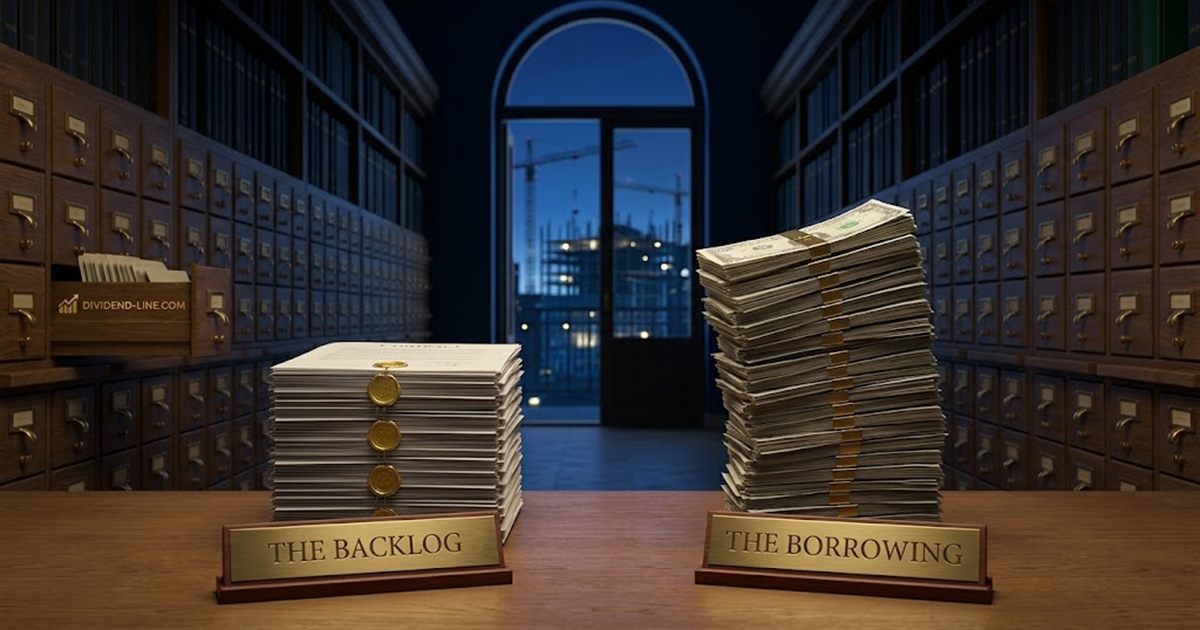
★★ The backlog and the borrowing
The single question the price turns on — shown, then weighed
Start with the good news, because it is real. In the quarter to 31 August, Oracle's operating cash flow was a record $23.1bn — much of it customers paying in advance. The company says most of the $30bn-plus of new AI contracts signed in the quarter were structured as prepayments or "bring your own hardware", so that they need no additional Oracle capital; the co-CEO Clay Magouyrk told analysts Oracle's own capital spending should now be seen as "decoupled" from how fast the business grows. GPU utilisation was 97.9%. Full-year revenue guidance was raised to at least $90bn, growth of roughly a third.
Now the rest of the ledger. Capital spending in the same quarter was $28.5bn — $18bn net of what customers funded — and free cash flow was −$5.4bn. For the full year Oracle guides to $90–95bn of capital spending, with no more than $70bn in net cash. S&P, which cut Oracle to BBB− on 9 July, projects free cash flow of about −$42bn this fiscal year. Borrowings have risen from around $104bn a year ago to about $125bn — $156bn including lease obligations — and in the quarter Oracle also sold $20bn of new shares through an at-the-market programme, after $5bn of mandatory convertible preferred and $25bn of bonds in February. Interest expense is up 55%.
★ Here is the whole case in one sentence: the order book is enormous, arrives slowly, and half of it is one customer — while the cost of serving it arrives now, and is borrowed. Only about 13% of the $664bn — some $86bn — is expected to become revenue in the next twelve months; 37% in the two years after that; half only after three years. The buildings, the chips and the interest have to be paid for long before most of it is recognised. That is a sound business model if every customer pays. It is a leveraged one if they do not.
How it makes money
Q1 fiscal 2027 — the growth is all in one line
Total revenue was $19.3bn, +30%; cloud revenue as a whole $11.6bn, +62%. Non-GAAP earnings were $1.92 a share. Three quarters of the growth is OCI. The software business that built Oracle's fortune is flat to slightly down — which is not a crisis, because it is being migrated to Oracle's own cloud rather than lost, but it means the entire growth story now rests on the capital-intensive half.
That matters for margins. A database licence costs almost nothing to deliver twice; a GPU cluster costs billions and depreciates in a few years. Management itself has said the non-GAAP operating margin — 42% last quarter — will keep drifting lower as OCI becomes a larger share of the mix.
★ The OpenAI question — and why it is also Microsoft's
More than $500bn of two companies' order books rests on one customer
| When | What happened |
|---|---|
| September 2025 | Oracle discloses a contract for roughly $300bn of computing over about five years with OpenAI, part of the Stargate programme. Backlog jumps; the shares hit a record; Oracle sells $18bn of bonds within weeks, and some $38bn of project loans follow in November. |
| February 2026 | Oracle announces a plan to raise up to $45–50bn in calendar 2026, half debt and half equity: $25bn of bonds, $5bn of mandatory convertible preferred, and a $20bn at-the-market share programme. |
| 2026 | Reports that OpenAI chose not to expand its Abilene campus with Oracle, preferring clusters of newer Nvidia chips; investor worries about OpenAI's ability to fund its commitments intensify. |
| 9 July 2026 | S&P cuts Oracle to BBB−, one notch above junk, citing the cost of the build-out and customer concentration — OpenAI roughly half of the then-$638bn backlog — and projecting about −$42bn of free cash flow in fiscal 2027. |
| 10 Sep 2026 | Q1 FY27: backlog $664bn; new contracts mostly prepaid or customer-funded; the $20bn share sale completed. |
Two days ago, in our follow-up on Microsoft, we found that OpenAI supplies at least a third of Microsoft's $678bn commercial backlog. Here it is about half of Oracle's $664bn. Between the two companies, more than $500 billion of contracted future revenue depends on the ability of a single company — one that has never reported a profit — to keep raising money and paying its bills.
We do not predict that OpenAI will fail to pay. It has extraordinary revenue growth, deep-pocketed backers and every incentive to honour contracts on which its own future depends. But concentration is not a prediction; it is a shape. Microsoft carries its third on a AAA balance sheet with $183bn of operating cash flow. Oracle carries its half on a BBB− balance sheet with negative free cash flow, $156bn of debt and a dividend it is borrowing to pay. The same customer is a manageable risk for one and the central risk for the other.
★ The asymmetry that decides it: if OpenAI pays, Oracle's backlog becomes one of the great revenue streams in technology and today's price looks cheap. If OpenAI renegotiates — as large customers do when their finances tighten — Oracle is left with specialised buildings, fast-depreciating chips and the debt that bought them. The first outcome is shared with every other supplier. The second falls hardest on the most indebted one.
The moat
Wide in the database, narrow in the cloud
| Business | The moat | Width & trend |
|---|---|---|
| Database & middleware | Switching costs of the highest order: decades of mission-critical data, custom code, trained staff and regulatory validation. The reason Oracle support revenue has survived every technology cycle since the 1980s. | Wide — slowly eroding |
| Multi-cloud database | A clever defence: Oracle databases now run inside Microsoft Azure, Google Cloud and AWS, growing 353%. Oracle keeps the customer even when the customer moves clouds. | Wide, widening |
| Applications (Fusion, NetSuite, Health) | Sticky ERP and a large installed base, against SAP, Workday and Salesforce. Solid, not dominant. | Moderate |
| AI cloud (OCI) | Speed of construction, good networking and a willingness to take on customers others found too large or too risky. But GPUs are bought from the same supplier as everyone else, and Amazon, Microsoft and Google have far larger balance sheets. | Narrow |
Type: switching costs — in the old business. We score the moat 7: the database franchise alone would earn a 9, but the capital, the growth and now the risk have moved to a business where Oracle's advantage is execution and appetite rather than something competitors cannot copy.
The circle of competence
The old half is simple; the new half depends on someone else's balance sheet
- OpenAI pays in full, on schedule — including the years after 2029 when most of the backlog is recognised — and its commitments are not renegotiated if its own funding tightens.
- The capex turns into free cash flow before the debt bites — prepayments and customer-funded hardware keep Oracle's net cash spending near the $70bn ceiling, and free cash flow turns positive by fiscal 2028–29 without a downgrade to junk.
- The old franchise stays a toll road — database and support revenue declines slowly enough, and migrates to Oracle's cloud rather than competitors', to keep funding the dividend and the interest.
Management & ownership
A founder who owns two-fifths, two new chief executives, and a reversal in capital allocation
Integrity: no veto, but a live question. Two lawsuits allege that Oracle understated how much it would need to borrow (Part X). We make no finding on them; we note that the pace of financing announcements — $18bn of bonds, then $38bn of loans eight weeks later, then a $45–50bn plan — surprised investors each time.
Capital allocation: the sharpest reversal on our board. In fiscal 2021 and 2022 Oracle bought back $39bn of its own shares, shrinking its equity almost to zero. In the quarter just reported it sold $20bn of new shares, at prices far below where it bought them. Diluted shares rose from 2,909m to 3,000m in a year. A company that shrank its share count for a decade is now growing it to pay for a single strategic bet. That may prove brilliant. It is not what an owner signed up for, and it earns a 4.
The numbers
Earnings still rise; cash does not — and six things our feed gets wrong
| Metric | Value | Read |
|---|---|---|
| Revenue, FY2026 · Q1 FY27 | $67.4bn · $19.3bn | ▲ +17% · +30%; FY27 guide ≥$90bn |
| Net income, FY2026 | $17.1bn · EPS $5.83 | ▲ +37%, including a $2.7bn pre-tax Ampere gain |
| Operating margin (TTM) | 32.4% | ◆ Non-GAAP 42% in Q1, guided lower |
| Capex, FY2026 · FY27 guide | $55.7bn · $90–95bn | ▼ Capex exceeds revenue (TTM 105%) |
| Free cash flow, FY2026 | −$23.7bn | ▼ Was +$13.8bn in FY2021 |
| Debt incl. leases · cash | $155.9bn · $37.1bn | ▼ Net debt ~3.2× EBITDA; interest cover 4.6× |
| Altman-Z · Piotroski · S&P | 1.56 · 5 · BBB− | ▼ The balance sheet is the weak link |
| Diluted shares, 1 year | 2,909m → 3,000m | ▼ +3.1% — the $20bn share sale |
| What the feed says | Value | What is true |
|---|---|---|
| Trailing P/E | 21.5× | Includes the $2.7bn pre-tax gain on the sale of Ampere in Q2 FY26 (about $0.76 a share after tax, approx.). Clean trailing EPS ~$5.62 → ~24×. |
| DCF value | −$26.13 | A negative value per share — the model extrapolates negative free cash flow forever. It is telling you only that at current spending the company consumes cash. Not used. |
| Return on equity · price/book | 42.6% · 6.1× | Equity was driven close to zero by a decade of buybacks (it was negative in FY2022). Both ratios are artefacts. |
| 52-week range | $134.57 – $322.54 | Press reports cite an intraday low of about $121.50 on 18 July 2026 and a record of $345.72 in September 2025, just outside the 52-week window. We use our feed's closes and flag the difference. |
| Ownership | Ellison 41.8% (2024) | The latest founder filing in our feed is from February 2024; the $20bn share sale since then has diluted every holder. |
| Product segments | two overlapping sets | Old and new segment definitions both reported for 2025. We use Oracle's own Q1 FY27 lines. |
★ The dividend — now paid with borrowed money
$2.00 a year, flat since the 2025 rise, and no longer covered by cash
| Test | Value | Reading |
|---|---|---|
| 1 · Cover on free cash flow | none | Fiscal 2026 dividends of $5.8bn against free cash flow of −$23.7bn. On earnings the payout looks comfortable (31%); on cash there is nothing to pay it from. |
| 2 · The trend | gone negative | Free cash flow covered the dividend 4.5× in FY2021 and 2.7× in FY2024; since FY2025 it has not covered it at all. |
| 3 · Funded by operations or debt? | debt & equity | The dividend is effectively financed by the same bonds and share sales that fund the data centres. |
| 4 · Balance-sheet room | BBB− | One notch above junk; interest cover 4.6×; S&P projects −$42bn of free cash flow this year. |
| 5 · What would force a cut | a downgrade | A cut to junk, or OpenAI renegotiating. At $5.8bn a year the dividend is small beside a $90bn capex budget — which is why the board can keep paying it, and why it would be an easy saving if lenders asked. |
| 6 · The growth rate | 0% since 2025 | Raised 25% to $0.50 a quarter in April 2025; unchanged since. A yield of 1.46%. |
★ Nobody should own Oracle for its dividend today. It is small, it is not growing, and it is not covered by the cash the business generates. Compare Microsoft, whose dividend is covered 2.3 times by free cash flow even at the peak of its own AI spending. The difference is not the strategy; it is the balance sheet that carries it.
Risks, lawsuits & controversies
Verified afresh, 27 September 2026
The risk we rank first is concentration. Roughly half of the backlog depends on OpenAI (Part IV). If that customer renegotiates, delays or fails to pay, Oracle is left with specialised buildings and chips that lose value quickly, financed with debt that does not.
Second, the balance sheet. BBB− since 9 July 2026, interest cover of 4.6×, net debt around 3.2× EBITDA and rising, and a financing plan that relies on markets staying open — now with a ten-year Treasury above 5%.
Third, the courtroom, verified this week. ① Securities class action: on behalf of buyers between 12 June and 16 December 2025, alleging Oracle misled investors about the costs and financing of its AI build-out; lead plaintiffs Sparinvest S.A. and SEB Funds AB, through Kessler Topaz Meltzer & Check, filed an amended complaint on 14 July 2026. No ruling on a motion to dismiss has been reported. ② Bondholder suit: filed in January 2026 and led by the Ohio Carpenters' Pension Plan, alleging that the offering documents for Oracle's $18bn September 2025 bond described further borrowing as merely under consideration when a much larger raise was planned; some $38bn of loans followed within about two months. Plaintiffs put losses at about $1.3bn. Both cases are at an early stage and their outcomes are uncertain.
Fourth, obsolescence. OpenAI reportedly declined to expand at Abilene in favour of newer Nvidia chips. A data centre is a thirty-year asset; the chips inside it are a three-to-six-year asset; the contracts are five years. The mismatch is where the risk lives.
★ Valuation — what you are paying for the second Oracle
Value the toll road first; the price of the airport is what is left
| Measure | Value | Reading |
|---|---|---|
| Share price, 25 Sep 2026 | $137.10 | Market capitalisation ~$395–410bn; enterprise value ~$514bn |
| P/E trailing · clean | 21.5× · ~24× | Clean excludes the Ampere gain (approx.) |
| ★ Forward P/E, FY27 → FY30 | 16.8× → 6.9× | Consensus $8.14 (FY27, 23 analysts), $11.02 (FY28), $19.76 (FY30, 11 analysts). If the backlog is paid, these are cheap numbers. |
| Free cash flow yield | −7.3% | Negative, and projected to worsen in FY27. |
| EV / EBITDA | 13.6× | Reasonable for software; generous for a leveraged landlord. |
| Dividend yield | 1.46% | Funded by financing, not cash flow (Part IX). |
| Piece | Estimate | How |
|---|---|---|
| The database & applications franchise | ~$285bn | ~$39bn of annual software and SaaS revenue at ~50% operating margin, taxed, at ~18× — a fair multiple for a slow-growing, very sticky business. |
| Less all net borrowings | ~−$88bn | ~$125bn of borrowings less $37bn of cash (leases excluded). |
| = The old Oracle, per share | ~$66 | On ~3.0bn shares. |
| ★ What $137 implies for the AI cloud | ~$213bn | About 1.3× the $162bn of property and equipment on the balance sheet — you pay a modest premium over cost for a business growing 121% with half its order book tied to one customer. |
So is Oracle cheap? On earnings, arguably yes: under 17 times next year's consensus, falling to single digits by 2029 if the backlog converts. On cash, it is not measurable, because there is none. On the two-Oracles arithmetic, the price asks you to pay a modest premium over cost for a leveraged AI landlord whose largest tenant has never made a profit.
★ This is not an overpriced company. It is an unpriceable one. The outcome is binary in a way most of the board is not: if OpenAI pays, $137 will look like a gift; if it does not, the debt decides what the equity is worth. A Buffett-style investor does not need to know which — only that he cannot know, and that the cost of being wrong is carried by the lender first and the shareholder second.
I have admired Oracle's database business for a long time, for the same reason I admire a good toll bridge. Everybody has to cross it, the maintenance is cheap, and nobody builds a second bridge beside it because the first one works and changing bridges is terrifying. Banks, airlines and governments have been paying Oracle's toll for forty years. That business is still there, still sticky, and still worth a great deal.
But that is not the business you are buying today. Oracle has decided — and with a founder owning two-fifths of the company, it is very much a decision — to become one of the great builders of data centres for artificial intelligence. This fiscal year it expects to spend ninety to ninety-five billion dollars doing it. That is more than all of its revenue.
I want to be fair about what it has built. The order book stands at six hundred and sixty-four billion dollars. Revenue grew thirty per cent last quarter; the cloud infrastructure business grew a hundred and twenty-one. The chips it has installed are ninety-eight per cent in use. And management has lately arranged for new customers to pay in advance or bring their own hardware, which is exactly what a careful landlord should do.
Now look at who pays and who carries the risk. About half of that order book belongs to one customer, OpenAI, which has never made a profit and depends on raising ever larger sums to honour its commitments. Only about thirteen per cent of the backlog becomes revenue in the next year; half of it only after three. Meanwhile the buildings, the chips and the interest are being paid for now — with a hundred and fifty-six billion dollars of debt, a credit rating one notch above junk, and twenty billion dollars of new shares sold in a single quarter by a company that spent the previous decade buying its shares back at much higher prices. Free cash flow was minus twenty-four billion last year, and the rating agency expects minus forty-two this year. Even the dividend is now paid with borrowed money.
Two days ago I wrote that OpenAI is at least a third of Microsoft's backlog. Here it is half of Oracle's. More than five hundred billion dollars of two companies' future revenue rests on one young company's ability to pay. Microsoft can carry its share on a AAA balance sheet. Oracle is carrying its share on borrowed money. The same customer is a footnote for one and the whole story for the other.
Is it cheap? On the earnings analysts expect, yes — under seventeen times next year's, and falling fast if the contracts are honoured. When I separate the two Oracles, the database business alone is worth roughly two-thirds of today's price after all the debt, and you are paying only a modest premium over cost for the data centres. So I cannot honestly call this an expensive share.
But I cannot price it either. The outcome turns on the finances of a company I cannot see into, on credit markets staying open with the ten-year Treasury above five per cent, and on chips that will be obsolete long before the buildings that house them are paid for. When the answer is either wonderful or very bad, and I cannot tell which, the right thing is to say so and to keep my money where I can understand the downside.
So: too hard. If the shares fell to around a hundred dollars, the toll road would pay for most of the price and the data centres would come at about sixty cents on each dollar they cost. At that point you are being paid for the risk rather than asked to ignore it, and I would look again.
And I would watch two things more closely than any earnings figure: the free cash flow line, which has to turn before the rating does, and any change in what OpenAI says it can pay. The first quarter it does less than it promised, the whole of this analysis gets simpler.
— The Buffett Lens · Dividend Line Research · admiring the toll road, declining the airport
Half the Backlog Is One CustomerA superb database franchise financing a leveraged AI build-out: $90–95bn of capex, FCF −$23.7bn, debt $156bn, BBB−, $20bn of new shares in one quarter — against a $664bn backlog roughly half of which is OpenAI. ★ At $137.10 (16.8× FY27 earnings) it is not expensive; it is unpriceable. Around $100 the toll road pays for most of the price and the data centres come at ~0.6× cost. Watch free cash flow and OpenAI. Q2 FY27 results mid-December.
You've just read Oracle the way we read every company.
The terminal that produced these numbers is free to use: 30 years of statements drawn as flows, a screener built around moats, Buffett's Desk, and an earnings feed read through the same lens. Opening an account takes a minute. No card.