The Coca-Cola Company
What we said in June — and what happened
Eight claims, graded in public, including two we got wrong
On 23 June we published Coca-Cola at $80.13: the textbook moat, a slow grower at a full price, to be accumulated — "begin a position here" — and bought with both hands below ~$73. The shares closed on 25 September at $87.81, and a $0.53 dividend went on the record on 15 September. Here is the account, errors first.
| What we said on 23 Jun | What happened by 27 Sep | Grade |
|---|---|---|
| 'James Quincey, Chairman & CEO' | Wrong on the day we wrote it. Henrique Braun, the chief operating officer, became chief executive on 31 March 2026; Quincey is executive chairman. The succession was announced in December 2025. | ✗ Wrong |
| Risks: sugar, plastic, currency, bottlers | We left out the largest one. Coca-Cola has paid $6.0bn to the IRS after losing a transfer-pricing case and estimates ~$14bn more for 2010–2025 if it loses the appeal — argued on 25 June, two days after we published. | ✗ Missed |
| 'FCF ~$10bn; earnings, owner earnings and cash converge' | True of the business, but we did not say that reported free cash flow was $4.7bn in 2024 and $5.3bn in 2025, after two one-off payments. Part II. | ◆ Right, incomplete |
| 'The textbook moat — pricing power' | Second quarter: unit case volume +5%, organic revenue +6%, comparable operating margin 35.6% from 34.7%. | ✓ Right |
| 'A 5–7% grower, no more' | Organic revenue guidance raised to ~5%; comparable EPS guidance to +9–10%, about 3 points of it from currency. | ✓ Right |
| 'Berkshire has never sold a share' | Still 400 million shares at the second-quarter 13F; about $848m of dividends to Berkshire this year. | ✓ Right |
| 'Begin a position here — accumulate' | +9.6% in price, +10.2% with the dividend, in three months. The $73 buy-with-both-hands zone was not reached. | ✓ Rewarded |
| Our sources | The June risk section cited three sources whose links were placeholders. Every source below links to the document. | ✗ Our fault |
Five right, one incomplete, two plainly wrong, plus the sources. The wrong ones are not about the business; they are about us. A reader who relied on our June page would have had the wrong name at the top of the company and no idea that a court was about to hear the largest financial risk it faces. That is exactly the kind of error a slow, simple business tempts an analyst into: the story is so familiar that one stops checking. We have added a rule to our own guide — verify the chief executive and all pending litigation on the day of writing, for every company, however well known.
★★ Two payments, one tax case, and a quarter that went right
What the screens show, what the business earned, and what is still owed if the appeal fails
The quarter. In 2025 Coca-Cola grew organic revenue 5% with volume flat: price and mix did all the work. In the second quarter of 2026 the order reversed — unit case volume +5%, concentrate sales +4%, price/mix only +2% — and organic revenue grew 6%. Volume-led growth is the healthier kind; it means people are buying more drinks, not merely paying more for the same ones. Management raised full-year guidance on 28 July.
The two payments. Coca-Cola's reported free cash flow was $4.7bn in 2024 and $5.3bn in 2025, while it paid dividends of $8.4bn and $8.8bn. A screen will tell you the dividend exceeded the cash for two years running. It did not. In 2024 the company deposited $6.0bn with the IRS after losing in the Tax Court; in March 2025 it made the final $6.1bn contingent payment for fairlife, the milk business it bought in 2020 and which did far better than the price assumed. Add them back and free cash flow was about $10.7bn and $11.4bn — the second figure is the company's own. For 2026 it guides to about $12.4bn, against dividends of about $9.1bn.
★ The fairlife payment was the price of a success; the IRS deposit is the first instalment of a dispute that is not over. The two look alike on a cash flow statement. They are not alike for an owner.
The tax case. The IRS argued that Coca-Cola's foreign "supply points" — the plants that make concentrate abroad — were paid too much, and the US parent too little, for the use of its brands in 2007–2009, abandoning a formula the two sides had agreed in 1996. The Tax Court agreed with the IRS and reallocated about $9bn of income; Coca-Cola paid $2.7bn of tax plus interest, $6.0bn in all, and appealed. It estimates that if the same method were applied to 2010–2025, it would owe roughly $14bn more, rising by about $450m a quarter. The Eleventh Circuit heard the appeal on 25 June 2026; reports from the courtroom described the panel as receptive to Coca-Cola's argument that the change was retroactive and arbitrary. No ruling has been issued. Coca-Cola's own guidance, in its words, excludes the impact of the litigation "if the company were not to prevail".
What would losing mean? About $15bn by now — roughly 4% of the market value, a little over a year of free cash flow, and enough to lift net debt from about 1.5 to about 2.4 times EBITDA. That would slow buybacks and perhaps the pace of dividend increases. It would not threaten the dividend itself or the franchise. Winning would return a good part of the $6.0bn. It is a large, finite, known risk — which is precisely why it belonged in June's report.
The people at the wheel
Corrected — and one decision worth a note
A note on capital. Two purchases of the last decade have not worked. Costa, bought for £3.9bn in 2018, was put up for sale in 2025; bids came in well below hopes, reportedly around £2bn, and the sale was abandoned. BodyArmor, whose remaining 85% was bought in 2021 for about $5.6bn, took a $960m trademark impairment in the fourth quarter of 2025. fairlife, by contrast, was a triumph — so much so that the earn-out cost $6.1bn. A great concentrate business is not automatically a great acquirer, and we have lowered the management dial by a point for it, and for a leadership transition that is too new to judge.
Insiders exercised options and sold shares between $86 and $91 in August — routine for executives with long-dated awards, and not a signal we would read much into. Berkshire still holds 400 million shares, unchanged.
The numbers — and four things our feed gets wrong
Sourced from the live pull · TTM unless noted
| Metric | Value | Read |
|---|---|---|
| Revenue, TTM · FY2025 | $50.1bn · $47.9bn | ▲ Q2 +7%, organic +6% |
| Comparable EPS, 2025 → 2026 guide | $3.00 → +9–10% | ▲ ~3 points from currency |
| Gross · comparable operating margin | 61.9% · 35.6% (Q2) | ▲ Widening |
| Return on invested capital | 13.9% | ▲ Solid; ROE 43% flattered by leverage |
| Net debt / EBITDA · interest cover | 1.5× · 9.5× | ◆ ~2.4× if the tax case is lost |
| Free cash flow 2025 · 2026 guide | $5.3bn ($11.4bn underlying) · ~$12.4bn | ◆ See Part II |
| Capex / revenue | 4.1% | ▲ Asset-light |
| Altman Z · Piotroski | 5.5 · 9 of 9 | ▲ Strong |
| What the feed says | Value | What is true |
|---|---|---|
| Free cash flow, 2024 · 2025 | $4.7bn · $5.3bn | After the $6.0bn IRS deposit and the $6.1bn fairlife payment. Underlying ~$10.7bn and $11.4bn. |
| DCF value | $72.01 | In June the same model said ~$101. The business did not lose 29% of its value in three months; the model is sensitive to the depressed 2024–25 cash flows. Not used. |
| Product segments | 'Pacific $37.4bn' | Mislabelled: Asia Pacific is one of Coca-Cola's smaller segments, nowhere near $37bn. Coca-Cola reports geographic operating segments plus Global Ventures and Bottling Investments; use its filings for the split. |
| Ownership | Vanguard 6.4% | Berkshire's 400 million shares (~9.3%) do not appear in the beneficial-ownership feed. |
The dividend
Sixty-four years of increases — and the cash to keep going
On 19 February the board raised the quarterly dividend from $0.51 to $0.53 (+3.9%), the 64th consecutive annual increase: $2.12 a year, a 2.4% yield at today's price — down from about 2.9% at the start of the year, because the shares rose.
Is it safe? Yes, on every measure that strips out the one-offs. The dividend takes about 64% of the $3.27–3.30 of comparable earnings guided for 2026, and about 73% of the ~$12.4bn of free cash flow — a high but steady payout for a business that needs only 4 cents of every revenue dollar for capital spending. The reported 2024–25 figures that show the dividend exceeding free cash flow are the result of the two payments explained in Part II. The one scenario that would squeeze it is losing the tax case; even then, at ~$15bn spread across the balance sheet, we would expect slower increases and fewer buybacks, not a cut.
| Dividend test | Value | Read |
|---|---|---|
| Payout of comparable EPS (2026 guide) | ~64% | ▲ Covered |
| Payout of free cash flow (2026 guide) | ~73% | ◆ High, steady |
| Increase, Feb 2026 | +3.9% | ◆ Slower than earnings (+9–10%) |
| Consecutive annual increases | 64 | ▲ Dividend King |
Risks, lawsuits & controversies
Verified afresh, 27 September 2026
First, the tax case (Part II): $6.0bn already paid for 2007–2009; ~$14bn estimated for 2010–2025 plus ~$0.45bn a quarter if the Tax Court's method stands. Argued before the Eleventh Circuit on 25 June 2026; ruling pending. Losing would be expensive and finite; winning would return much of the deposit.
Second, the price. At 26.6 times this year's expected earnings for a business that grows organic revenue about 5%, a great deal of good news is already paid for. The earnings growth this year is flattered by about 3 points of currency.
Third, the slow tides we named in June — sugar taxes, changing tastes, plastic packaging, currency — are unchanged, and none has shown up in the volume numbers this year. We also note that the sale of the African bottler (held for sale; an impairment was trimmed by $66m in the second quarter) and a new head for North America are still in progress.
★ Valuation
Fair, leaning full — and inside the range we would pay
| Measure | June | Today | Reading |
|---|---|---|---|
| Share price | $80.13 | $87.81 | Market value ~$378bn. 52-week range $65.35–$92.49. |
| P/E — 2026 · 2027 consensus | ~24× · ~23× | 26.6× · 24.9× | EPS $3.31 (13 analysts) · $3.53 (14). |
| Free cash flow yield (2026 guide) | 3.6% | 3.3% | ~$12.4bn on ~$378bn. |
| Dividend yield | 2.6% | 2.4% | Below its five-year norm of ~3%. |
| Our owner-earnings range | — | ~$86–101 | $2.88 of FCF a share growing ~5% a year, valued to return 8–8.5%. |
| Street target (mean · range) | $86 | $95.75 · $86–104 | +9%. |
What does $88 assume? That organic growth of about 5% a year continues, margins hold, and the tax case costs somewhere between nothing and $15bn. On those assumptions an owner earns roughly the 2.4% yield plus 5–6% growth — around 8% a year, with unusual reliability. That is a fair return for a very safe business. It is not a margin of safety; the margin of safety here is the franchise, not the price.
I owe you two corrections before anything else.
In June I told you that James Quincey ran Coca-Cola. He had handed the job to Henrique Braun three months earlier. And in a section headed "Risks", I listed sugar, plastic and currency, and left out the largest risk the company faces: a dispute with the American tax authorities in which Coca-Cola has already paid six billion dollars and estimates that it could owe some fourteen billion more. The appeal was heard two days after I wrote. Neither error changes what Coca-Cola is. Both are the kind of mistake that comes from knowing a company so well that one stops checking, and I have changed how we work so that it does not happen again.
Now the good news, which is most of the news. The business did better than I asked of it. In 2025 Coca-Cola grew only by charging more; the number of drinks it sold did not move. In the second quarter of this year it sold five per cent more drinks, margins widened, and management raised its guidance. The board raised the dividend for the sixty-fourth year in a row. Berkshire still owns every one of its four hundred million shares. The shares rose ten per cent, dividend included, in three months.
A word on something your screens will tell you. For 2024 and 2025 they show Coca-Cola paying more in dividends than it produced in free cash. It did not. In those two years it made two large one-off payments — six billion dollars deposited with the tax authorities, and six billion to complete the purchase of fairlife, a milk business that succeeded beyond its price. Add them back and the business produced eleven billion a year, and it expects about twelve and a half this year, against nine of dividends.
The tax case deserves a sober view. If Coca-Cola loses, the bill is about fifteen billion dollars — four per cent of what the company is worth, a little more than a year of its cash. That would slow the buybacks and perhaps the dividend increases. It would not touch the formula, the bottlers or the habit of two billion drinks a day. If it wins, a good part of the six billion comes back. The judges, by the accounts of those in the room, listened sympathetically. I would not bet the house on it either way, and you do not need to.
Which leaves the price. At eighty-eight dollars you are paying about twenty-six and a half times this year's earnings for a business that grows five or six per cent a year. That is fair, leaning full. My own reckoning of the cash puts the value somewhere between eighty-six and a hundred and one dollars, so eighty-eight is in the range — lower half. I told you after Microsoft that when a wonderful business sits inside my own range I will not ask you to wait for a bargain. Keep accumulating, slowly. And if the market ever offers it near seventy-five, buy with both hands.
— The Buffett Lens · Dividend Line Research · checking the name on the door, every time
Slowly, With the Tax Bill in ViewThe franchise did its part: volume +5%, guidance raised, a 64th dividend increase — and the price rose +9.6% from our June $80. ★ We correct two June errors: Braun is CEO, and a ~$14bn IRS appeal (ruling pending) belongs among the risks. At $87.81 — 26.6× 2026 earnings, inside our ~$86–101 range — keep accumulating slowly; buy with both hands near ~$75. Q3 results expected around 20 October.
Articles that take this apart
 PortfolioWhy trading doesn't payMost arguments against trading are about psychology. The stronger argument is arithmetic, it is not close, and you can work it out on the back of an envelope.
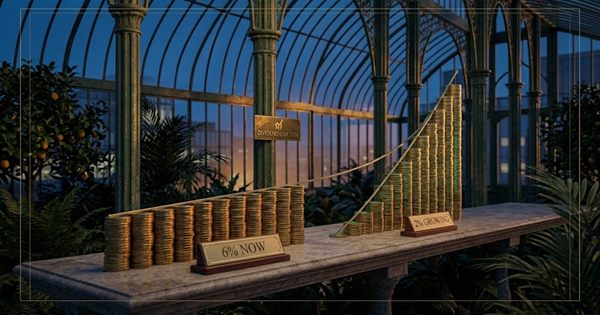 Dividends6% now or 2% growing: which one actually pays you moreEveryone says growth beats yield. The arithmetic agrees, and then adds a detail nobody mentions: it takes two decades, and most people are not investing for two decades.
 DividendsThe ex-dividend date, and why buying the day before doesn't workEveryone learns the rule: own it before the ex-date and the dividend is yours. Almost nobody is told what the market does to the share price that same morning.
You've just read The Coca-Cola Company the way we read every company.
The terminal that produced these numbers is free to use: 30 years of statements drawn as flows, a screener built around moats, Buffett's Desk, and an earnings feed read through the same lens. Opening an account takes a minute. No card.