Alphabet
What we said in June — and what happened
Seven claims, graded in public
On 30 June we published Alphabet at $357.37: a wonderful franchise facing its first real test, fairly priced, to be owned "watchfully" and added to with conviction toward ~$300. The shares are $343.92. Here is the account.
| What we said on 30 Jun | What happened by 27 Sep | Grade |
|---|---|---|
| 'A toll booth on the world's information' | Search & other revenue $63.3bn, +17% in Q2 2026 — faster than a year earlier. The Gemini app reached 950 million monthly users. | ✓ Right |
| 'The moat is contested — AI answers may monetise worse than links' | Not yet visible in the numbers. The question is unchanged; the evidence so far favours Google. | ◆ Untested, trending well |
| 'Cloud inflecting to profit' | Understated. Cloud revenue $24.8bn, +82%; operating income $8.8bn, from $2.8bn. | ✓ Right, understated |
| 'A $185bn capex bet crushes free cash flow' | Worse. Guidance raised in July to as much as $205bn; in Q2 capex of $44.9bn exceeded operating cash flow of $39.1bn — free cash flow −$5.8bn. | ✓ Right, understated |
| '~27× earnings — fair for the quality' | The reported figure is now misleading in the other direction: paper gains on SpaceX and Anthropic cut the feed's trailing P/E to 16.9×. On operating earnings it is about 34×. Part II. | ◆ Needs restating |
| 'Antitrust: data-sharing remedies; ad-tech remedies pending' | Ad tech: no divestiture — behavioural remedies and a six-year monitor (opinion unsealed 16 September). Search: data-sharing in force, cross-appeals at the DC Circuit. | ✓ Right — resolved better than feared |
| 'Own, watchfully — add toward ~$300' | Price −3.8% in three months. The add-zone was not reached. | ◆ Unrewarded, not wrong |
Four right, three needing more nuance, none wrong. The business did better than we expected on every operating line — and one number we used in June has become unreliable in a way we should explain before anything else.
★★ The record quarter, taken apart
What Alphabet earns, what it owns — and why the second must not be confused with the first
On 22 July Alphabet reported net income of about $112bn for a single quarter — up almost 300% and the largest in its history. Almost none of the increase came from Google. It came from two investments.
SpaceX listed on Nasdaq on 12 June. Alphabet has owned a stake since 2015; after the listing it had to carry the shares at market value, and at 30 June its holding — about 4.9% of the company on an effective basis — was worth $94.0bn. Anthropic, in which Alphabet owns about 14%, raised money at a far higher valuation, lifting Alphabet's stake to roughly $124bn. Together they produced about $98bn of "other income". By the company's own reckoning the stakes accounted for $6.26 of the $9.11 earned per share. The businesses — search, YouTube, cloud — earned about $2.85.
★ These are real assets, well bought, and worth a great deal. They are not earnings power. An unrealised gain is the price of a share someone else could sell you today. It recurs only if the price keeps rising, and it reverses when the price falls. SpaceX has fallen since 30 June — our SpaceX analysis put it at $148 on 24 September — so the third quarter may well show a loss on the same stake. Value Alphabet on what it earns; count the stakes separately, as a balance-sheet asset worth roughly $218bn, about 5% of the market value.
Two days ago we found the same pattern at NVIDIA, where gains on stakes in AI laboratories supplied about 16% of half-year profit. At Alphabet the share is far larger in the latest quarter. It is becoming a feature of the AI era that the largest technology companies own pieces of each other and of the laboratories they supply, and their reported profits move with private valuations. Our screens were not built for that, and neither, probably, are yours.
On operating earnings — operating income of $147.8bn over the last four quarters, taxed at about 17% — Alphabet earned roughly $10.10 a share. At $343.92 that is about 34 times. That is dearer than the 16.9 times our feed shows, and dearer than the 27 times we quoted in June; it is also the honest number.
The business, three months on
The question we could not answer in June has a first answer
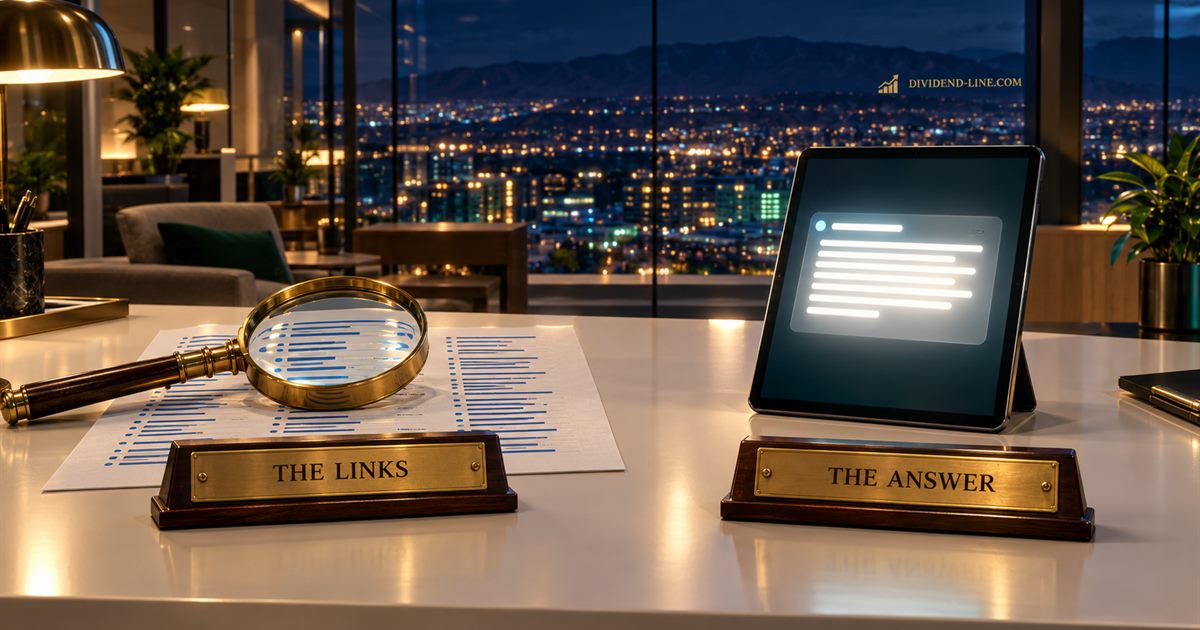
The June question was whether AI answers would monetise worse than ten blue links. A quarter is not a verdict, but this one is hard to argue with: the search business accelerated while Google put AI answers in front of billions of users. The explanation Alphabet offers — more queries, longer queries, and ads that sit inside the answer — is plausible and consistent with the numbers. Our image for this report puts the two on the same desk: the links and the answer. For now, one company owns both.
The second engine is the surprise. Google Cloud grew faster than any cloud business its size we have seen, with margins rising, because it sells the one thing every AI company needs and few can supply — computing on Google's own TPU chips. It is also, like Microsoft and Oracle, a supplier to laboratories in which it owns a stake: Anthropic is both Alphabet's investment and one of its largest cloud customers.
The numbers — and the cash
Operating strength, a capex bill, and five things our feed gets wrong
| Metric | Value | Read |
|---|---|---|
| Revenue, Q2 2026 · FY2025 | $119.8bn · $402.8bn | ▲ +24% · +15% |
| Operating income, TTM | $147.8bn | ▲ Margin ~33% |
| EPS, Q2 2026 — reported · operating (approx.) | $9.11 · ~$2.85 | ◆ $6.26 from equity stakes |
| Capex TTM · 2026 guide | $132.4bn · up to $205bn | ▼ 30% of revenue |
| Free cash flow TTM · Q2 2026 | $53.3bn · −$5.8bn | ▼ Yield 1.3% |
| Cash · debt (end-2025) | $126.8bn · $59.3bn | ▲ Debt more than doubled in 2025, from $25.5bn |
| Buybacks · dividends, 2025 | $45.7bn · $10.0bn | ◆ Buybacks down from $62.2bn in 2024 |
| What the feed says | Value | What is true |
|---|---|---|
| Trailing P/E | 16.9× | On earnings swollen by ~$136bn of equity gains across two quarters. On operating income, ~34×. |
| Net margin (TTM) | 54.8% | Same cause. The operating margin, ~33%, is the business. |
| Consensus EPS, 2026 | $20.60 | Includes the gains already booked; 2027 ($15.13) is the cleaner forward figure — and may still include some. |
| DCF value | $95.46 | −72%, built on free cash flow at the capex peak. Not used. |
| Ownership | Vanguard only | The founders' control — about half the votes through Class B shares, as noted in June — does not appear in the filings feed. |
The dividend
A token, raised modestly — safe by any measure
Alphabet raised its quarterly dividend from $0.21 to $0.22 in April 2026 (+4.8%); the yield is 0.26%. Cover is ample on any measure — about $10.7bn a year against $53.3bn of trailing free cash flow even at the capex peak, funded from operations, with net cash on the balance sheet. It is not the reason to own Alphabet; buybacks ($45.7bn in 2025) matter more, and they fell by a quarter last year as capital spending rose. That is the trade-off to watch: every dollar of the $205bn is a dollar not returned.
Risks, lawsuits & controversies
Verified afresh, 27 September 2026
The risk we rank first is the capital bill. Up to $205bn of capital spending in 2026, free cash flow negative in the second quarter, buybacks lower, debt higher. The return on that spending is visible in Cloud's growth; its adequacy is not yet provable.
Second, the quality of reported earnings. With stakes worth roughly $218bn in two companies whose values swing by tens of billions a quarter, headline profit is now partly a market variable. Expect losses as well as gains.
Third, the courtroom, verified this week. ① Ad tech: in the Justice Department's ad-tech case, Judge Leonie Brinkema declined to order the sale of Google's AdX exchange; her remedies opinion, unsealed on 16 September 2026, orders interoperability with rivals (including Prebid), data-sharing and non-discrimination rules, policed by a monitor for six years. ② Search: Judge Amit Mehta's remedies of September 2025 — no Chrome or Android divestiture, a ban on exclusive default deals, and sharing of search index and interaction data with qualified competitors — are in force; the court denied as premature Google's request to pause them pending appeal. Google appealed on 22 January 2026 and the Justice Department and states cross-appealed seeking stronger remedies; briefing continues at the DC Circuit. Both outcomes are better for shareholders than the break-ups once feared; both constrain the business for years.
★ Valuation
A better business at a lower price — valued on what it earns
| Measure | June | Today | Reading |
|---|---|---|---|
| Share price | $357.37 | $343.92 | Market value ~$4.14tn. 15.8% below the $408.61 high. |
| P/E on operating earnings (approx.) | — | ~34× | ~$10.10 a share over the last four quarters. The reported 16.9× is not usable. |
| Forward P/E, 2027 · 2028 | ~21× (2028) | 22.7× · 19.1× | Consensus $15.13 (41 analysts) and $17.98 (35). |
| Free cash flow yield | ~1.5% | 1.3% | At the capex peak. |
| Equity stakes (SpaceX + Anthropic) | — | ~$218bn | About $18 a share; about 5% of the market value. |
| Street target | — | $431.57 | +25.5%. 2 strong buy · 70 buy · 10 hold · 1 sell. |
What does $344 assume? That search keeps growing while AI answers spread; that Cloud's growth converts the capital bill into returns; and that operating earnings rise from about $10 a share toward the $15–18 analysts expect in 2027–28. Two of the three have better evidence behind them than in June. The third — the return on $205bn a year — is the one to watch, and it is the reason the valuation dial stays at 6.
In June I told you the question that would decide Alphabet: whether answers written by artificial intelligence would eat the search business that pays for everything else. I said I could not yet tell, and that you should own it watchfully.
Three months later I have a first answer, and it is a good one. Search revenue grew seventeen per cent in the second quarter, faster than a year earlier, while Google put AI answers in front of billions of people. The toll booth held. And a second engine caught fire: Google Cloud grew eighty-two per cent, with operating income more than tripling, because it sells the computing that every AI company needs. The ad-tech case ended without a break-up. I am more confident in this business than I was in June.
Now the part the headlines missed. Alphabet reported a hundred and twelve billion dollars of profit for a single quarter, the largest in its history. Two-thirds of it came from marking up its stakes in SpaceX, which went public in June, and in Anthropic, which raised money at a much higher price. Of the nine dollars and eleven cents earned per share, six dollars and twenty-six cents were those gains. They are real assets and good investments; they are not earnings, and they go down as easily as up. SpaceX has already fallen since the quarter ended. Value the businesses on what they earn — about ten dollars a share over the last year — and count the stakes separately.
On that basis Alphabet is not cheap: about thirty-four times trailing operating earnings, and the company is now spending on data centres more than its businesses bring in. Capital spending this year could reach two hundred and five billion dollars; in the second quarter free cash flow was negative. That is the part I would watch.
But here is what matters for a decision. In June I called three hundred and fifty-seven dollars a fair price for a wonderful business. The business has since got better and the price has fallen to three hundred and forty-four. Two days ago I wrote, after an expensive lesson with Microsoft, that when a wonderful business sits at a price I have already called fair, I will not ask you to wait for a bargain. So I will not.
Accumulate. Buy steadily rather than all at once, because the capital bill is large and the reported profits will swing with the prices of companies Alphabet does not control. Add with conviction at around three hundred dollars, about twenty times what analysts expect it to earn in 2027.
And when the third quarter arrives in late October, do me one favour: look past the headline number. If it is lower because SpaceX fell, ignore that. If search growth slows sharply while AI answers spread, pay close attention.
— The Buffett Lens · Dividend Line Research · owning the toll booth, not the paper gains
Value It on What It EarnsThe June question got a first answer: Search +17%, Cloud +82%, no ad-tech break-up — a better business at a lower price ($343.92 vs $357.37). ★ But $6.26 of Q2's $9.11 EPS was paper gains on SpaceX and Anthropic; on operating earnings it is ~34×, and capex (up to $205bn) has overtaken cash flow. Under our own rule a wonderful business at a price we called fair is one to accumulate: buy steadily; add with conviction near ~$300. Q3 results late October.
You've just read Alphabet the way we read every company.
The terminal that produced these numbers is free to use: 30 years of statements drawn as flows, a screener built around moats, Buffett's Desk, and an earnings feed read through the same lens. Opening an account takes a minute. No card.