Enbridge
The business, in plain English
What it owns · how it is paid · why it rarely loses a customer
Enbridge moves energy and charges a fee for it. Its Mainline carries crude oil from Alberta to refineries in the American Midwest and Ontario, and on to the Gulf Coast, where it also owns a large export terminal. Its gas transmission pipelines, such as Texas Eastern, carry natural gas to the cities of the US Northeast. Its gas utilities — in Ontario, and since 2024 in Ohio, Utah and North Carolina — deliver that gas to homes and businesses under regulated rates. It also owns some wind and solar farms.
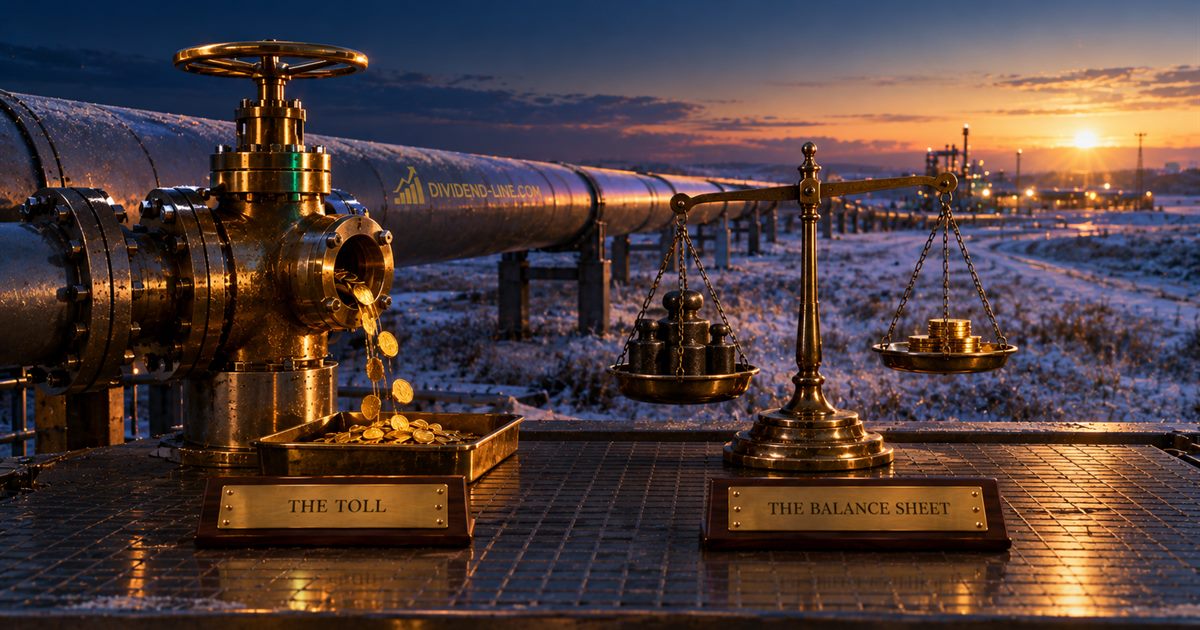
Most of these earnings come from contracts or regulated tariffs that are paid whatever the price of oil or gas: a pipeline is a toll road, and its tolls are set by regulators or long-term agreements. That is why Enbridge's cash flow barely moved through the oil crashes of 2015 and 2020. It is based in Calgary and listed in Toronto and New York; its accounts and dividend are in Canadian dollars.
★★ The network — and what it earns
A picture of the toll roads, the mix of the business, and how the dividend is covered
The network. The map is a schematic, not a survey, but it shows the point: Enbridge's pipelines connect the largest oil and gas producing basins of Canada and the United States to the refineries, cities and export docks that need them. Replacing them would take decades of permits — if permits could be obtained at all, which, as Line 5 under the Straits of Mackinac shows, is no longer certain.
The mix. In the second quarter liquids pipelines produced about 49% of adjusted EBITDA, gas transmission 30%, the gas utilities 18% and renewables 3%. Adjusted EBITDA rose 2.8% to C$4.8 billion; distributable cash flow (DCF) was C$2.9 billion. For 2026 Enbridge guides to EBITDA of C$20.2–20.8 billion and DCF of C$5.70–6.10 a share, and to about 5% annual growth afterwards, backed by a secured backlog of C$41 billion of projects.
How the dividend is covered. A pipeline is best judged, like a REIT, on the cash it distributes before growth spending, not on accounting earnings or "free cash flow" after building new pipelines, which it funds with new debt and equity by design. On that basis the C$3.88 dividend takes about two-thirds of DCF — the middle of Enbridge's own 60–70% target — leaving about a third to reinvest.
★ The part that deserves attention is the balance sheet. Debt stood at 5.1 times EBITDA in June, above the company's 4.5–5.0× target range. In September Enbridge agreed to buy Tallgrass's crude business (the Pony Express pipeline) for US$2.55 billion and, shortly before, Salt Creek Midstream's crude gathering business — and sold C$3.0 billion of new shares at C$66.85 to help pay for them and restore its ratios. The shares fell on the news. Selling equity at a 5.8% dividend yield is an expensive way to fund growth; it is also the responsible one.
The moat
Steel in the ground that can no longer be built
Pipelines are among the most durable monopolies there are. Once built, they are the cheapest way to move oil and gas over land; and in North America it has become extraordinarily hard to build new ones, which makes the existing ones more valuable every year. The gas utilities are regulated monopolies in their territories. Contracts, tariffs and rate bases make Enbridge's cash flow more predictable than almost any company in the energy sector.
We score the moat 8 rather than higher for two reasons. The regulatory protection cuts both ways: governments can challenge a pipeline's right to operate, as Michigan is doing with Line 5. And over the long run the volumes that flow through the liquids pipelines depend on the demand for oil, which is a question for the 2040s rather than the 2020s — but a real one.
Management & ownership
Verified on the day of writing
Enbridge's management has a long record of delivering on guidance and on the dividend, and a habit of growth through acquisitions financed partly with shares. The 2024 utilities purchase, and this year's crude deals, fit the strategy of owning the "toll roads" of the energy system. The cost is visible in the share count, which has grown from about 2.0 billion to 2.2 billion since 2021. Ownership is broad and institutional, heavily Canadian.
The numbers — the pipeline way — and four things our feed gets wrong
Canadian dollars unless stated
| Metric | Value | Read |
|---|---|---|
| Adjusted EBITDA, Q2 2026 · 2026 guide | C$4.8bn (+2.8%) · C$20.2–20.8bn | ▲ Steady |
| DCF per share, H1 2026 · 2026 guide | C$3.11 · C$5.70–6.10 | ▲ Covers the dividend |
| Adjusted EPS, Q2 2026 | C$0.63 (−3%) | ◆ Flat |
| Secured growth backlog | C$41bn | ▲ ~5% growth after 2026 |
| Debt / EBITDA (company measure) | 5.1× (target 4.5–5.0×) | ▼ Above target |
| Interest cover (EBIT) | ~2.1× | ◆ Thin, typical of pipelines |
| Shares outstanding, 2021 → 2025 | ~2.03bn → ~2.19bn | ◆ Plus 44.7m in Sept 2026 |
| What the feed says | Value | What is true |
|---|---|---|
| Dividend payout | 135% of EPS | The wrong yardstick for a pipeline. Of DCF, about 66%. |
| Free cash flow | C$3.1bn (2025) | After growth capex, which Enbridge funds with debt and equity by design. DCF (~C$13bn a year) is the measure the dividend depends on. |
| Street target | '+39% upside' | Compares a C$65.5 target with the US$ NYSE price. Against the TSX price (~C$66.7) the Street sees roughly no upside. |
| Total debt / revenue | C$146bn / C$31bn a quarter | Inconsistent with Enbridge's own 5.1× leverage (~C$105bn); revenue includes gross commodity marketing. Use the company's measures. |
The dividend
Thirty-one years of raises — the reason to own it
Enbridge pays C$0.97 a quarter, C$3.88 a year — about US$2.74 at today's exchange rate — a 5.8% yield. In December 2025 it raised the dividend 3% for 2026, the 31st consecutive annual increase. The dividend has grown more slowly in recent years (about 3% a year) than in the 2010s, in line with DCF per share.
Is it safe? On the cash, yes: about two-thirds of DCF, from contracts and regulated tariffs that do not depend on commodity prices. The risk is the balance sheet: with leverage above target, Enbridge must keep issuing shares or selling assets to fund growth, which dilutes owners and slows per-share growth. A cut is very unlikely; fast increases are equally unlikely. For US holders, dividends are paid in Canadian dollars (converted), subject to Canadian withholding tax, and move with the exchange rate.
| Dividend test | Value | Read |
|---|---|---|
| Dividend / 2026 DCF per share (midpoint) | ~66% | ▲ Inside the 60–70% target |
| Increase for 2026 | +3% | ◆ Slow |
| Consecutive annual increases | 31 | ▲ A long record |
| Leverage vs target | 5.1× vs 4.5–5.0× | ▼ The pressure point |
Risks, lawsuits & controversies
Verified afresh, 28 September 2026
First, Line 5. The 70-year-old line runs under the Straits of Mackinac between Lakes Michigan and Huron. Michigan's attorney general sued in 2019 to shut it down; in April 2026 the US Supreme Court ruled unanimously that the case belongs in state court, where Enbridge had tried to move it out of too late. On 31 July 2026 the Michigan Supreme Court vacated the state regulator's approval of the tunnel Enbridge wants to build to replace the underwater segment, ordering a new environmental review; a federal permit from the Army Corps of Engineers is still pending. Separately, Enbridge has sanctioned a US$1.0 billion relocation of the line in Wisconsin. Line 5 is a small part of Enbridge's earnings but a large part of its regulatory risk.
Second, the balance sheet. Debt above target, thin interest cover and a steady need for new capital make Enbridge sensitive to interest rates and to the price at which it can sell shares.
Third, the long run. Gas and utility assets have decades of use; the value of crude pipelines depends on oil demand in the 2040s and beyond, which no one can forecast with confidence.
★ Valuation
Priced like the bond it resembles
| Yardstick | Value | Reading |
|---|---|---|
| Share price | US$47.14 · ≈ C$66.7 | The September share sale was priced at C$66.85. |
| Price / 2026 DCF per share | ~11.3× | An 8.8% DCF yield. |
| P/E — 2026 adjusted consensus | ~23× | Consensus C$2.90; EPS understates pipeline cash. |
| Dividend yield | 5.8% | Growing ~3% a year. |
| Our value range | ~US$42–50 (C$59–71) | 10–12× 2026 DCF per share at USD/CAD 1.414. |
| Street target (mean) | C$65.5 | About the current TSX price. |
What does $47.14 assume? That DCF per share grows about 3–5% a year, that the dividend follows, and that leverage returns to target without much more dilution. The owner's return is then roughly the 5.8% yield plus 3–5% growth. That is attractive for income; it is not the return of a compounder, and it depends on the capital markets remaining open to Enbridge on reasonable terms.
A toll road is a fine thing to own, provided you do not pay too much for it and do not borrow too heavily against it. Enbridge is a toll road for North American energy: its pipelines carry a large share of the continent's crude oil and natural gas, and its utilities deliver gas to millions of homes. It is paid mostly by contract or regulated tariff, whatever the price of oil. Its cash flow has held steady through every oil crash of the past decade.
It has used that steadiness to raise its dividend for thirty-one years in a row. The dividend today yields close to six per cent and takes about two-thirds of the cash the business distributes. I see no realistic threat to it.
What I watch is the other side of the ledger. Enbridge grows by building and buying, and it pays for that with debt and new shares. Its debt now stands above its own target, and this month it sold three billion Canadian dollars of new shares to pay for two more acquisitions. Every such sale gives existing owners a slightly smaller slice of the toll. And Line 5, the pipeline under the Straits of Mackinac, is back in Michigan's courts, where the state is trying to close it.
My advice is plain. Own Enbridge for its income, in a size that suits you, knowing that its return will come mostly from the dividend and a few per cent of growth. Do not add leverage of your own to a company that already carries plenty. If the market offers it near forty US dollars — a seven per cent yield — buy more with both hands.
— The Buffett Lens · Dividend Line Research · collecting the toll, counting the debt
The Leverage Is Enbridge's, Not YoursA 5.8% dividend raised for 31 years, covered by distributable cash flow (~66% payout) from contracted and regulated pipelines, at ~11× DCF — the upper-middle of our ~US$42–50 range. The balance sheet is stretched (5.1× debt/EBITDA, new shares sold in September) and Line 5 is back in court. Own it for the income, in moderation; buy more near ~US$40 (≈ 7% yield). Q3 results in early November.
Articles that take this apart

You've just read Enbridge the way we read every company.
The terminal that produced these numbers is free to use: 30 years of statements drawn as flows, a screener built around moats, Buffett's Desk, and an earnings feed read through the same lens. Opening an account takes a minute. No card.