ASML Holding
The business, in plain English
What a lithography machine does · why only ASML makes the best ones
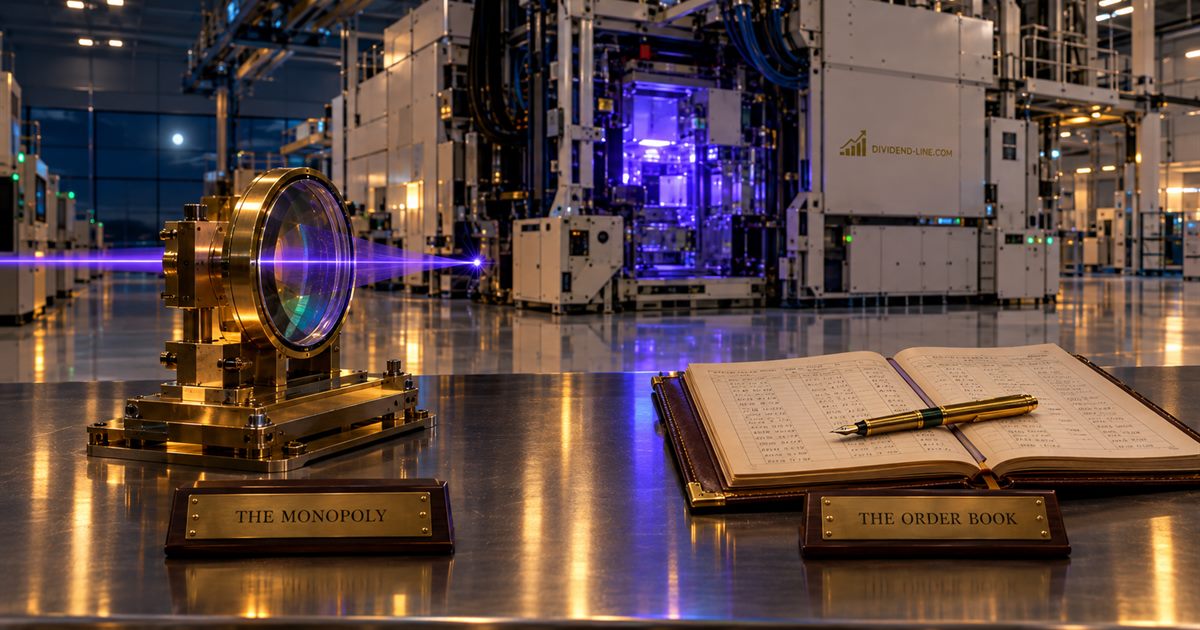
A chip is built layer upon layer on a silicon wafer, and each layer's pattern is printed with light — a process called lithography. The finer the light, the smaller the transistors and the more powerful the chip. For the most advanced chips, the light is extreme ultraviolet (EUV), produced by firing a laser at droplets of molten tin fifty thousand times a second, and focused by the flattest mirrors ever made. Only one company in the world can build these machines: ASML, of Veldhoven in the Netherlands.
Each EUV system costs well over €100 million and is shipped in dozens of containers; its newest "High-NA" successor costs more. Its customers are the handful of companies that make leading-edge chips — TSMC, Samsung, Intel, SK Hynix, Micron. ASML also sells older deep-ultraviolet (DUV) machines, where it competes with Nikon and Canon, and earns a growing, steady income from servicing and upgrading the thousands of machines already installed. In 2025 it sold €32.7 billion and earned €9.6 billion. It is worth about €592 billion.
★★ A monopoly riding a wave — with a hand on the brake
Orders, capacity, China and the cash
The wave. ASML's sales were flat in 2023–24 while chipmakers digested earlier purchases; that is the cycle of this industry. Then the demand for AI chips — and for the high-bandwidth memory beside them — returned with force. In April ASML raised its 2026 guidance to €36–40 billion; in July, after second-quarter bookings of about €5.5 billion, to €43–45 billion, with third-quarter sales guided at €11–12 billion and a gross margin of 55–57%. It plans to lift low-NA EUV capacity from about 65 systems this year by 30% in 2027, DUV immersion from about 130 by 30%, and is studying a further 30% for 2028; management said it is close to having all the orders it needs for 2027.
The brake. China bought a third of ASML's sales in 2025. Dutch export rules, under American pressure, already forbid EUV sales there and require licences for the more advanced DUV machines and even for servicing them. ASML expects China to fall to about 20% of sales in 2026. In Washington, the proposed MATCH Act — advanced by a congressional committee in April — would push allies to stop selling even older DUV machines to Chinese chipmakers, and in August Dutch press reported that the US was preparing to force the issue. The AI wave has more than replaced the lost Chinese sales; the question is whether it will keep doing so.
The cash. ASML converts its profits into cash (€11.1 billion of free cash flow in 2025), holds more cash than debt, and returns the surplus: €2.6 billion in dividends and €6.0 billion in buybacks last year, a dividend raised 17% to €7.50 for 2025, and a new buyback programme of up to €12 billion for 2026–28. Customer prepayments make its cash flow lumpy from quarter to quarter — negative in the first quarter of 2026, strongly positive at the end of 2025 — but steady over a year.
The moat
The purest monopoly on our board
Few businesses we have analysed can say that no competitor exists for their most important product. ASML can. EUV took more than two decades and tens of billions of euros to bring to market, with suppliers — Zeiss's optics above all — whose own know-how is equally hard to replicate. China is trying to build its own lithography industry and is years behind at the leading edge. Even a determined, well-funded rival would need a decade to arrive where ASML is today, by which time ASML would be a generation further on.
The moat is reinforced by the installed base: every machine sold brings decades of service, parts and upgrades, now a large and steadier share of revenue. We score it 10. What it does not protect against is the cycle of its customers' spending, or a government deciding whom it may sell to.
Management & ownership
Verified on the day of writing
ASML's management has a long record of honest guidance through cycles, of investing heavily in research through downturns, and of returning cash when it is not needed. Ownership is broad and institutional; there is no controlling shareholder.
The numbers — in euros — and three things our feed gets wrong
Sourced from the live pull · euros unless stated
| Metric | Value | Read |
|---|---|---|
| Net sales 2025 · 2026 guidance | €32.7bn · €43–45bn | ▲ +35% at the midpoint |
| Q2 2026: sales · gross margin · EPS | €9.3bn · 54.0% · €7.59 | ▲ Above guidance |
| Q3 2026 guidance | €11–12bn · GM 55–57% | ▲ Accelerating |
| EPS — 2025 · 2026e · 2027e · 2028e | €24.71 · €38.63 · €53.35 · €69.12 | ▲ Consensus nearly triples in three years |
| Return on invested capital | 37% | ▲ Exceptional |
| Free cash flow 2025 · net cash | €11.1bn · ~€10bn | ▲ Fortress |
| China share of sales, 2025 → 2026e | 33% → ~20% | ◆ Being cut back |
| What the feed says | Value | What is true |
|---|---|---|
| DCF value | $319 | −82%, built on euro cash flows against a dollar price and a trough-cycle base. Not used. |
| Quarterly data | Q3 2025 listed twice | The same quarter appears under two dates (28 and 30 September 2025); trailing sums must drop one. |
| Interest cover | 0 | ASML has net interest income, not expense; the ratio is meaningless, not alarming. |
The dividend
Small in yield, fast in growth
ASML pays quarterly interim dividends and a larger final dividend. For 2025 it paid €7.50 a share, up 17%; the interim paid in August 2026 was €1.88, up from €1.60. At today's price the yield is about 0.5% — too small to matter to an income investor on its own, but growing fast and covered many times: dividends took about a quarter of 2025 free cash flow, with buybacks taking more than twice as much. For US holders, dividends are paid in euros and subject to Dutch withholding tax.
Risks, controversies & regulation
Verified afresh, 28 September 2026
First, the cycle. Chipmakers buy lithography in waves. ASML's order book is full into 2027 and filling for 2028, but the history of the industry is that booms end, and when they do the equipment makers feel it first. The current wave depends heavily on AI spending by a handful of companies.
Second, geopolitics. ASML is caught between Washington and Beijing. It already cannot sell EUV to China; the MATCH Act would push the Netherlands to forbid older DUV sales as well. China's share of sales is falling fast. ASML says it complies with every rule; the risk is the rules themselves.
Third, concentration and price. A few customers — TSMC above all — account for much of revenue; see our TSMC analysis for the geopolitical risk they carry in turn. And the shares already discount a great deal of growth. We found no litigation we would consider material.
★ Valuation
Paying for the wave
| Yardstick | Value | Reading |
|---|---|---|
| Share price · market value | $1,770 (≈ €1,556) · ~€592bn | 52-week range $935–$2,000. |
| P/E — TTM · 2026e · 2027e · 2028e | 56.5× · 40.3× · 29.2× · 22.5× | In euros; consensus nearly triples EPS from 2025 to 2028. |
| Free cash flow yield | ~1.7% | Last twelve months. |
| Our value range | ~$1,520–1,820 | 25–30× 2027 consensus (€1,334–1,600) at EUR/USD 1.138. |
| Street target (mean · range) | $2,306 · $2,000–2,623 | +30%. |
What does $1,770 assume? That earnings per share roughly double between 2025 and 2027 and keep rising in 2028, as analysts expect, and that the multiple holds near 30 times. The monopoly makes the long-run case easy. The price makes the next two years less forgiving: a pause in AI spending or a sharper cut to China would not damage the business, but could take a third off the shares, as it did in 2024.
In a long life of looking at businesses, I have rarely seen one with no competitor at all for its most important product. ASML is one. The machines that print the world's most advanced chips with extreme ultraviolet light are made by ASML and by nobody else. Every leading-edge processor in every AI data centre passed through one of them.
That is a moat of the rarest kind. It took more than twenty years and tens of billions of euros to build, it rests on suppliers whose own skills are almost as rare, and every machine sold brings decades of service income behind it. The finances match: returns on capital above a third, more cash than debt, and a habit of handing the surplus back to owners.
This year the orders came in a flood. In April ASML expected to sell thirty-six to forty billion euros this year; by July it expected forty-three to forty-five, and it is adding a third more capacity for next year. Meanwhile China, which bought a third of its machines last year, is being cut back by governments that ASML does not control. So far the rest of the world has more than made up the difference.
The trouble with wonderful businesses is that everyone can see them. The shares have nearly doubled in a year. At about twenty-nine times what analysts expect for 2027, you are paying a fair price for a monopoly — but a price that assumes the AI wave rolls on. In this industry, waves break; when they do, the equipment makers' shares fall first and furthest, as ASML's did in 2024.
My advice is simple. Accumulate, slowly, because a business like this should be owned. Keep some powder dry for the next cyclical scare, and if it offers ASML near thirteen hundred and sixty-five dollars, buy with both hands.
— The Buffett Lens · Dividend Line Research · owning the only machine, paying for the wave carefully
Slowly, and Keep Powder DryThe purest monopoly on our board — the only EUV maker, with 2026 guidance raised to €43–45bn and capacity up 30% in 2027 — at ~29× 2027 earnings, in the upper part of our ~$1,520–1,820 range. China is shrinking and politics could cut deeper, and the shares have nearly doubled. Own it, but build slowly; buy with both hands near ~$1,365. Q3 results in mid-October.
You've just read ASML Holding the way we read every company.
The terminal that produced these numbers is free to use: 30 years of statements drawn as flows, a screener built around moats, Buffett's Desk, and an earnings feed read through the same lens. Opening an account takes a minute. No card.