AbbVie
The business, in plain English
What it sells · what it replaced · where the risk sits
AbbVie invents, buys and sells prescription medicines, mostly for chronic diseases where a patient takes the drug for years. It was spun out of Abbott Laboratories in 2013 with one enormous asset — Humira, an injection for rheumatoid arthritis, psoriasis and Crohn's disease that became the best-selling drug in the world, peaking at about $21 billion of sales in 2022. In 2025 AbbVie sold $61.2 billion of medicines. It is worth about $467 billion.
A drug's patents are a moat with a date on it. Humira's American protection ended in 2023, and cheaper "biosimilar" copies have since cut its sales by more than four-fifths. The whole story of AbbVie for a decade has been the race to replace it — mostly with two drugs it developed for the same diseases, Skyrizi and Rinvoq, and with the purchase of Allergan in 2020, which brought Botox and a neuroscience business.
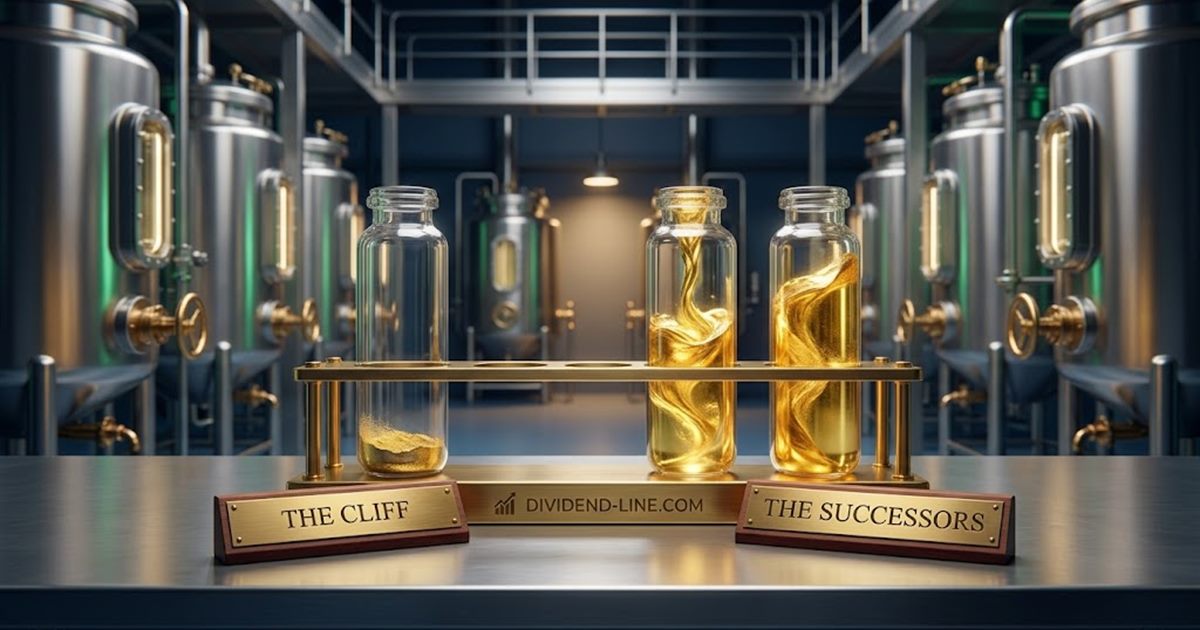
★★ The cliff, the successors — and which profit to believe
How AbbVie replaced Humira, and why its two earnings figures differ by a factor of four
The successors arrived on time. In 2021 Skyrizi and Rinvoq together sold about $4.6 billion. In 2025 they sold $25.9 billion, and in the second quarter of 2026 they ran at $32 billion a year — half as much again as Humira at its peak — while Humira itself shrank to a $3 billion run-rate. Total revenue dipped only once, in 2023, and grew 10% in the second quarter. Settlements with generic makers announced in September 2025 keep copies of Rinvoq out of the United States until April 2037. Few drug companies have ever managed a cliff this well.
Which profit? (§5.7) Our feed shows AbbVie on 74 times earnings; the company guides to "adjusted" earnings that put it on 19 times. Both are honest; they measure different things. In the second quarter AbbVie earned $2.03 a share under accounting rules, then added back $0.81 of amortisation — the write-down of drugs it bought, mostly through Allergan — and $0.83 from revaluing "contingent consideration", payments it owes the former owners of acquired drugs as their sales grow, which rise in value exactly when those drugs succeed. The result is $3.65 adjusted.
★ The cash sides with the adjusted figure — with one caveat. Free cash flow over the last year was about $11 a share, close to adjusted earnings; the amortisation is not cash. But a drug company's patents always expire, and the way AbbVie replaces them is increasingly to buy other companies: ImmunoGen ($10.1bn) and Cerevel ($8.7bn) in 2024, Apogee ($10.9bn) completed this month. About $30 billion in thirty months. An owner should treat a good part of that as the real cost of staying in business — which is why we do not take the adjusted multiple at face value.
The cash, in order. AbbVie generated $17.8bn of free cash flow in 2025 and paid $11.7bn in dividends. Buybacks have been small — about $1bn — because the rest, and new borrowing, goes into acquisitions and paying down the Allergan debt. Book equity is now slightly negative, which is a product of accounting for acquisitions and buybacks rather than a sign of distress, but net debt of about 3 times EBITDA before the Apogee purchase leaves less room than we would like.
The moat
Patents with dates, and the skill of replacing them
A drug company's moat is its patents plus the machine that produces the next ones. AbbVie's present patents are long: Rinvoq to 2037 in the United States, Skyrizi into the 2030s. Its franchises in immunology are among the most valuable in medicine, sold to specialists who change prescriptions reluctantly once a patient is stable. Botox, in both its cosmetic and therapeutic forms, has a brand and a safety record rivals have struggled to dislodge.
What makes us score the moat 8 rather than higher is the date on every one of those assets, and the government. Medicare now negotiates prices for the most expensive older drugs: Imbruvica's negotiated price took effect this January, and Medicare prices for Vraylar (−44%) and Linzess (−71%) take effect on 1 January 2027. More AbbVie drugs will be selected in later rounds. The moat is renewed by skill, not granted by nature.
Management & ownership
Verified on the day of writing
AbbVie's management deserves real credit for the Humira transition — planned years in advance, with successors approved and launched before the cliff. The capital-allocation record is more mixed: Allergan (2020) was expensive and brought debt that is still being repaid, and the pace of acquisitions is rising again. Apogee will reduce adjusted earnings by about $0.14 a share this year and $0.46 in 2027, with no accretion expected until 2032 — a long-dated bet.
Ownership is institutional and broad. Insider activity is small: one executive exercised options and sold about 32,700 shares at $250 in August.
The numbers — and four things our feed gets wrong
Sourced from the live pull · TTM unless noted
| Metric | Value | Read |
|---|---|---|
| Revenue 2025 · Q2 2026 | $61.2bn · $16.99bn | ▲ +10% in Q2 |
| Adjusted EPS Q2 · 2026 guide | $3.65 · $13.87–14.07 | ▲ +23% in Q2 |
| GAAP EPS TTM | $3.56 | ◆ After amortisation and revaluations |
| Gross · operating margin | 71.5% · 29.3% | ▲ Pharma economics |
| Free cash flow TTM · yield | ~$19.6bn · 4.2% | ▲ Strong |
| Debt · net debt / EBITDA | $69.1bn · ~3.0× | ▼ Before Apogee |
| Interest cover | 6.5× | ◆ Adequate |
| What the feed says | Value | What is true |
|---|---|---|
| Trailing P/E | 74.5× | On GAAP earnings after ~$3bn a year of amortisation and large contingent-consideration charges. On 2026 adjusted guidance, 18.9×. |
| Dividend payout | 190% | Of GAAP earnings. Of adjusted earnings it is ~50%; of free cash flow ~62%. |
| 52-week high | $253.35 | Stale. The shares closed at $264.34 and touched a record $269.34 on 23 September. |
| DCF value | $122.27 | −54%. Built on GAAP inputs for a company whose GAAP profit is mostly accounting. Not used. |
The dividend
Raised every year since 2013 — and covered by the cash
AbbVie pays $1.73 a quarter, $6.92 a year — a 2.6% yield — after a 5.5% increase declared in October 2025. It has raised the dividend every year since its 2013 spin-off, from $0.40 a quarter at the start; the next increase would normally be declared around the end of October.
Is it safe? Yes, on the measures that matter. It takes about half of adjusted earnings and about 62% of the last year's free cash flow. The screen that shows a 190% payout is dividing by GAAP earnings, which are depressed by non-cash charges. The risks to the dividend are indirect: leverage, the cost of acquisitions, and Medicare price cuts — each of which could slow the increases before they threaten the payment.
| Dividend test | Value | Read |
|---|---|---|
| Payout of 2026 adjusted EPS (midpoint) | ~50% | ▲ Covered |
| Dividends / TTM free cash flow | ~62% | ▲ Covered |
| Payout of GAAP earnings | 190% | ◆ Misleading — see above |
| Increase, Oct 2025 | +5.5% | ▲ Steady |
Risks, lawsuits & controversies
Verified afresh, 27 September 2026
First, Washington. Medicare's negotiated prices already hit Imbruvica this year (−29% in the second quarter). From 1 January 2027 Medicare will pay 44% less for Vraylar — a $4 billion-a-year drug — and 71% less for Linzess. Later rounds may reach larger AbbVie products. The effect depends on how much of each drug's sales come through Medicare, which AbbVie does not break out.
Second, leverage and acquisitions. Debt of $69bn before Apogee; an acquisition pace that is rising again; a new purchase that will not add to earnings until 2032. None of this is alarming for a business generating ~$20bn of free cash a year, but it narrows the margin for error.
Third, the courtroom — modest. ① A 2023 class action alleging Humira's price was excessive was dismissed in January 2026; the plaintiff has appealed. ② A 2025 suit by health plans alleges AbbVie's rebates impaired biosimilar competition to Humira; it is at an early stage. Earlier antitrust claims over Humira's "patent thicket" were dismissed. ③ In the Netherlands, claims against Allergan were dismissed in December 2025 and are on appeal. We see no single matter likely to be material.
★ Valuation
A fair price for a very good business — near its record
| Yardstick | Value | Reading |
|---|---|---|
| Share price · market value | $264.34 · ~$467bn | Near a record high. |
| P/E — 2026 adjusted guide · 2027e · 2028e | 18.9× · 16.1× · 14.8× | Consensus $16.41 for 2027 may not yet include all of Apogee's $0.46 dilution. |
| P/E — GAAP TTM | 74× | See Part II. |
| Free cash flow yield | 4.2% | Before acquisitions. |
| Dividend yield | 2.6% | Low for AbbVie, because the price has risen. |
| Our value range | ~$240–290 | 15–17.5× 2027 earnings less Apogee dilution (~$16); a discount to the adjusted multiple for the cost of buying pipelines. |
| Street target (mean · range) | $287.08 · $235–315 | +8.6%. |
What does $264 assume? That Skyrizi and Rinvoq keep growing in the high teens for several more years, that Medicare cuts are absorbed, and that the acquired pipeline produces the next generation on time. AbbVie has earned the benefit of the doubt on the first; the second and third are where the risk lives. At 16 times next year's earnings the price is reasonable. It is not the price at which a careful buyer gets paid extra for the uncertainty.
Every drug company lives with a clock. Its best medicine is protected for a number of years, and then the copies arrive and the sales collapse. Most companies, when the clock runs out on their biggest drug, shrink for a while. AbbVie's biggest drug was the biggest in the world, and AbbVie did not shrink.
Humira sold twenty-one billion dollars in its best year. It now sells at a rate of about three billion. In its place, two medicines AbbVie developed for the same diseases — Skyrizi and Rinvoq — are selling at a rate of thirty-two billion, growing by a quarter a year, and one of them is protected until 2037. I do not know of a better-managed handover in the industry.
So why am I not more excited? Three reasons. First, the market already knows; the shares are near a record. Second, the company's future increasingly comes from buying other companies — thirty billion dollars in thirty months — and that is a real, recurring cost that the company's favourite profit measure leaves out. Third, it carries sixty-nine billion dollars of debt, and from January Medicare will pay far less for two of its drugs.
A word on the numbers you will see. Your screen will say AbbVie trades at seventy-four times earnings and pays out nearly twice what it earns. Neither is true in any useful sense; both come from accounting charges for drugs it bought years ago. Its cash tells the real story: about eleven dollars a share of free cash last year, of which the dividend took a little under seven.
My verdict is that this is a very good business at a fair price. That is not a reason to rush, and it is not a reason to stay away. Start with a small position if you want its growing dividend and its immunology franchise, and add near two hundred and thirty-five dollars, where the price would pay you a little more for the risks.
— The Buffett Lens · Dividend Line Research · admiring the jump, pricing the landing
Start Small, Add Near $235AbbVie managed the best patent-cliff handover in the industry: Skyrizi + Rinvoq at a $32bn run-rate, Rinvoq protected to 2037. But at $264.34 — near a record, mid-way through our ~$240–290 range — the price assumes it keeps landing softly, while $69bn of debt, ~$30bn of pipeline purchases and Medicare cuts in January add risk. A small position for income is reasonable; add near ~$235. Q3 results and the usual dividend increase around end-October.
You've just read AbbVie the way we read every company.
The terminal that produced these numbers is free to use: 30 years of statements drawn as flows, a screener built around moats, Buffett's Desk, and an earnings feed read through the same lens. Opening an account takes a minute. No card.